333,871 Service connections in Charlotte Water's service line inventory (Charlotte Water)
0 Lead service lines listed in that inventory (Charlotte Water)
66 Galvanized service lines the inventory lists as requiring replacement (Charlotte Water)
18,300 Service lines Gastonia's Two Rivers Utilities identified by material for its inventory (Two Rivers Utilities)
Last Updated:
Lead service line replacement is the removal of a lead water pipe between the street and a house, and in the Charlotte area it mostly comes down to checking a line and, where it is galvanized or unknown, replacing it. Level Repiping Charlotte identifies and replaces water service lines across Charlotte and the surrounding counties, with the work performed by licensed and insured contractors under a plumbing permit where one is required. Before anything else, the local picture: Charlotte Water’s service line inventory lists no lead service lines at all.
What the inventories actually show
Water systems must now keep an inventory of what every service line is made of, because of the federal Lead and Copper Rule. Charlotte Water’s inventory covers 333,871 service connections across Mecklenburg County. It lists 0 lead service lines and 66 galvanized lines requiring replacement, mostly in older central and inner-ring neighborhoods. Charlotte Water describes Charlotte as a relatively young city, with most of its growth after lead plumbing was banned in 1986.
There is an important limit. On the owner’s side of the meter, a large share of Charlotte Water’s records are predictions rather than confirmed observations: the utility classifies many lines as predicted non-lead based on the age of the home. A prediction is a good indication, not proof for one address. If you own an older house, the only certain answer is the pipe itself.
Outside Mecklenburg, each utility keeps its own inventory. Gastonia’s Two Rivers Utilities identified the material of 18,300 service lines ahead of the revised Lead and Copper Rule, in copper, plastic and galvanized categories. Concord publishes its inventory online, as does the Lancaster County Water and Sewer District, which serves Indian Land. Rock Hill’s lead results on record with the EPA sit at 2 to 3 parts per billion at the 90th percentile, well under the 15 ppb action level. Low system results describe a water system, not your house’s line, but none of these figures suggests widespread lead service lines in the region.
Why galvanized and unknown lines still matter
A galvanized steel service line is not lead, but it rusts from the inside. As it narrows, flow drops and water can run brown after it sits. Some galvanized lines also sat downstream of a lead pipe or connector at some point, and federal rules treat those as needing replacement because the galvanized pipe can hold lead particles. That is the category behind Charlotte Water’s 66 lines.
An unknown line is simply one nobody has looked at. In an older house with a crawl space, it can often be seen where it comes through the foundation. In a slab house it often rises through the floor near the water heater or along a garage wall. Our guide to lead and galvanized service lines in Charlotte goes deeper on reading the inventory, and the guide to identifying pipe material shows the scratch and magnet tests.
Lead Free CLT and who replaces what
Charlotte Water’s Lead Free CLT program has four parts: more lead testing at elementary schools and childcare facilities, a searchable map of private service line material, public education, and removal of lead service lines or galvanized lines that sat downstream of lead. The utility selects homes for replacement using its predictive model, prioritized by building age and community need, and contacts those owners directly. It is not a rebate an owner applies for.
Responsibility is split at the meter. Charlotte Water owns the main, the meter, the meter box and the line from the main to the meter. The owner owns the tail piece, the shutoff valve, the line from the meter to the house, and everything inside. Our guide to who owns the water line in Charlotte explains that split, and it is why a replacement on the owner’s side is a private job.
What happens on the first visit
The visit starts where the line enters the house. The person assessing it identifies the material by sight, a scratch test and a magnet, and checks the main shutoff. Where the meter box can be opened safely, the pipe on the owner’s side of the meter is checked too. The recorded material in the utility’s inventory for your address is compared with what is found. Street pressure is measured at a hose bib, because a line replacement is a natural time to add a pressure-reducing valve where pressure runs high; our high water pressure guide explains why that matters in parts of Charlotte.
If a line ever does turn out to be lead, the first call is to the water utility, which needs to update its inventory and can advise on testing and on its side of the meter. Replacing only the owner’s half of a lead line and leaving the utility’s half is called a partial replacement, and it is coordinated with the utility rather than done on its own.
If the line is copper or plastic in good condition, the answer is that it does not need replacing for lead, and you have it in writing. If it is galvanized, unknown and unreachable, or lead, the result is a written scope with a price.
How a service line replacement runs
A new line is run from the meter to the house, either in a narrow trench or by boring under a driveway, walk or roots. The new pipe must be rated for at least 160 psi at 73.4°F and listed to NSF 61 under the North Carolina amendments. At the house it gets a new main shutoff. The line is pressure tested, inspected where a permit is pulled, connected, and the trench is backfilled and the yard restored to the scope. Where the utility’s side of the meter is involved, the work is coordinated with the utility.
Service line replacement is quoted per job. The drivers are the distance from meter to house, trenching or boring, what the line passes under, depth, the pipe material, a new shutoff or pressure-reducing valve, the permit, and restoration of lawn or paving. To have your line identified or replaced, call (704) 452-4386 or use the estimate form.
What's included
What a lead service line replacement includes
A service line estimate should say which material was found, how it was identified, and exactly where the new pipe starts and ends.
A look at the service line where it enters the house and, where reachable, at the meter end, to identify the material
A check of your utility's published inventory or service line map for the recorded material at your address
A written scope naming the new pipe, the route from meter to house and the trenching or boring method
The plumbing permit, pulled by the licensed contractor doing the work
Coordination with the water utility where its side of the meter is involved
A new main shutoff valve where the line enters the house
A pressure test of the new line, the inspection, and backfill and restoration as written in the scope
The real choice
What your service line material means
Find the row that matches what you see where the line enters the house. Utility inventories are a starting point, not proof for a single address.
What your service line material means
Material found
How it looks
What it usually means
Next step
Copper
Penny-colored; a key scratch shows shiny copper; a magnet does not stick
The most common recorded material in Charlotte
No action for lead; replace only if it leaks or is undersized
Plastic (PE, PEX, PVC)
Black, blue, white or gray plastic pipe
Not a lead concern
Replace only for leaks, damage or old polybutylene
Galvanized steel
Dull gray; a magnet sticks; threaded joints
Rusts from the inside; some lines are listed for replacement where they sat downstream of lead
Check the utility inventory; plan replacement, especially if flow is poor or water runs brown
Lead
Dull gray and soft; a scratch shows bright silver; a magnet does not stick
None recorded in Charlotte Water's inventory; possible in very old homes elsewhere
Tell the utility, follow its testing advice and replace the owner's side
Unknown
Pipe cannot be seen, or the inventory says predicted or unknown
The record is an estimate
Have the line identified where it enters the house
Service line replacement is quoted per job after the line is identified.
Guides
Related resources
Guides that go deeper on lead service line replacement decisions.
Charlotte Water has classified every one of its service connections. Here is what the inventory says about lead and galvanized lines, what Lead Free CLT does, how to look up your address, and where lead can still hide inside a house.
Charlotte Water draws a clear line at the meter. Here is what the utility owns, what the property owner owns, how to tell which side a leak is on, and when the service line is worth replacing with a repipe.
Five supply pipes turn up in Charlotte-area houses. Color, joints, markings and a magnet tell most of them apart in a few minutes, as long as you look in more than one place.
North Carolina law requires plumbing permits but exempts some single-family work. Here is how that exemption applies to a repipe, who is allowed to pull the permit, what Mecklenburg County charges, and how the inspection runs.
How it runs
How a lead service line replacement runs
The call or the form
The age of the house, the pipe you have seen, crawl space or slab, and what has been leaking.
The assessment
Pipe material, fixture count, access routes and street pressure, written up as a scope with a price.
The repipe
New lines are run, then connected to fixtures and the water heater, then pressure tested before walls are closed.
Inspection and patching
The permit office inspects the new piping; access openings in walls and ceilings are then patched to the agreed scope.
What this work looks like
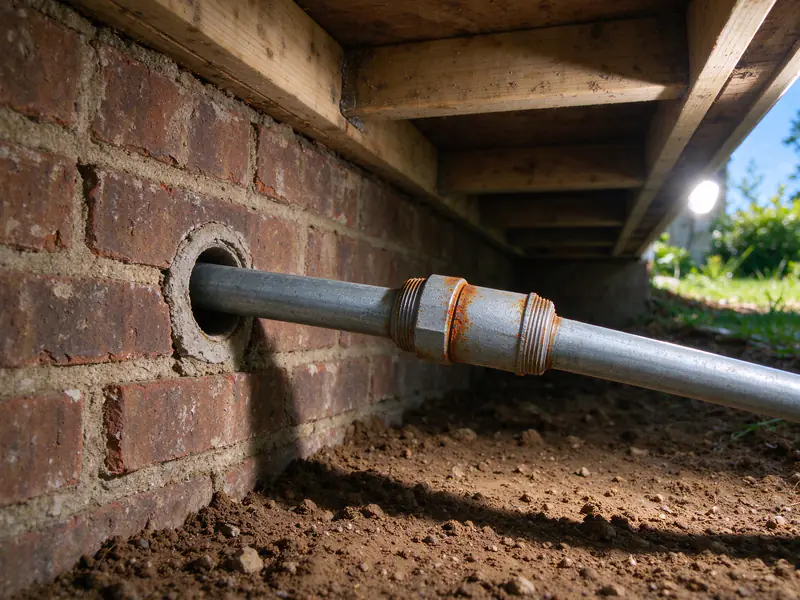
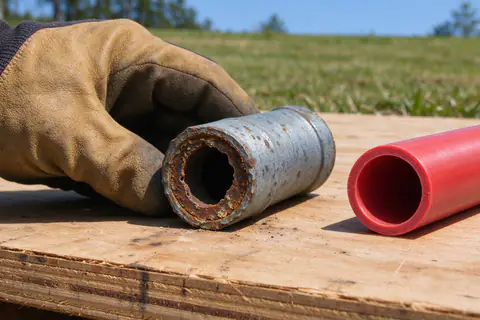
Gray galvanized steel water pipe with a threaded joint and rust at the threads, entering a crawl space
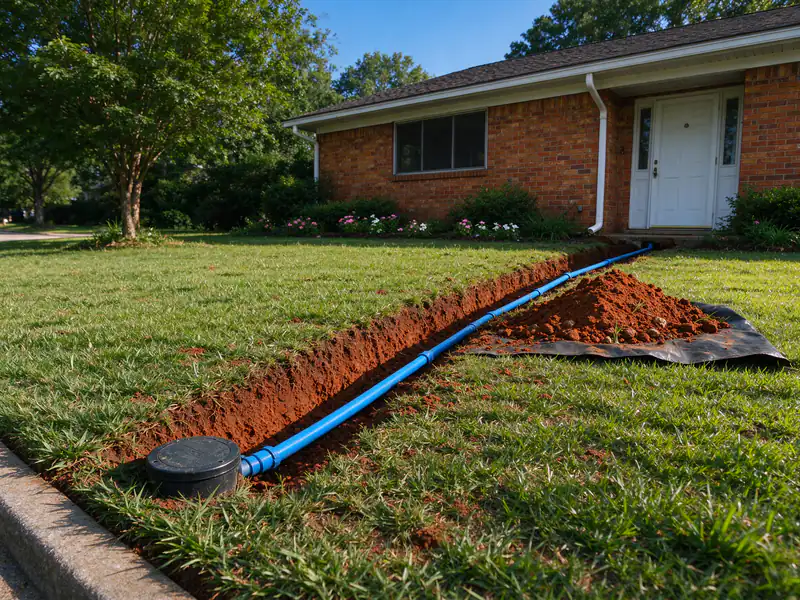
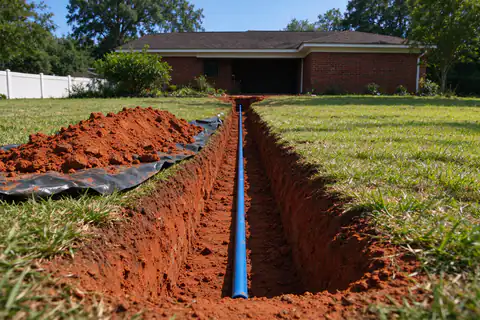
Narrow trench across a front yard from a meter box toward a house, with blue polyethylene pipe laid in it
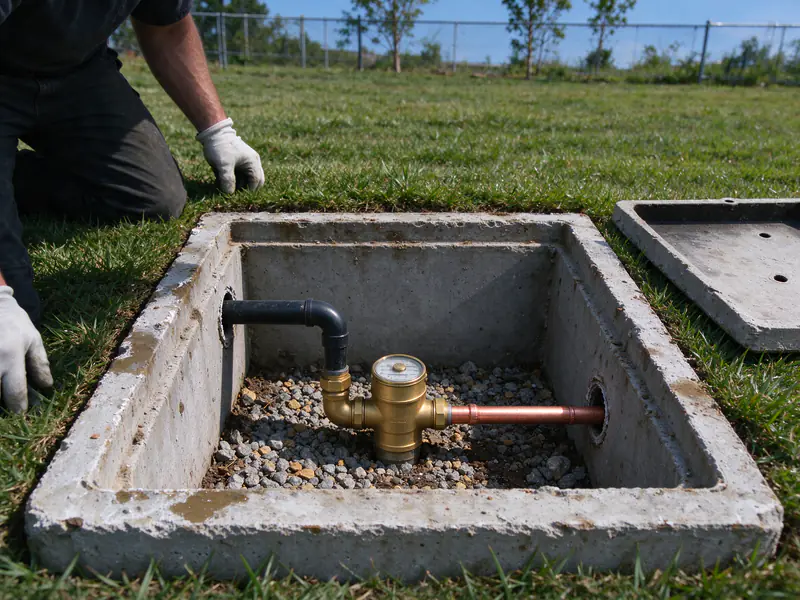
Open concrete water meter box in a lawn with a new copper line connected on the house side of the meter
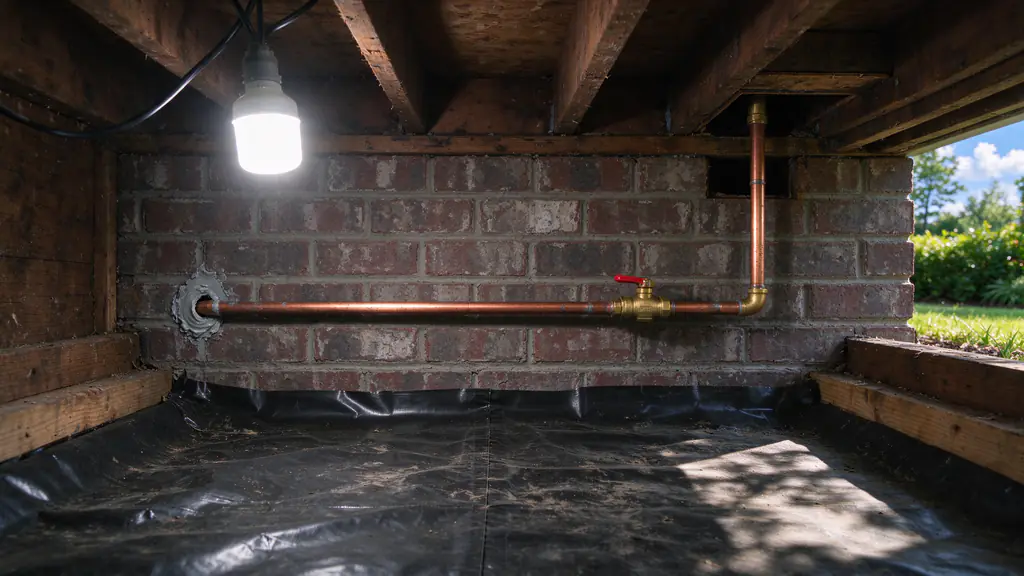
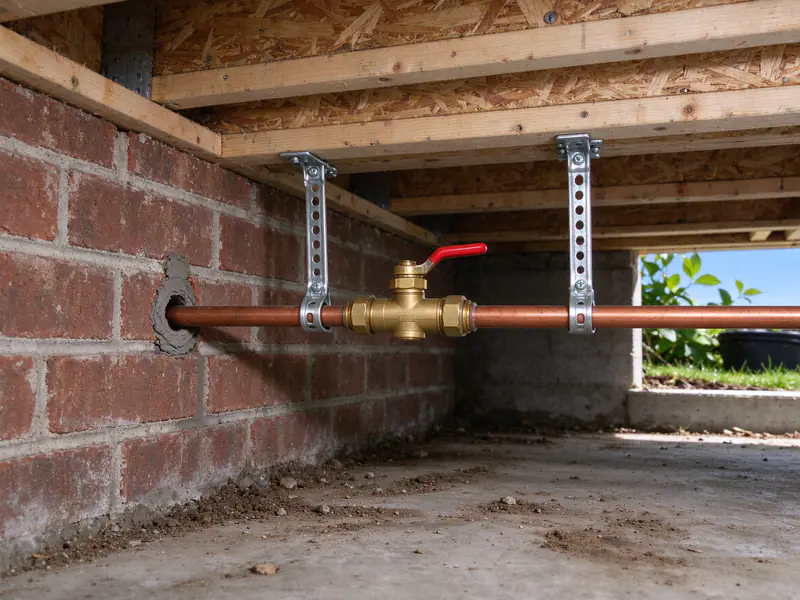
New quarter-turn main shutoff valve on a copper line just inside a brick foundation wall
Want your service line identified?
Tell us the year the house was built, your water utility, and what the pipe looks like where it enters the house, if you can see it.
How do I find out what my service line is made of in Charlotte?
Start with Charlotte Water's lead and copper page, which links to a searchable map of private service line material. Many records there are predictions based on the age of the home, so the reliable check is the pipe itself where it comes through the foundation or slab, before the main shutoff.
What does galvanized requiring replacement mean on a service line inventory?
It is a category in the federal lead rules for galvanized steel service lines that are, or once were, downstream of a lead pipe or connector, because the galvanized pipe can hold lead particles. Charlotte Water's inventory lists 66 such lines, and its Lead Free CLT program includes removing them.
Will Charlotte Water replace my service line for me?
Charlotte Water owns and maintains the line from the main to the meter. Its Lead Free CLT program removes lead lines and galvanized lines that sat downstream of lead at homes it selects, and it contacts those owners. For other lines, the pipe from the meter to the house is the owner's to repair or replace.
If I replace my service line, does that remove all lead risk from my water?
Not necessarily. Charlotte Water notes that lead can also come from lead solder in older copper plumbing and from brass faucets and fittings, and that fixtures made before 2014 could contain up to 8% lead even when labeled lead-free. A certified lab test of your tap water is the way to know what is in it.
Do suburbs outside Charlotte have lead service lines?
Each water system keeps its own inventory. Gastonia's Two Rivers Utilities identified the material of 18,300 service lines, Concord publishes its inventory online, and the Lancaster County Water and Sewer District serving Indian Land posts one too. Check your own utility's inventory for your address, then confirm at the pipe.