$59.70 Minimum Mecklenburg plumbing permit fee, for work valued from $1 to $3,000, plus a $3 technology charge (Mecklenburg County fee ordinance)
$40,000 Single-family plumbing replacements at or under this value may be exempt from a permit if the design does not change (N.C.G.S. 160D-1110)
80 psi Above this street pressure, new or remodeled plumbing needs a pressure-reducing valve (Charlotte Water)
Last Updated:
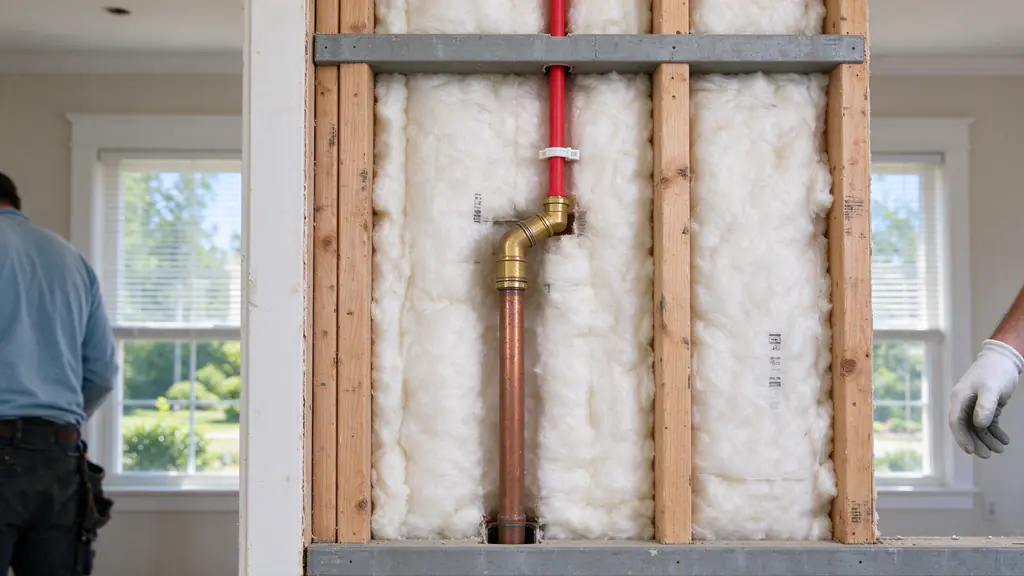
A partial repipe replaces a defined part of a house’s supply piping, such as the hot side, one bathroom group, one floor or one failing branch, and leaves the rest of the original pipe in service. Level Repiping Charlotte arranges partial repipes across Charlotte and the surrounding counties, carried out by licensed and insured contractors, with the new runs, the pipe that stays and every transition between them written into the scope. This page covers when a partial repipe is the right call, when it is not, and how to make sure the boundary is clear.
The difference matters. A whole house repipe leaves no old supply pipe in use. A partial repipe does, and the old pipe that stays is the same age and material as the pipe that failed. That is not a reason to avoid partial work. It is a reason to know exactly what stays.
When a partial repipe makes sense
A partial repipe fits when the problem is genuinely local and the rest of the system is sound.
Failures confined to one area. Pinholes that keep appearing on the same copper branch, often near a recirculation pump or on a run with high velocity, can point to a local cause. Replacing that branch fixes the area that is failing. Our guide to pinhole leaks in copper pipe explains the usual causes.
Walls already open. A kitchen or bathroom remodel exposes the supply pipe behind it. Replacing those runs while the wall is open costs far less in access and patching than coming back later.
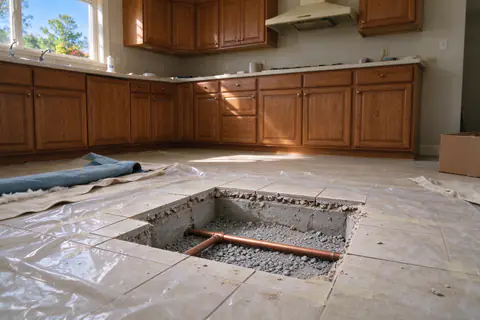
One failed line under a slab. In a slab house, a leak in one buried branch can be bypassed with a new line through the attic and down a wall, leaving the rest of the slab plumbing in service. Our slab leak repair page compares that reroute with a repair in place.
A planned stage. Some owners repipe one floor or one side of the house now and the rest later. That works when the first stage is designed for the last.
When a partial repipe is the wrong scope
Partial work does not fit when the material itself is failing everywhere. A house with polybutylene throughout has the same pipe and fittings in every wall; replacing one bathroom’s lines leaves the rest to fail on its own schedule, and an insurer or buyer will still see polybutylene. The same is true of galvanized steel that is rusting from the inside throughout.
Flow is the other trap. Water reaching an upstairs bathroom passes through every foot of pipe between the main and that fixture. If the restriction is in a galvanized trunk near the main, new pipe to the bathroom will not restore flow. The narrowest section upstream sets the limit. That is why the assessment checks flow along the whole path before a boundary is drawn, and why the low water pressure work starts with measurement rather than replacement.
Hot water and cold water repiping
The hot and cold sides of a house wear differently, so they are sometimes replaced on their own.
Hot water line replacement is the more common partial scope. Hot lines carry water at higher temperature, and in houses with a recirculation loop they carry it constantly and often fast. Copper erodes faster under those conditions, and some plastics age faster with heat. A hot-side repipe runs new lines from the water heater to every fixture, ties into the existing cold system, and leaves the cold lines alone.
Cold water repiping on its own is less common. It usually means replacing the cold trunk from the main shutoff, where an older galvanized or polybutylene line feeds a house whose branches were replaced earlier, or rebuilding the cold side as part of moving the main shutoff or adding a pressure-reducing valve.
Either way, the side left in place is the same age as the side that failed. The written scope should say so plainly, and the assessment should look at both.
What happens on the first visit
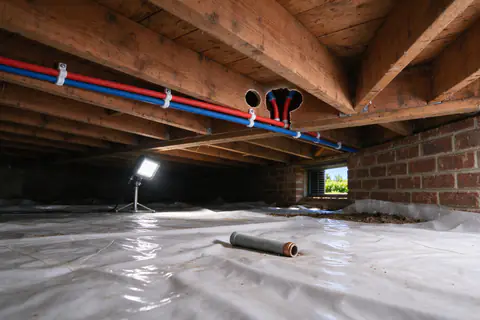
The assessment for a partial repipe has one extra job: drawing the boundary. The person assessing the house identifies the material at the main shutoff, under sinks and in the crawl space or attic, notes any earlier repairs, and works out where the new pipe will start and stop. Street pressure is measured at a hose bib; Charlotte Water requires a pressure-reducing valve on new or remodeled plumbing where pressure runs above 80 psi, and high pressure stresses the retained pipe as much as the new. Our high water pressure guide explains why.
The result is a written scope that names the new runs fixture by fixture, lists the pipe that stays, and identifies every transition.
Transitions and the pipe that stays
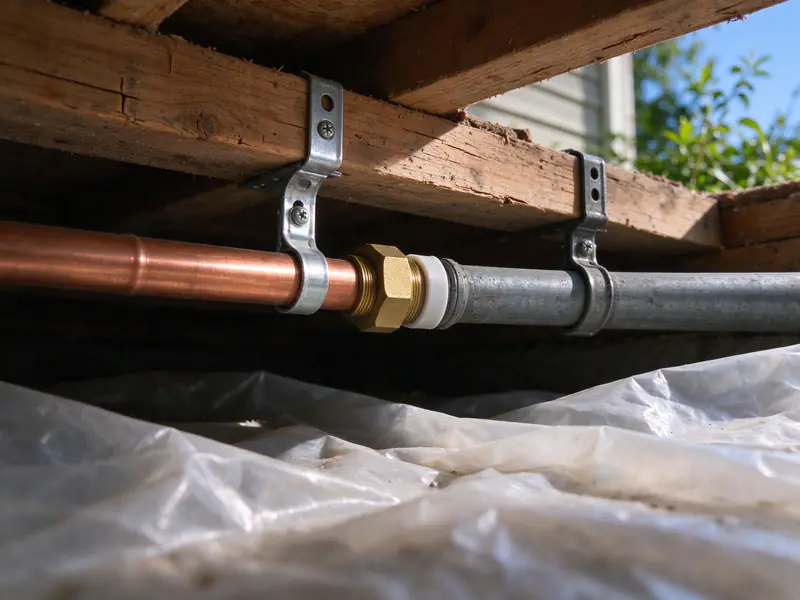
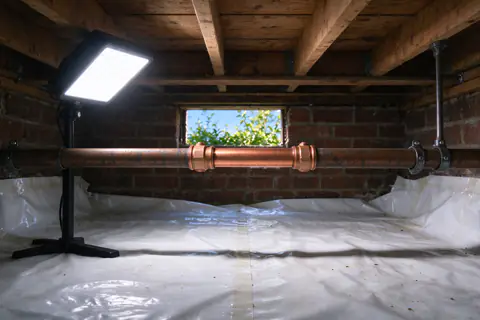
Every place new pipe meets old pipe is a joint between two materials, and each pair has its own rule. Copper meeting galvanized steel needs a dielectric fitting, because the two metals corrode each other where they touch. PEX joins copper through listed adapters. Polybutylene and CPVC need transition fittings listed for those materials. Transitions are placed where they can be reached again, in a crawl space, an attic or behind an access panel, rather than sealed inside a finished wall.
The retained pipe is part of the job even though it is not replaced. Shutting down and restarting an old system disturbs it. Galvanized pipe can shed rust into new valves and faucets. Brittle plastic can crack when it is handled at a tie-in. Old shutoff valves can fail to close or reopen. The scope should say how those risks are handled and what happens if retained pipe fails at a tie-in point during the work.
Permits and inspection
Whether a partial repipe needs a permit is confirmed per project. North Carolina law (G.S. 160D-1110) exempts some single-family plumbing work valued at $40,000 or less when it replaces pipe without changing the size, capacity or design of the system; other work needs a permit. In Mecklenburg County, Code Enforcement issues plumbing permits for Charlotte and the six towns, and its fee ordinance sets a minimum fee of $59.70 for work valued from $1 to $3,000, plus a $3 technology charge. Our permit guide explains how the decision is made.
What a partial repipe costs
Partial repipes are quoted per job. The drivers are the length of new pipe, the number of fixtures, the access route, the number and type of transitions, whether walls are already open, the patching standard, and the permit. Because a partial repipe still carries the fixed costs of a visit, a permit and patching, the price does not fall in proportion to the pipe left out. Our guide to repairing or repiping helps decide where the line falls, and the repipe cost guide shows the whole house range for comparison.
To have a boundary drawn for your house, use the estimate form or call (704) 452-4386. Tell us which fixtures or floor are affected and what pipe you can see.
What's included
What a partial repipe includes
A partial repipe is only as clear as its boundary. If an estimate does not say what stays, ask before signing.
A written boundary: the exact start and end points of the new pipe, by fixture and location
A list of the existing pipe that stays in service, with its material and where it runs
Every transition point named, with the fitting type used for that pair of materials
New pipe sized for the whole house where a later stage is planned, not only for the fixtures on this stage
New shutoff valves at the replaced fixtures, and at the boundary where that helps isolate the old system
A pressure test of the new section, and a check of the retained pipe at each tie-in once water is restored
A flush of the new lines, with aerators and valves checked where old pipe may shed rust or scale
Patching of access openings to the standard written in the scope
The real choice
Spot repair, partial repipe or whole house repipe
The choice turns on whether the problem is local or systemic, and on what the rest of the pipe looks like.
Spot repair, partial repipe or whole house repipe
Spot repair
Partial repipe
Whole house repipe
Scope
One failed section or joint
A defined branch, zone, floor or the hot or cold side
Every supply line from the main shutoff
Old pipe left in service
Almost all
Named in the scope
None
Fits when
One failure, rest of the system sound
Failures confined to one area, or walls are already open
The material itself is failing across the house
Main risk
The next failure elsewhere
Weak points at transitions and in retained pipe
Larger access and patching scope
Price
Quoted per job
Quoted per job
Typical Charlotte range published on the whole house page
Repairs and partial repipes are quoted per job. The published Charlotte range covers a whole house PEX repipe.
Guides
Related resources
Guides that go deeper on partial repipe decisions.
One leak on sound pipe is a repair. A pattern of leaks, or a pipe with a known failure history, is a question about the whole system. The evidence that separates the two is usually in the house.
The three supply pipes found in older Charlotte-area houses, how each one was meant to work and how it fails, the signs that point to the pipe rather than something else, the rules and insurance questions around replacement, and what each scope leaves behind.
North Carolina law requires plumbing permits but exempts some single-family work. Here is how that exemption applies to a repipe, who is allowed to pull the permit, what Mecklenburg County charges, and how the inspection runs.
Copper fails from the inside, usually at one spot first. The cause can be the water, the speed it moves, how the pipe was installed or the tube itself, and often more than one of those at once.
The typical Charlotte range for a whole house PEX repipe, why copper is quoted separately, how the Mecklenburg permit fee is set, and which parts of the job only a walk-through can price.
How it runs
How a partial repipe runs
The call or the form
The age of the house, the pipe you have seen, crawl space or slab, and what has been leaking.
The assessment
Pipe material, fixture count, access routes and street pressure, written up as a scope with a price.
The repipe
New lines are run, then connected to fixtures and the water heater, then pressure tested before walls are closed.
Inspection and patching
The permit office inspects the new piping; access openings in walls and ceilings are then patched to the agreed scope.
What this work looks like
Copper-to-galvanized dielectric union with a plastic insulating sleeve, installed on a horizontal line under a floor
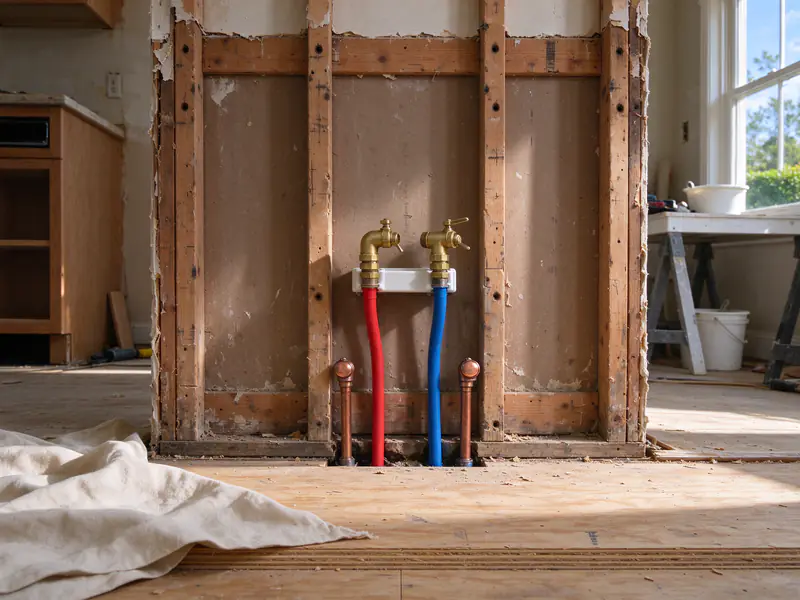
Open kitchen wall during a remodel with new PEX stub-outs and capped older copper lines below
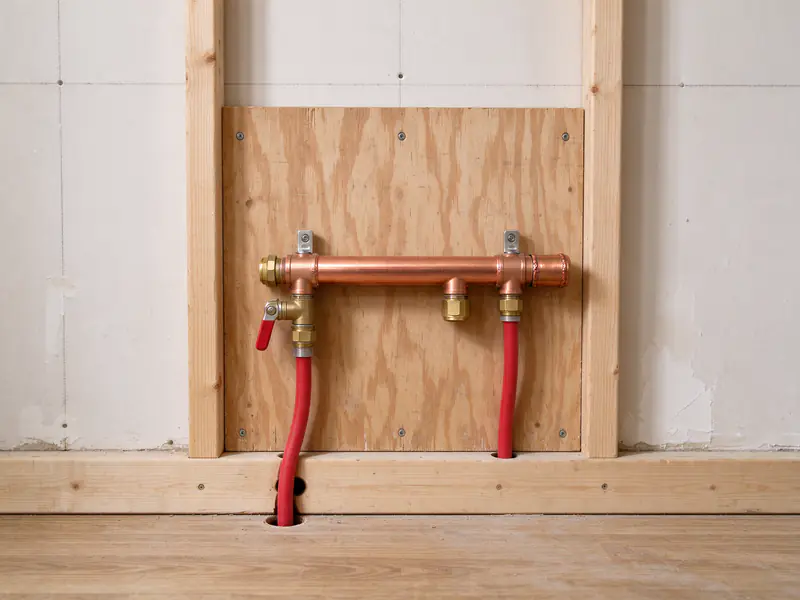
Two-port PEX manifold with one capped spare outlet mounted between studs
Is your problem confined to one part of the house?
Tell us which fixtures or which floor is affected, the pipe material you can see, and whether walls are already open for a remodel.
Can only the hot water lines in a house be replaced?
Yes. A hot-side repipe replaces the lines from the water heater to each fixture and leaves the cold lines in place. It fits when failures are confined to the hot side, which carries hotter, often faster water and tends to wear first in copper and some plastics. The cold side should still be checked, because it is the same age and material.
Will a partial repipe restore water pressure at one weak bathroom?
Only if the restriction is in the pipe being replaced. Water reaching a bathroom passes through every section upstream of it. If old galvanized pipe near the main is narrowed with rust, new pipe to the bathroom alone will not fix the flow. The assessment checks flow and pressure along the path before the boundary is drawn.
Should a partial repipe be described as a repipe when the house is sold?
Describe it accurately. A partial repipe means some original pipe is still in service, and a buyer, inspector or insurer will want to know which parts. Keep the written scope and the inspection record, which name the new runs and what stayed. Ask your agent how to word it on any disclosure.
Can a house be repiped in stages, one partial repipe at a time?
It can, if the first stage is planned with the last one in mind. The new trunk is sized for the whole house, capped tees or spare manifold ports are left for later branches, and transitions are placed where the next stage can reach them. Staging spreads the cost and the disruption, but each stage adds its own access, permit and patching.
What fittings join new pipe to old pipe in a partial repipe?
It depends on the pair of materials. Copper to galvanized steel needs a dielectric fitting to slow galvanic corrosion. PEX joins copper through listed adapters. Polybutylene and CPVC need transition fittings listed for those materials. Each transition is a joint, so it is placed where it can be reached later rather than buried in a finished wall.