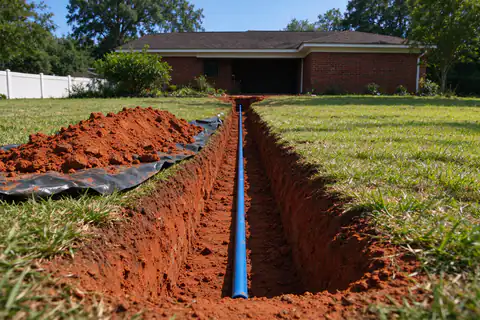
Who is responsible for the water line from the meter to the house in Charlotte?
Charlotte Water draws a clear line at the meter. Here is what the utility owns, what the property owner owns, how to tell which side a leak is on, and when the service line is worth replacing with a repipe.
Last Updated:
Short answerThe property owner is. Charlotte Water owns the main, the meter, the meter box and the line from the main to the meter. The owner owns the tail piece, the shut-off valve, the service line from the meter to the house and all interior plumbing, so leaks on that side are the owner's to repair.
Who is responsible for the water line from the meter to the house in Charlotte? The property owner. Charlotte Water owns the system up to and including the meter, and everything on the house side of it belongs to the owner. Level Repiping Charlotte arranges water line replacement and interior repipes across Charlotte and the surrounding counties through licensed and insured contractors. This guide sets out the ownership split, explains how to tell which side a leak is on, and covers when the service line is worth replacing at the same time as the pipes inside.
Where Charlotte Water’s line ends
Charlotte Water serves all of Mecklenburg County, and it describes the split this way on its Lead Free CLT page:
Part of the system
Owner
Water main in the street
Charlotte Water
Fire hydrant and hydrant line
Charlotte Water
Service line from the main to the meter
Charlotte Water
Meter and meter box
Charlotte Water
Tail piece and shut-off valve on the house side of the meter
Property owner
Service line from the meter to the house
Property owner
All interior plumbing
Property owner
The meter box is the boundary. In most Charlotte neighborhoods it sits near the street or sidewalk, and the owner’s line runs underground from there to where it enters the house, usually at a crawl space wall, a garage or a utility closet.
What the “water service pipe” is under North Carolina code
North Carolina’s plumbing code amendments call the underground run the water service pipe. It runs from the main, or from the meter where the meter sits at the right of way, to the building, and the code treats it as ending 5 feet outside the foundation wall, where the water distribution system inside the house takes over. The amendments require water service pipe to meet NSF 61 for drinking water, carry a listing, and handle at least 160 psi at 73.4°F. Exterior water supply pipe must be buried at least 12 inches below grade and at least 6 inches below the frost line.
Those rules matter when the line is replaced. Some materials that are fine underground are not approved inside a house, so the code makes them stop outside the foundation, at or before the full-open valve where the line enters.
Leaks and the water bill
Charlotte Water says leaks inside a building or between the meter and the building are the customer’s to repair with a plumber, and that the leading cause of a high water bill is a private plumbing leak: running toilets, dripping faucets, irrigation and old plumbing. The utility repairs leaks on its own side, almost 4,000 in a single year by its own count. After a private leak is repaired, Charlotte Water says it has resources to help with the outstanding balance, so it is worth asking the utility once the repair is done.
How to tell which side a leak is on
A simple test narrows it down:
Turn off every fixture, the ice maker and any irrigation.
Look at the meter. If the dial or leak indicator is moving, water is leaving somewhere past the meter.
Close the main shutoff where the line enters the house.
Look at the meter again. If it has stopped, the leak is inside the house. If it keeps moving, the leak is on the service line between the meter and the house, or the main shutoff is not closing fully.
Wet ground, a soft spot in the lawn or a sinkhole along the path from the meter to the house points to the service line. A leak inside a slab house that never shows on the surface can be under the floor; the slab leak signs guide covers that case.
The main shutoff
The main shutoff is the valve that stops water to the whole house. In Charlotte houses it is usually where the service line enters, in the crawl space, the garage or near the water heater, with a second shutoff at the meter on the owner’s side. Old gate valves seize, and a shutoff that won’t close fully turns any plumbing problem into a bigger one. Replacing a worn main shutoff is a common part of a whole house repipe and of a service line replacement.
Replacing the service line with a repipe
Interior repiping and service line replacement are different jobs. A repipe works inside the house through crawl spaces, attics and walls. Service line replacement is underground, from the meter to the foundation, and it is usually done by trenching or by pulling a new line through the path of the old one, depending on the yard.
They are often done together because the old pipe is often the same. A house with polybutylene inside frequently has a polybutylene service line too, and older houses can have galvanized steel underground. Of the 81 Mecklenburg plumbing permits from April 2025 to October 2026 that describe a repipe, 12 also include water service work. Doing both at once means one shutdown and one set of fittings at the foundation. The service line is still a separate run with its own price, so it should appear on its own line in the estimate. The repipe cost guide shows how it fits among the other price drivers.
A related case is a house moving from a private well to city water. About 40 Mecklenburg plumbing permits since 2024 describe abandoning a private well and connecting to a city tap with a new service line. The well line replacement page covers well systems.
Lead and galvanized service lines
Charlotte Water’s service line inventory lists no lead service lines and 66 galvanized lines that require replacement. Its Lead Free CLT program publishes a searchable map of service line material by address. The lead and galvanized service lines guide explains what the inventory means and how to read the map.
Outside Charlotte Water’s area
Other utilities in the region set their own rules, and the meter split can differ in detail, so it is confirmed per address:
Gastonia is served by the city’s Two Rivers Utilities. See the Gastonia page.
Concord runs its own water system, and Kannapolis serves some addresses inside Concord directly. See the Concord page.
Rock Hill runs its own system, and Fort Mill buys its water from Rock Hill. See the Rock Hill and Fort Mill pages.
Indian Land is served by the Lancaster County Water and Sewer District. See the Indian Land page.
Next step
If the line from the meter is old, leaking or a known material such as polybutylene, the water line replacement page explains how the run is replaced. To talk through your line, call (704) 452-4386.
Questions
More questions on this
Who fixes a leak between the street and the Charlotte Water meter?
Charlotte Water. The utility owns the main, the line from the main to the meter, the meter and the meter box. If water is surfacing near the street or the meter box itself, report it to Charlotte Water. A leak on the house side of the meter is the property owner's.
Is the shutoff at the meter the homeowner's or Charlotte Water's?
The homeowner's. Charlotte Water lists the tail piece and the shut-off valve on the house side of the meter as customer-owned, along with the line to the house. If that valve is stuck or leaking, replacing it is the owner's job, and it is often done when the service line is replaced.
Should a polybutylene line from the meter be replaced along with the house pipes?
Often, yes. A polybutylene or galvanized service line fails for the same reasons as the pipe inside, and replacing it while the house is already being repiped avoids a second shutdown later. It is a separate underground run with its own price, so it appears as its own line on the estimate.
Get an Estimate for water line replacement
Tell us the age of the house, the pipe you have seen and what is going wrong. Or call.
Charlotte Water has classified every one of its service connections. Here is what the inventory says about lead and galvanized lines, what Lead Free CLT does, how to look up your address, and where lead can still hide inside a house.
Street pressure in Charlotte depends on how high your house sits. Here is what the 80 psi line means, how to read a gauge, why pressure creeps up overnight, and how a pressure-reducing valve and an expansion tank work together.
A leak under a concrete floor rarely announces itself. Here are the signs that point to one, the ordinary things that cause the same signs, and the simple test that tells you whether water is leaving the house at all.
The typical Charlotte range for a whole house PEX repipe, why copper is quoted separately, how the Mecklenburg permit fee is set, and which parts of the job only a walk-through can price.
Polybutylene usually turns up in the inspection report, partway through due diligence, with an offer already on the table. Here is what to confirm, who to call, and how buyers handle it, in the order the clock allows.