40 to 100+ psi Street pressure range across the system, from high ground to low areas near creeks (Charlotte Water)
80 psi Above this, new or remodeled residential plumbing needs a pressure-reducing valve (Charlotte Water)
7 to 12 years Typical service life of a pressure-reducing valve before it needs replacing (Charlotte Water)
66 Customer-side galvanized service lines marked for replacement in the utility's inventory (Charlotte Water)
Last Updated:
Low water pressure in Charlotte has several causes, and old pipe is only one of them. Street pressure varies widely across the city, pressure-reducing valves wear out, valves get left partly closed, and fixture aerators clog. Level Repiping Charlotte arranges low water pressure diagnosis and repairs across Charlotte and the surrounding counties, performed by licensed and insured contractors, and the work starts with a gauge reading rather than a repipe quote. This page explains how the cause is found and when replacing pipe is, and isn’t, the answer.
What happens on the first visit
The first visit measures before it recommends. A gauge on a hose bib near where the water enters gives the static pressure: the force in the system with nothing running. Flow is then checked at the fixtures that are weak and at one that seems normal. Running hot and cold separately at the same tap shows whether the water heater is involved.
The pattern tells most of the story, and the repipe assessment asks the same questions if you want to work through them first. Whole-house low pressure points to the street, the pressure-reducing valve, the main valve or the service line. One fixture points to that fixture. The farthest bathroom being worst, with brown water after the house sits, points to corroded pipe. The person assessing the house also identifies the pipe material at the main, the water heater and under sinks, because a galvanized house and a copper house lead to different conclusions.
Pressure and flow are different problems
A house can have good static pressure and poor flow. The gauge reads fine with nothing running, but the shower weakens when the washing machine starts. That points to a restriction somewhere between the main and the fixture: a narrowed pipe, a partly closed valve, or a service line too small or too corroded for the demand. Charlotte Water makes the same point: a restriction that shows up during use points to a problem between the main and the fixture, which is on the owner’s side.
Low static pressure with nothing running is different. It means less force is reaching the house in the first place, from the street or through a valve that is cutting it down.
Street pressure across Charlotte
Charlotte Water serves all of Mecklenburg County through more than 4,500 miles of mains, and pressure depends mostly on a house’s elevation relative to the utility’s storage tanks. It reports about 40 psi or lower in some high areas and well above 100 psi in low areas near creeks. A house on a ridge can sit at the bottom of that range with nothing wrong inside it.
No pipe inside the house can raise street pressure. A repipe on a low-pressure street gives cleaner, unrestricted flow, but the force behind it stays the same. If the gauge reads low at the hose bib with everything else ruled out, the options are discussed for that house, and the finding says so plainly.
A failing pressure-reducing valve
The opposite problem creates its own low-pressure cases. Where street pressure runs high, a pressure-reducing valve on the main line brings it down. Charlotte Water says county codes require one on new or remodeled residential plumbing where pressure is above 80 psi, that it can sit just behind the meter box or inside before the water heater, and that it typically needs replacing in 7 to 12 years.
As these valves age, debris and wear can leave them stuck partly closed, cutting pressure to the whole house. Others fail the other way and let pressure creep up, which strains fittings and supply hoses, and a hidden leak can also pull pressure down; the water leak detection page covers how that is ruled out. A reading on each side of the valve shows which is happening. Adjustment sometimes helps; an old valve is usually replaced. The high water pressure guide covers the high side of the same valve.
Valves, aerators and fixtures
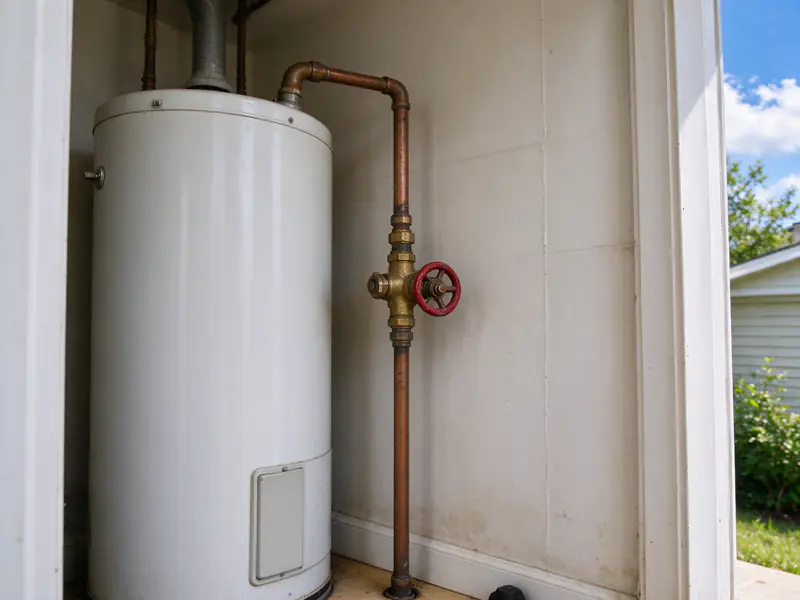
Some of the most common causes cost the least to fix. An old gate valve at the main can lose its gate inside the body, so the handle turns but the valve stays partly shut. A valve closed for other work and never fully reopened does the same thing. Fixture aerators and shower heads catch grit, especially after work on a street main stirs up sediment. Single-handle faucets and showers have cartridges that wear and scale. A whole-house filter or softener with a clogged cartridge restricts everything downstream of it.
If the hot side is weak and the cold is fine, the water heater, its inlet valve or the hot-side piping is the place to look, not the whole system. A single leaking fixture or a damaged section found along the way is a pipe repair, not a reason to replace everything.
Galvanized pipe: when the pipe really is the cause
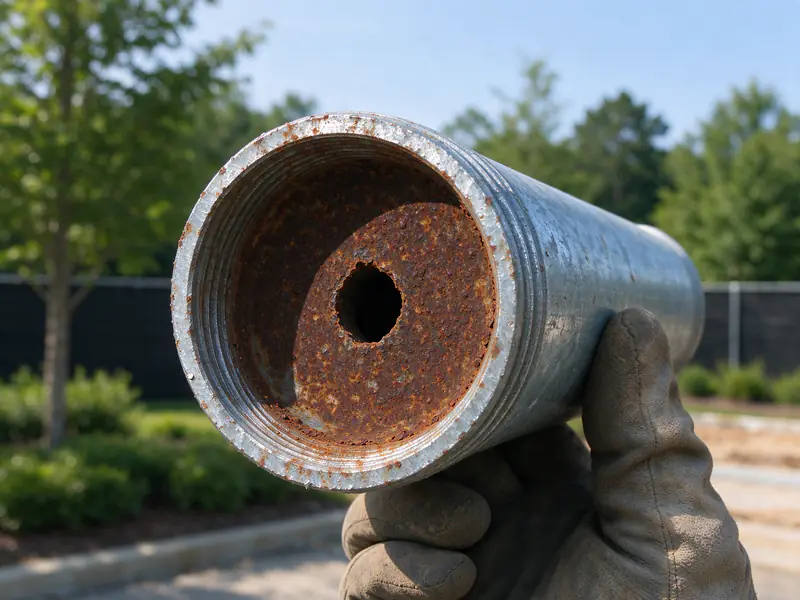
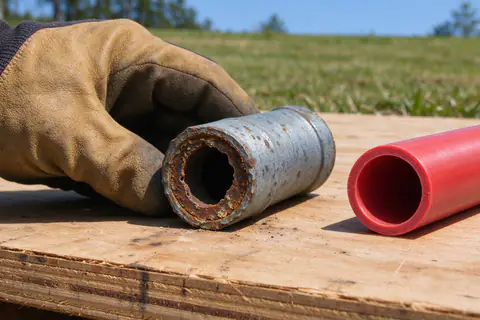
Galvanized steel supply pipe was common in houses built before copper took over, and it is still found in older central Charlotte neighborhoods. It rusts from the inside. Scale builds up on the pipe wall and the bore narrows, slowly, until a half-inch line passes a fraction of the water it was sized for. Because the restriction adds up along the run, the fixtures farthest from the main lose flow first. Rusty or brown water after the house has sat overnight is a common companion.
Brown water has more than one source, though. Work on a street main, a water heater shedding rust, or sediment can all discolor water, so the source is identified before interior pipe is blamed. Charlotte Water treats its water with lime to raise the pH for corrosion control; its latest annual water quality report gives an average of pH 8.5 where water enters the system. That chemistry protects pipe in general. It does not reverse corrosion already inside decades-old galvanized steel.
When galvanized pipe is the restriction, no cleaning or treatment restores it, and replacement is the fix. The galvanized pipe replacement page covers that work. Our guide to identifying your pipe material helps you check what you have.
The water service line
A narrowed or damaged service line between the meter and the house cuts flow to every fixture at once, and it gets worse when several run together. Charlotte Water’s inventory lists 66 customer-side galvanized service lines marked for replacement, mostly in central and inner-ring neighborhoods. Comparing flow at the main with what the meter side delivers shows whether the buried line is the bottleneck. The water line replacement page covers that scope, and the service line guide explains the inventory.
What a repipe will and won’t change
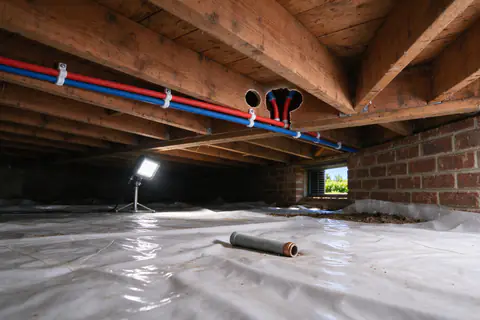
A repipe helps pressure only when old pipe is the restriction. It removes corroded galvanized steel, and its sizing and layout set how well flow holds up when several fixtures run. Pipe sizing matters here: PEX of the same nominal size has a smaller inside diameter than copper, so a well-designed whole house repipe sizes the main lines for the house’s fixtures. Our guide to manifold and trunk-and-branch layouts explains how each delivers water. A repipe does not raise street pressure, fix a failing valve upstream or clear a narrowed service line, and an estimate that promises better pressure without checking those first is skipping steps.
What diagnosis and the fix cost
Diagnosis and repair are quoted per job. A clogged aerator or a stuck valve is a small repair. A new pressure-reducing valve is a modest one. Replacing galvanized runs or the service line is a larger scope priced from the house. If your showers are weak, read a hose bib with a gauge if you have one, note which fixtures are affected, and call (704) 452-4386 or describe it through the estimate form.
What's included
What a low water pressure includes
A low pressure visit should end with a cause and a measured reading, not a repipe quote by default.
A static pressure reading at a hose bib near the meter side of the house, with nothing running
Flow checks at the fixtures that are weak, and at one that isn't, to see whether the problem is the whole house, one area or one fixture
A hot-versus-cold comparison to rule the water heater in or out
A check of the main shutoff, the meter-side valve and any branch valves for partly closed or failed gates
Inspection of the pressure-reducing valve, if there is one, and a reading on both sides of it where possible
Aerators, shower heads and cartridges checked for debris or scale
The pipe material identified at the main, the water heater and under sinks
A written finding naming the likely cause and the fix, whether that is a valve, a fixture part, a section of pipe, the service line or a repipe
The real choice
Common causes of low water pressure and how each is checked
Several causes produce the same weak shower. The pattern of which fixtures are affected usually points to the right one.
Common causes of low water pressure and how each is checked
Cause
Typical pattern
How it is checked
Usual fix
Low street pressure
Whole house, all the time, often on high ground
Static gauge reading at a hose bib
Not a pipe problem; options are discussed per house
Failing pressure-reducing valve
Whole house, sometimes after years of normal pressure
Reading on both sides of the valve; age of the valve
Adjust or replace the valve
Partly closed or failed valve
Whole house or one branch, often after other work
Valve positions; flow before and after each valve
Open or replace the valve
Clogged aerators or cartridges
One fixture, often after street work
Flow with the aerator removed
Clean or replace the fixture part
Water heater or hot-side restriction
Hot water weak, cold fine
Hot and cold flow at the same fixture
Water heater service or hot-side piping
Corroded galvanized pipe
Farthest fixtures worst, rusty water after sitting
Pipe identification; flow by distance from the main
Replace the galvanized runs or the whole system
Narrowed or damaged service line
Whole house, worse when several fixtures run
Flow at the main versus at the meter
Repair or replace the service line
Every fix here is quoted per job once the cause is confirmed.
Guides
Related resources
Guides that go deeper on low water pressure decisions.
Street pressure in Charlotte depends on how high your house sits. Here is what the 80 psi line means, how to read a gauge, why pressure creeps up overnight, and how a pressure-reducing valve and an expansion tank work together.
Five supply pipes turn up in Charlotte-area houses. Color, joints, markings and a magnet tell most of them apart in a few minutes, as long as you look in more than one place.
Charlotte Water has classified every one of its service connections. Here is what the inventory says about lead and galvanized lines, what Lead Free CLT does, how to look up your address, and where lead can still hide inside a house.
A repipe can feed fixtures from shared main lines with branches, or give each fixture its own line from a central manifold. The house's shape, where the water heater sits and what the owner wants to control decide which.
The three supply pipes found in older Charlotte-area houses, how each one was meant to work and how it fails, the signs that point to the pipe rather than something else, the rules and insurance questions around replacement, and what each scope leaves behind.
How it runs
How a low water pressure runs
The call or the form
The age of the house, the pipe you have seen, crawl space or slab, and what has been leaking.
The assessment
Pipe material, fixture count, access routes and street pressure, written up as a scope with a price.
The repipe
New lines are run, then connected to fixtures and the water heater, then pressure tested before walls are closed.
Inspection and patching
The permit office inspects the new piping; access openings in walls and ceilings are then patched to the agreed scope.
What this work looks like
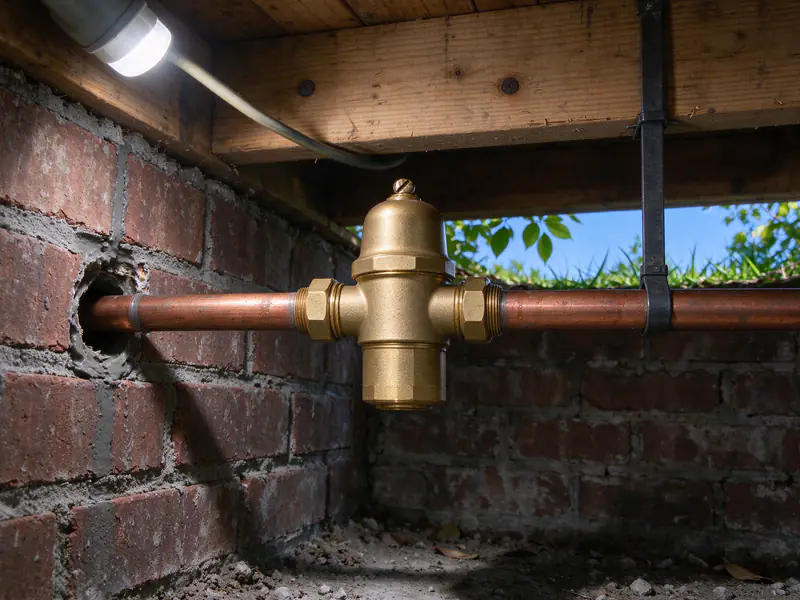
Bell-shaped brass pressure-reducing valve on a copper main line just inside a crawl space wall
Cut section of old galvanized pipe with the bore almost closed by rust buildup
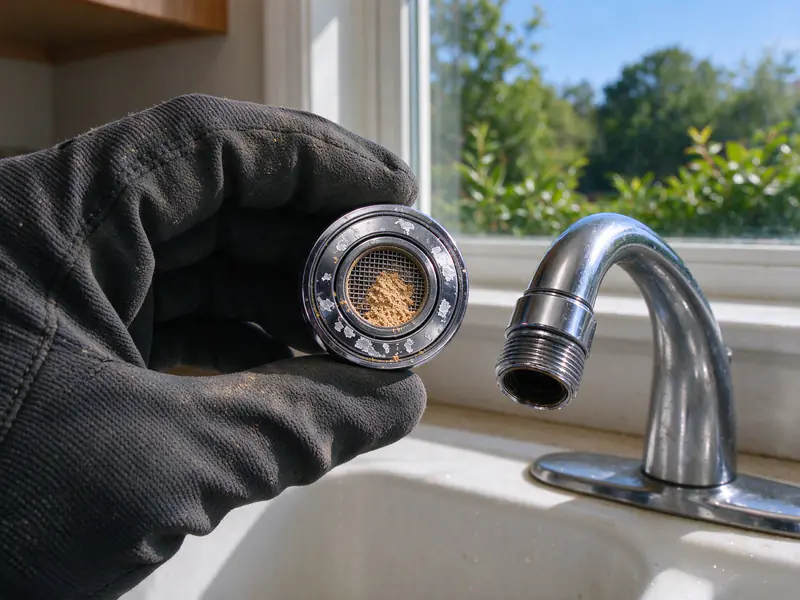
Faucet aerator unscrewed and held over a sink, its screen clogged with grit and scale
Gate valve handle on an old main line near a water heater, partly turned
Weak showers or pressure that keeps dropping?
Tell us whether it's the whole house or one fixture, hot or cold, and what the pipe looks like where the water comes in.
Why is only one faucet or shower in my house low on pressure?
When one fixture is weak and the rest are fine, the cause is almost always at that fixture or on its branch: a clogged aerator or shower head, a worn cartridge, or a partly closed stop valve under the sink. Unscrewing the aerator and running the tap is a quick test. If flow jumps, the pipe is not the problem.
How do I know if my pressure-reducing valve is failing?
A bell-shaped brass valve on the main line, near the meter or where the water enters, is usually the pressure-reducing valve. Signs of failure are pressure that drops or swings for no reason, or pressure that creeps up and makes fixtures bang. Charlotte Water says these valves typically need replacing in 7 to 12 years, so age is a clue. A gauge reading confirms it.
Why did my water pressure drop after work on the street main?
Work on a main can stir up sediment that then lodges in aerators, shower heads and fixture cartridges, so the first check is to clean those. A valve at the meter or the main that was closed for the work and not fully reopened has the same effect on the whole house. If neither explains it, a gauge reading shows whether street pressure itself has changed.
What is normal water pressure for a house in Charlotte?
Charlotte Water delivers anywhere from about 40 psi on high ground to more than 100 psi near creeks, depending on elevation relative to its storage tanks. It treats 80 psi as the point where a pressure-reducing valve should be considered, and county code requires one on new or remodeled plumbing above that. A gauge on a hose bib tells you where your house sits.
Is a repipe the fix for weak water pressure in a galvanized house?
It can be, when the galvanized pipe is the restriction. Galvanized steel rusts inside and narrows, and no cleaning restores it. But a galvanized house can also have a bad valve, low street pressure or a narrowed service line, and a repipe fixes none of those. The pressure and flow readings decide whether replacing the pipe is the answer.