$4,000 to $12,000+ Typical Charlotte-area range for a whole house PEX repipe on a single-family home
17 Mecklenburg repipe permits from April 2025 to October 2026 that name PEX as the new pipe (Mecklenburg County)
R-6.5 Minimum insulation on water pipe in an unconditioned attic or crawl space (NC Plumbing Code 305.4)
58.3 Average nights a year at or below 32°F at Charlotte Douglas (NOAA 1991-2020 normals)
Last Updated:
A PEX repipe replaces the supply pipe in a house with cross-linked polyethylene tubing, run in long flexible lengths from the main shutoff to each fixture. Level Repiping Charlotte arranges PEX repipes across Charlotte, the Mecklenburg towns and the surrounding counties, carried out by licensed and insured contractors under a plumbing permit where one is required. This page covers the choices inside a PEX repipe: which tubing, which fittings, which layout, and how the tubing is protected in Charlotte attics and crawl spaces.
If you are still deciding whether to repipe at all, the whole house repipe page covers that decision. If you are still choosing between materials, our PEX vs copper guide sets them side by side. This page assumes PEX is on the table and explains what a good PEX job looks like.
Why PEX suits most Charlotte repipes
PEX bends. A trained installer can pull one length of tubing from a crawl space, along the joists and up into a wall cavity without a joint, where copper would need an elbow at every turn. Fewer joints means fewer places for a leak to start and often fewer openings in finished walls, because tubing can be fished through spaces that a rigid pipe cannot follow.
That is why PEX dominates permitted repipes here. Of the 81 Mecklenburg County plumbing permits issued from April 2025 to October 2026 that describe a repipe, 17 name PEX as the new pipe. Many permits do not name a material at all, so the true share is likely higher.
PEX is not the right answer for every house, and it is not maintenance-free. It must be kept out of sunlight, away from heat, protected where it passes through framing, and joined with fittings listed for that tubing. A PEX repipe done carelessly fails at the same places any plumbing fails: the joints and the spots where the pipe was left unprotected.
What happens on the first visit
The assessment for a PEX repipe maps the same things as any repipe: the existing pipe, every fixture, and the routes in. For PEX it also settles three questions that shape the estimate.
The first is the route. In a crawl space house, tubing runs along the joists and rises through the floor behind each fixture. In a slab house, it runs through the attic and drops down interior walls. In a two-story house, lines to the upper bathrooms need a path through a wall, a chase or a closet.
The second is the layout: trunk and branch, a home-run manifold, or a hybrid. The comparison table below sets out the trade-offs.
The third is pressure. Street pressure is measured at a hose bib. Charlotte Water reports system pressure from about 40 psi on high ground to more than 100 psi in low areas near creeks, and new or remodeled plumbing needs a pressure-reducing valve where pressure runs above 80 psi. High pressure shortens the life of any plumbing, PEX included, so the valve is part of the scope where it is needed. Our high water pressure guide explains why.
PEX-A and PEX-B: tubing and fittings
All PEX is cross-linked polyethylene, but it is made in different ways, and the difference shows up in the fittings.
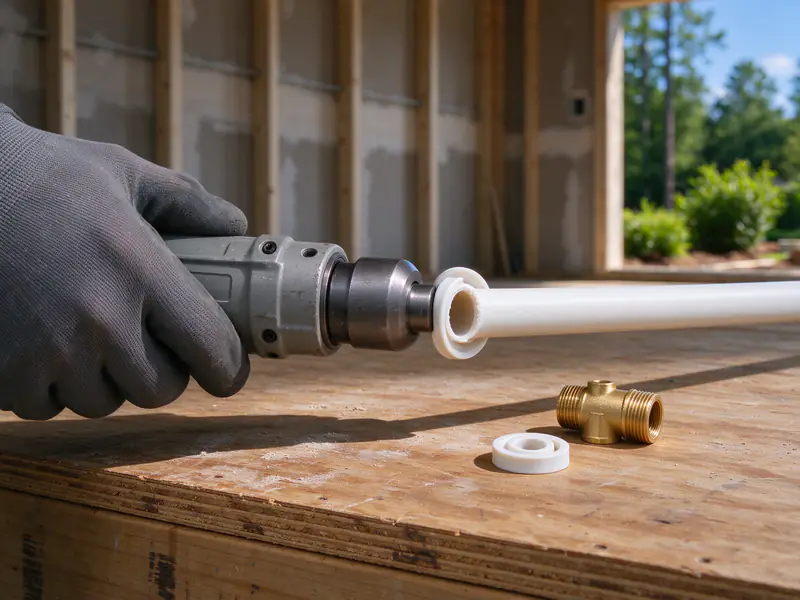
PEX-A is cross-linked during extrusion by the peroxide method. It is the most flexible type, and a kink can often be recovered with heat. It is usually joined with expansion fittings: the end of the tube is stretched with a tool, slipped over a fitting, and shrinks back to grip it. Because the tube was stretched before it went on, the fitting narrows the bore less than an insert fitting does.
PEX-B is cross-linked after extrusion by the silane method. It is stiffer and holds its shape on long straight runs. It is usually joined with crimp or stainless clamp rings squeezed over an insert fitting, which narrows the bore at each joint. Some newer PEX-B systems use their own expansion-style fittings.
Both are listed to the same tubing standard, ASTM F876, and both are approved under the North Carolina code. What matters most is that the tubing and fittings are a matched, listed system, joined with the right tool and checked with the right gauge. Our PEX-A vs PEX-B guide goes into the fittings in more detail.
Manifold or trunk and branch
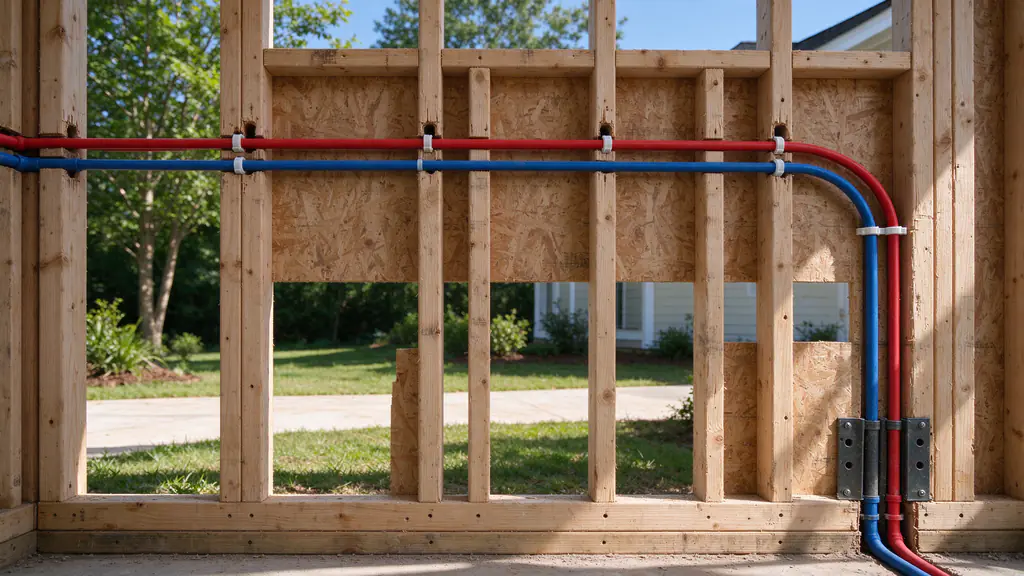
A trunk and branch layout is the traditional pattern: a larger main line runs through the house and smaller branches tee off to each fixture. It uses the least tubing, but each tee is a joint, and many of those joints end up inside walls or ceilings.
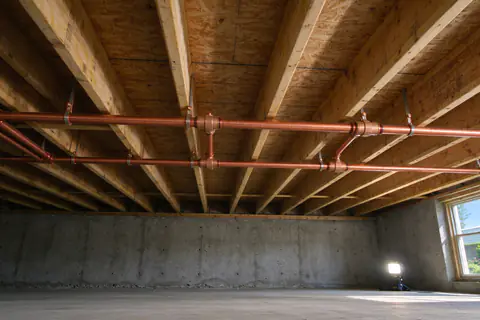
A home-run manifold layout gives every fixture its own line from a central manifold, with a valve for each one in a single panel. It uses more tubing and puts almost every joint at the manifold or the fixture, where it can be reached. It suits crawl space houses where lines can run straight along open joists.
A hybrid runs a trunk to small manifolds near each group of fixtures. It often fits larger and two-story houses where bathrooms sit far apart.
Hot water wait is not decided by the layout alone. It depends on how far a fixture sits from the water heater and how much water sits in the line between them. The scope should show where the manifold or trunk sits relative to the heater. The manifold vs trunk and branch guide has diagrams of each.
Protecting PEX: sunlight, heat and cold
Sunlight. Ultraviolet light breaks down PEX. Tubing is stored covered and installed within the exposure limit its maker sets, and it is never left exposed outdoors. Where a line rises to an exterior hose bib, the tubing stays inside the wall.
Heat. PEX makers set clearances from flue pipes, recessed light housings and other heat sources, and limits on how close the tubing may start to a water heater. A short metal connector at the heater is a common way to meet them. Charlotte attics get hot in summer, so attic runs are kept low in the insulation and away from the roof deck.
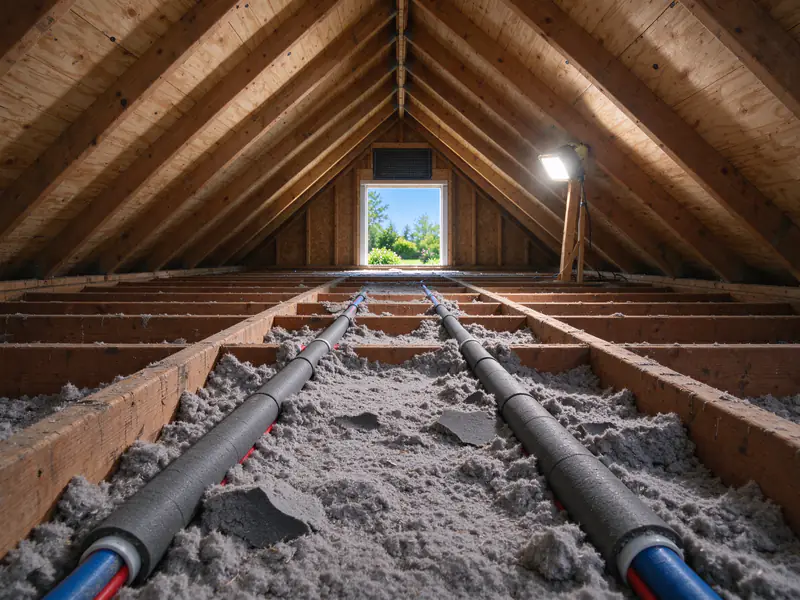
Cold. The North Carolina amendment to section 305.4 of the plumbing code requires water pipe in an unconditioned attic or crawl space to have at least R-6.5 insulation or be protected by heat, and pipe in an exterior wall to sit on the heated side of the wall insulation. Charlotte averages 58.3 nights a year at or below freezing and 7.2 at or below 20°F, based on 1991-2020 normals. Hard freezes such as 6°F on January 7, 2014, 9°F on December 24, 2022 and 10°F on February 2, 2026 are when unprotected runs fail. PEX tolerates freezing better than copper, but it is not freeze-proof, and fittings still crack. Our guide to frozen pipes in crawl spaces covers the details.
Pressure testing and inspection
When the new tubing is in and connected, the system is pressure tested before any wall is closed. The test pressure and method are set by the tubing maker and the inspector, and confirmed per project. The new lines are flushed so debris from cutting and from the old pipe does not settle in valves and faucet cartridges. Where a permit is pulled, the county or town inspects the new piping. In Mecklenburg County that is Code Enforcement, which covers Charlotte and the six towns. Our permit guide explains when a permit is required.
What a PEX repipe costs
A whole house PEX repipe on a single-family home typically runs $4,000 to $12,000 or more in the Charlotte area. Larger homes, two-story homes and slab homes run higher. Within that range the main drivers are the number of bathrooms and fixtures, the foundation, the number of stories, the layout, attic or crawl space access, the patching standard, and whether a pressure-reducing valve or the water service line is added. The repipe cost guide breaks the range down, and the cost estimator places your house in it.
To have a PEX layout scoped for your house, use the estimate form or call (704) 452-4386. Say whether the house sits on a crawl space or a slab and how many bathrooms it has, and the assessment can start from there.
What's included
What a PEX repipe includes
A PEX repipe estimate that names the tubing, the fittings and the layout is one you can compare line for line with another.
A layout drawn for the house: trunk and branch, a central manifold, or a mix with small remote manifolds
A stated tubing type (PEX-A or PEX-B) and the fitting system that goes with it, from one maker where possible
Hot and cold lines from the main shutoff to every fixture, the water heater, hose bibs and the ice maker or dishwasher
Stub-outs and new shutoff valves at each fixture
Supports at the spacing the tubing maker requires, plus nail plates where tubing passes close to the face of a stud
Clearance or metal connectors where tubing meets the water heater and anywhere near a flue
Insulation on attic and crawl space runs to the 305.4 standard
A pressure test before walls close, a flush of the new lines, and labels on the manifold ports or main valves
The permit, inspection and patching of access openings as written in the scope
The real choice
PEX layouts for a Charlotte repipe
The layout changes how many joints sit in walls, how fixtures are shut off, and how long hot water takes to arrive. The house decides which fits.
PEX layouts for a Charlotte repipe
Trunk and branch
Home-run manifold
Hybrid (remote manifolds)
How it runs
A larger main line with tees branching off to each fixture
One line from a central manifold to each fixture
A trunk to small manifolds near each bathroom group
Shutoffs
At each fixture and the main
One valve per fixture at the manifold, plus fixture stops
Per fixture group at each small manifold
Joints hidden in walls and ceilings
More, at each tee
Fewest; joints mostly at the manifold and fixture
In between
Tubing length
Least
Most
In between
Where it suits
Compact houses, short runs, tight access
Crawl space houses with open joists; owners who want shutoffs in one place
Larger or two-story houses with bathrooms far apart
The published Charlotte range covers a whole house PEX repipe in either layout; the written scope prices the one drawn for your house.
Both are approved under the North Carolina Plumbing Code. The house, the routes the pipe has to take and what the owner values decide between them, not a rule of thumb.
The two common types of PEX differ in how they are crosslinked, how flexible they are and which fittings they take. The fitting system and the installer's tools often matter more than the letter.
A repipe can feed fixtures from shared main lines with branches, or give each fixture its own line from a central manifold. The house's shape, where the water heater sits and what the owner wants to control decide which.
Charlotte freezes most winters and sees a hard freeze every few years. Here is why crawl space and attic pipes are the ones that split, what the state code requires, and what helps before and after a cold night.
The typical Charlotte range for a whole house PEX repipe, why copper is quoted separately, how the Mecklenburg permit fee is set, and which parts of the job only a walk-through can price.
A repipe runs in stages, and most of them happen with the water still on. Here is what each stage involves, what makes one house take longer than another, and when you will actually be without water.
How it runs
How a PEX repipe runs
The call or the form
The age of the house, the pipe you have seen, crawl space or slab, and what has been leaking.
The assessment
Pipe material, fixture count, access routes and street pressure, written up as a scope with a price.
The repipe
New lines are run, then connected to fixtures and the water heater, then pressure tested before walls are closed.
Inspection and patching
The permit office inspects the new piping; access openings in walls and ceilings are then patched to the agreed scope.
What this work looks like
PEX expansion tool lined up with the ringed end of white PEX-A tubing, with a brass fitting and spare expansion ring beside it
Foam-insulated PEX lines running between attic ceiling joists in blown insulation, well away from the roof deck
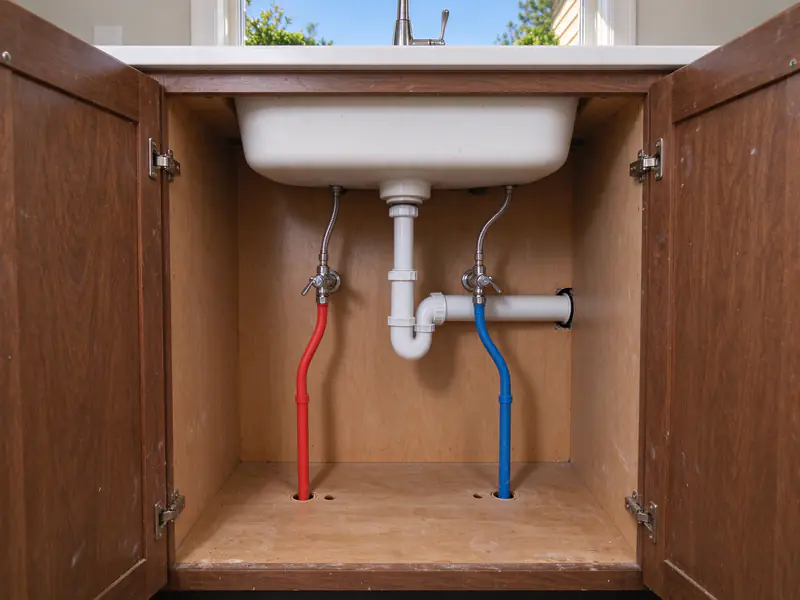
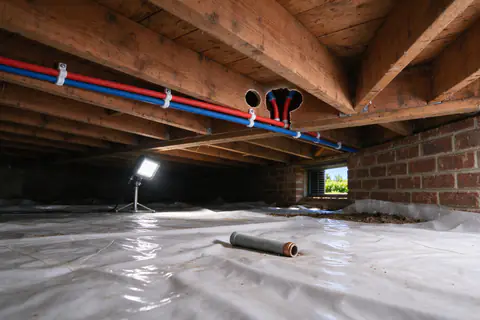
Two PEX lines rising from a crawl space through a subfloor hole into a cabinet base, with new chrome angle stops
Want a PEX repipe layout drawn for your house?
Send the number of bathrooms, whether the house sits on a crawl space or slab, and whether there is an attic above the second floor.
Is PEX-A or PEX-B better for a repipe in Charlotte?
Neither is better for every house. PEX-A is more flexible and uses expansion fittings, which narrow the bore less at each joint. PEX-B is stiffer, usually joined with crimp or clamp rings, and costs less as material. Both are listed to the same tubing standard and approved under the North Carolina code. The written scope should name which one is used and which fitting system goes with it.
Can PEX run through a hot Charlotte attic?
Yes, within the tubing's temperature rating and away from heat sources such as flues and recessed lights. Attic runs in a slab house still need at least R-6.5 insulation under the North Carolina amendment, mainly to protect against freezing in winter. Tubing is kept off the hot roof deck and supported so it does not sag onto anything warm.
Will PEX pipes freeze and burst in a crawl space?
They can. PEX stretches more than copper as water freezes, so it often survives a freeze that would split metal pipe, but fittings and tubing can still fail in a hard freeze. That is why crawl space runs get insulation to the R-6.5 standard and why lines are kept on the warm side of foundation vents where possible.
Does a PEX repipe include a manifold with a shutoff for every fixture?
Only if the layout calls for one. A home-run manifold gives each fixture its own line and its own valve in one panel. Many houses are better served by trunk and branch or by small remote manifolds. The scope names the layout before work starts, so you know what you are paying for.
Why do some PEX repipe estimates use copper at the water heater?
Tubing makers set limits on how close PEX may run to a water heater, a flue or any other heat source. A short copper or other metal connector at the heater is a common way to meet that limit. It is a normal part of a PEX repipe, not a sign the job is mixed or unfinished.