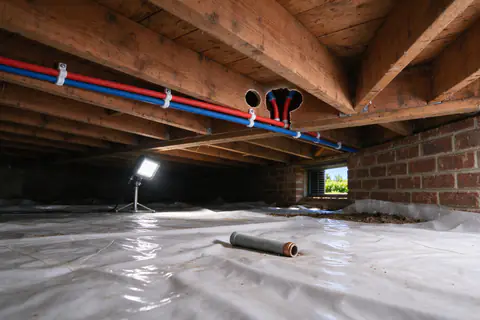
Do you need a permit to repipe a house in Mecklenburg County?
North Carolina law requires plumbing permits but exempts some single-family work. Here is how that exemption applies to a repipe, who is allowed to pull the permit, what Mecklenburg County charges, and how the inspection runs.
Last Updated:
Short answerOften, but not always. North Carolina requires a permit to install, extend or generally repair plumbing, yet exempts single-family work of $40,000 or less unless it adds to or changes the plumbing design. A repipe can fall on either side of that line, so the permit question is confirmed per project, and the licensed contractor pulls it.
Do you need a permit to repipe a house in Charlotte or the six Mecklenburg towns? Often, but the answer is set by a state law with an exemption, so it is confirmed for each project. Level Repiping Charlotte arranges repipes in Mecklenburg County and the surrounding counties through licensed and insured contractors, and where a permit applies, the contractor doing the work pulls it. This guide explains the law, the homeowner rules, the county fee and the inspection.
What North Carolina law says
Two parts of the same statute decide the question. G.S. 160D-1110(a) requires a building permit for the installation, extension or general repair of any plumbing system. G.S. 160D-1110(c) then exempts work of $40,000 or less in a single-family residence, unless that work involves, among other things, the addition or change in the design of plumbing. Replacements that do not change the size or capacity of the system are exempt. Mecklenburg County Code Enforcement repeats this exemption on its own permitting page.
A repipe sits close to that line, which is why there is no single answer. Replacing old pipe with new pipe of the same size, along the same routes, to the same fixtures looks like a replacement. A repipe that reroutes a slab house’s lines through the attic, switches to a manifold with home runs to each fixture, changes pipe sizes or adds fixtures looks more like a design change. A whole house repipe on a large home can also pass $40,000. So the permit question is answered for the actual scope, and the written estimate says whether a permit is included.
In practice, repipes are permitted in Mecklenburg regularly. County permit records from April 2025 to October 2026 include 81 plumbing permits whose descriptions name a whole-house or major water-distribution repipe: 59 in Charlotte, 7 in Huntersville, 6 in Matthews, 5 in Cornelius, 2 in Davidson and 2 in Mint Hill.
Who is allowed to do the work
Permits and licenses are separate questions. Under G.S. 87-21, anyone who installs, alters or restores plumbing for pay is in the business of plumbing contracting and needs a license from the State Board of Examiners of Plumbing, Heating and Fire Sprinkler Contractors. A Class I license covers all structures; a Class II license covers single-family detached dwellings. Installing plumbing on property intended for sale or rental counts as contracting whether or not anyone is paid. The $40,000 permit exemption does not change the license requirement.
In South Carolina, residential plumbing work over $500 requires a Residential Plumber license from the state’s Residential Builders Commission, part of the Department of Labor, Licensing and Regulation. Work in Fort Mill, Tega Cay, Lake Wylie, Rock Hill and Indian Land is done by South Carolina licensed contractors.
Homeowner permits, and why they rarely fit a repipe
Mecklenburg County issues homeowner permits, but its rules are narrow. The owner must be on the deed and live in the house as a primary residence. The property can’t be a deeded condominium, and trusts and powers of attorney don’t qualify. The homeowner must install the work personally and file a Homeowner Trade Work Certificate of Ownership. Projects of $40,000 or more need a bond account and an Owner Exemption Affidavit.
The county is direct about the most common mistake: homeowners hiring a contractor should not use a homeowner permit, because the contractor pulls the permit. If someone suggests you pull the permit in your own name so they can do the work, that is the arrangement the county’s rules are written to stop. Condo owners face the extra limit above; our condo repipe page covers how shared buildings change the work.
The Mecklenburg permit and its fee
Mecklenburg County Code Enforcement, based at 2145 Suttle Avenue in Charlotte, issues plumbing permits and performs inspections for Charlotte, Huntersville, Cornelius, Davidson, Matthews, Mint Hill, Pineville and unincorporated Mecklenburg. Its fee ordinance, revised July 1, 2026, sets fees by permit value:
Permit value or type
Mecklenburg fee
$1 to $3,000
$59.70 minimum
$3,001 to $50,000
$59.70 plus $12.19 per $1,000 over $3,000
Renovation and alteration projects
May instead be charged $79.61 per trade plus $0.08 per square foot of altered space for plumbing
Homeowner permit (owner-occupant doing own work, under $40,000)
$60 per trade plus $45 per inspection trip
All permits
Plus a $3 technology charge
The county decides which basis applies to a particular repipe. The permit is a small part of the price, and the repipe cost guide shows where it sits among the rest.
How the permit and inspection run
For trade-only work that needs no building permit, a licensed contractor can apply through Mecklenburg’s Trade Internet Permitting system, known as TIP. Once the work is ready, the contractor requests the inspection online. Small residential projects under $40,000 are inspected by the county’s Residential Multi-Trade Inspections team, and results are posted online, so an owner can follow along with the permit number.
The inspection happens before walls and ceilings are closed. The new piping is filled and put under test pressure, and the gauge has to hold with no drop while the inspector looks at the exposed joints, supports, protection plates and insulation. The test medium and pressure are confirmed per project with the permit office. For comparison, the Town of Fort Mill’s Residential Inspection Guide calls for an air test of interior water lines at 200 PSI. A failed inspection lists what needs fixing, and the inspector comes back once it is corrected. Openings are patched after the pass, which is one reason the drywall guide and the repiping process guide both put patching last.
Outside Mecklenburg County
Each county and some cities run their own permit office, so the fee and the application route change with the address:
Gastonia, Belmont and Mount Holly. Gaston County Building and Development Services issues permits and inspections for the city and most Gaston County towns. See the Gastonia page.
Concord, Kannapolis and Harrisburg. In Concord, the City reviews zoning and Cabarrus County reviews building through one online submission. See the Concord page.
Fort Mill, Tega Cay and Lake Wylie. Fort Mill Building and Codes lists re-piping of water lines among the projects that need a permit, and it enforces the South Carolina Plumbing Code. See the Fort Mill page.
Rock Hill. The City of Rock Hill runs its own permit portal, separate from Fort Mill’s. Its fees and inspection steps are confirmed per project. See the Rock Hill page.
Indian Land. Lancaster County Development Services permits residential work in the unincorporated panhandle. See the Indian Land page.
Which code applies
North Carolina’s plumbing rules come from the 2018 North Carolina Plumbing Code, which took effect January 1, 2019 and is still the code in force. A newer edition was adopted, but its effective date was moved by S.L. 2024-57 and again by S.L. 2025-2, so it can be used only as an alternative at the owner’s request until it takes effect. The state’s amendments add rules that matter on a repipe, such as at least R-6.5 insulation on pipe in unconditioned attics and crawl spaces.
Why the permit is worth having
A permit puts an inspector’s eyes on the new piping while it is still visible, and it leaves a public record of the work. Mecklenburg permit records are searchable, so a future buyer’s inspector or an insurer can see that a repipe was permitted and passed. For a house being sold with polybutylene pipe replaced, that record answers a question before it is asked. The whole house repipe page shows where the permit fits in the job, and you can call (704) 452-4386 to ask how it applies to your house.
Questions
More questions on this
Can I pull a Mecklenburg homeowner permit if a contractor is doing my repipe?
No. Mecklenburg County Code Enforcement says homeowners who hire a contractor should not use a homeowner permit; the contractor pulls the permit. A homeowner permit is for an owner who lives in the house and installs the work personally, and it carries a signed certificate of ownership.
Does a condo owner qualify for a Mecklenburg homeowner plumbing permit?
Not for a deeded condominium. Mecklenburg's homeowner permit rules exclude deeded condominium units, as well as property held in a trust or handled under a power of attorney. A condo repipe is permitted by the licensed contractor, and the building's rules on shared risers and shutoffs come into it too.
How do I check a repipe inspection result in Mecklenburg County?
Mecklenburg County Code Enforcement posts inspection results online. With the permit number from your contractor, you can look up whether the plumbing inspection passed, failed or is still pending. A failed result lists what has to be corrected before the inspector returns.
Get an Estimate for whole house repipe
Tell us the age of the house, the pipe you have seen and what is going wrong. Or call.
The typical Charlotte range for a whole house PEX repipe, why copper is quoted separately, how the Mecklenburg permit fee is set, and which parts of the job only a walk-through can price.
A repipe runs in stages, and most of them happen with the water still on. Here is what each stage involves, what makes one house take longer than another, and when you will actually be without water.
Every repipe needs some access. How many openings a house needs depends on its foundation, its stories and where the fixtures sit, and how they are closed depends on a patching standard that belongs in writing.
A policy usually pays for the damage a sudden leak causes, not for replacing the old pipe. Where a repipe helps is with the insurer's view of the house, and that depends on the carrier.
Polybutylene usually turns up in the inspection report, partway through due diligence, with an offer already on the table. Here is what to confirm, who to call, and how buyers handle it, in the order the clock allows.