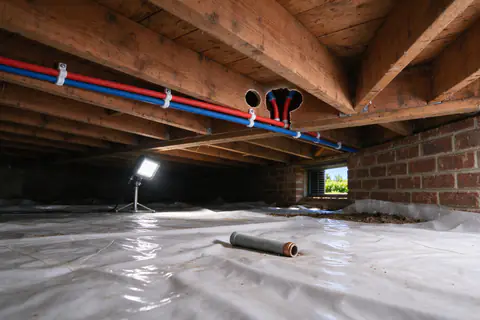
Five supply pipes turn up in Charlotte-area houses. Color, joints, markings and a magnet tell most of them apart in a few minutes, as long as you look in more than one place.
Last Updated:
Short answerCheck the pipe at the water heater, the main shutoff and under sinks. Reddish-brown metal with soldered joints is copper. Dull gray metal that a magnet sticks to, with threaded joints, is galvanized. Gray flexible plastic, often printed PB2110, is polybutylene. Red, blue or white flexible plastic printed PEX is PEX. Cream rigid plastic is CPVC.
What kind of pipes do I have? It is the first question in any repipe conversation, because each material fails in its own way and leads to a different decision. Level Repiping Charlotte arranges whole house repipes and pipe replacements across Charlotte and the surrounding counties through licensed and insured contractors, and the assessment always starts by identifying the pipe. This guide shows you how to do the first pass yourself.
Where to look
Supply pipe is hidden most of the time, so look where it comes into view:
The water heater. The two lines on top are the easiest place to see pipe. Look past the flexible connectors to where the rigid pipe begins.
The main shutoff. Where the water line enters the house, usually in the crawl space, a garage wall or a utility closet.
Under sinks. The stubs coming out of the wall behind the shutoff valves.
The crawl space. In a crawl space house, the supply lines run along the joists, and you can follow them.
The attic. In many slab houses, the supply runs through the attic.
The washing machine box and outdoor hose bibs.
Look in more than one place. A house can have copper stubs at the sinks and polybutylene behind the wall, or a galvanized main with copper branches added during a remodel. Mecklenburg assessor records show about half of single-family homes in the county sit on a crawl space, so many owners can see the pipe directly.
The five pipes, side by side
Material
Color
Joints
Quick test
Typical era
Copper
Reddish-brown, sometimes dull brown or green
Soldered fittings or press fittings with a ridge
Magnet doesn’t stick
From the middle of the last century on
Galvanized steel
Dull gray or silver
Threaded, with chunky couplings
Magnet sticks
Mostly houses built before copper became common
Polybutylene
Usually gray; sometimes white, blue or black
Plastic fittings, or copper fittings with crimp rings
Printed “PB2110” in many cases
Late 1970s to mid-1990s
PEX
Red, blue, white, sometimes gray or orange
Crimp, clamp or expansion rings
Printed “PEX” and a standard
Mostly houses built or repiped since the late 1990s
CPVC
Cream, tan or off-white, rigid
Glued (solvent-welded) fittings
Printed “CPVC”
From the 1980s on
Copper
Copper is metal the color of a new penny when clean, darkening to brown with age and sometimes showing green patches. Joints are soldered, with a silver line of solder at the edge of each fitting, or pressed, with a ridge around the fitting. A magnet won’t stick. The printing on copper tube, when visible, shows the type: L or M. Copper is still approved and installed; what matters is its condition and leak history. The copper pinhole leaks guide explains what a pinhole or a green crust can mean.
Galvanized steel
Galvanized pipe is gray steel with threaded joints and thick couplings and elbows. A magnet sticks to it firmly. It shows up in Charlotte’s oldest neighborhoods: Mecklenburg assessor records give average build years of 1932 in Dilworth II and 1943 in Elizabeth, both mostly on crawl spaces. Signs of trouble include low flow at the farthest fixtures and brown water after the pipe sits. The outside can look fine while the inside is badly narrowed. See galvanized pipe replacement.
Lead pipe is also gray but softer, with a dull surface that scratches to a shiny silver, and a magnet doesn’t stick. In Charlotte it is unlikely: Charlotte Water’s inventory of 333,871 service connections lists no lead lines. The lead and galvanized service line guide covers the line from the meter.
Polybutylene
Polybutylene is flexible plastic, usually gray indoors, installed in many houses from the late 1970s to the mid-1990s. Many runs carry the printed code “PB2110.” The fittings are either gray or beige plastic, or copper and brass with aluminum or copper crimp rings around the pipe. Polybutylene often connects to the water heater and fixtures through short copper stubs, so check the pipe behind the stub, not just the stub.
PEX is flexible plastic, usually red for hot, blue for cold and white for either, though some brands are gray or orange. It is printed with “PEX,” a type such as PEX-A or PEX-B, and the standards it meets. Fittings are brass or plastic, held by copper crimp rings, stainless clamps or expansion rings. Gray PEX is the one most often confused with polybutylene, and the printing settles it. The PEX-A vs PEX-B guide explains the types.
CPVC
CPVC is rigid plastic in cream, tan or off-white, joined with solvent cement, so the joints look glued. It is printed “CPVC.” Older CPVC can turn brittle and crack when it is disturbed; the CPVC guide covers when that matters.
What identification tells you
Knowing the material is the first step, not the last. Polybutylene and galvanized point toward planning a replacement because the whole system shares the same weakness. Copper and CPVC point toward the leak history and the condition of the pipe. PEX in a recent house usually needs nothing. The guide on when to repipe a house goes through each case, and the repipe assessment quiz gives a quick read.
If you’d rather someone else looked, the assessment identifies every material in the house and writes up a scope. Call (704) 452-4386 to describe what you found.
Questions
More questions on this
Can polybutylene pipe be a color other than gray?
Yes. Indoor polybutylene was usually gray, but it was also made in white and other colors, and polybutylene water service lines outside were often blue or black. Color alone is not proof. The printed code, usually PB2110, the outside diameter and the fittings help confirm it.
Can one house have more than one kind of supply pipe?
Often. A remodel may have added PEX or copper to one bathroom, an earlier leak repair may have spliced in a different material, and the line from the meter can differ from everything inside. That is why the assessment checks several places, and why a written scope lists each material it found and what happens to it.
Where do I look for the pipe material of the line from the meter?
Where the line enters the house, usually at the main shutoff in a crawl space, garage or utility closet, and at the meter box if you can safely lift the lid. Charlotte Water publishes a searchable private service line map. The line from the meter to the house is the owner's, and it can be a different material from the pipe inside.
Get an Estimate for whole house repipe
Tell us the age of the house, the pipe you have seen and what is going wrong. Or call.
The three supply pipes found in older Charlotte-area houses, how each one was meant to work and how it fails, the signs that point to the pipe rather than something else, the rules and insurance questions around replacement, and what each scope leaves behind.
Polybutylene usually turns up in the inspection report, partway through due diligence, with an offer already on the table. Here is what to confirm, who to call, and how buyers handle it, in the order the clock allows.
Copper fails from the inside, usually at one spot first. The cause can be the water, the speed it moves, how the pipe was installed or the tube itself, and often more than one of those at once.
CPVC is an approved water pipe, not a defective one. But it ages, it becomes brittle, and brittle CPVC cracks in ways that make repairs harder each time. Here is how to tell which situation you are in.
Charlotte Water has classified every one of its service connections. Here is what the inventory says about lead and galvanized lines, what Lead Free CLT does, how to look up your address, and where lead can still hide inside a house.