About 30% Rise in the producer price index for copper and brass mill shapes from September 2025 to September 2026 (U.S. Bureau of Labor Statistics)
pH 8.5 Average pH of Charlotte Water at its entry points, raised with lime for corrosion control (Charlotte Water)
32 ppm Average hardness of Charlotte Water: soft water, with alkalinity near 21 ppm (Charlotte Water)
Last Updated:
A copper repipe replaces the supply pipe in a house with new copper tube, joined at every turn with soldered or press fittings, from the main shutoff to each fixture. Level Repiping Charlotte arranges copper repipes across Charlotte and the surrounding counties, carried out by licensed and insured contractors under a plumbing permit where one is required. This page explains the choices that decide what a copper repipe costs and how long it lasts: which tube, which joints, how the pipe is protected, and how Charlotte’s water fits in.
PEX is the more common material in Charlotte repipes, and our PEX repipe page covers it. Copper is still the right choice for some owners and some houses. The PEX vs copper guide compares the two directly; this page is for owners who have chosen copper or are close to it.
When copper makes sense
Owners choose copper for a few reasons. Some want metal pipe throughout, often because they plan to stay for decades or because a buyer in their part of town expects it. Some have exposed runs in a basement or utility room, where copper holds its line and resists the knocks that would scuff plastic. Some are matching copper elsewhere in a house that is being partly repiped, which our partial repipe page covers.
Copper does not last forever. It can thin from the inside through erosion and corrosion, and a house with repeated pinholes in its copper is often why a repipe is being discussed in the first place. Our guide to pinhole leaks in copper pipe explains those causes. New copper, installed well, removes the old pipe and its history; it does not make the new pipe immune to the same causes if they are still present.
What happens on the first visit
The assessment maps the existing pipe, every fixture and the routes in, as for any repipe. For copper, the route matters more, because rigid tube cannot be fished around obstacles. Every change of direction needs a fitting, and long runs inside finished walls may need more or larger openings than a PEX job would. Our guide to drywall after a repipe covers how openings are patched. The assessment notes where solder would be done next to framing, insulation or finished surfaces, because that decides where press fittings are worth their cost.
Street pressure is measured at a hose bib. High pressure and high water velocity wear copper from the inside, especially on hot lines, so the pressure-reducing valve and pipe sizing are part of the scope. Charlotte Water requires a pressure-reducing valve on new or remodeled plumbing where pressure runs above 80 psi, and pressure in its system ranges from about 40 psi to more than 100 psi depending on elevation.
Type L or Type M
Copper water tube is sold in three common wall thicknesses. Type K is the heaviest and is mostly used underground. Type L is the middle weight. Type M is the thinnest. The North Carolina Plumbing Code lists all three for water distribution inside a house.
The practical choice in a repipe is between L and M. Type L costs more but gives more wall to lose before a pinhole forms, which matters most on hot lines and in houses with high velocity or recirculation. Type M is lighter and cheaper and is widely used in protected interior runs. The print stripe tells you which is which: blue on Type L, red on Type M. The comparison table below sets out the differences, and the written scope should name the type.
Press fittings or solder
Copper joints are made one of two ways, and many repipes use both.
Soldered joints
Press fittings
How the joint seals
Lead-free solder drawn into the gap by heat and flux
An O-ring inside the fitting, crimped onto the tube by a powered tool
Open flame
Yes, a torch at every joint
No
Fitting cost
Low
Higher per fitting
Labor
More time per joint, and the line must be dry
Fast, and can be made on a damp line
What makes it fail
Dirty metal, too much or too little heat, flux left inside the pipe
Tube not fully inserted, rough or out-of-round cut, wrong jaws
Solder is the traditional method. Tube and fitting are cleaned, fluxed and heated until solder flows into the joint. For drinking water the solder and flux must be lead-free. The open flame is the main risk inside a finished house, next to wood framing and insulation, and it calls for heat shields and a fire watch after the last joint.
Press fittings avoid the torch. Each fitting carries a sealing ring; the tube is cut square, deburred, marked for depth and inserted, and a powered tool presses the fitting closed. Press fittings cost more per fitting, but they save labor and remove the fire risk where joints sit inside walls or close to finishes. Their weak point is workmanship of a different kind: a tube not fully seated or a damaged ring. Many listed press systems are designed so an unpressed fitting leaks during the pressure test, which is one reason that test matters. The repiping process guide shows where the test falls in the schedule.
Charlotte water and copper
Charlotte Water draws from Mountain Island Lake and Lake Norman. Its water is soft, with average hardness around 32 ppm and alkalinity around 21 ppm. The utility adds lime to raise the pH, which averaged 8.5 at its entry points, because lead and copper dissolve more readily at lower pH. North Carolina’s public water supply regulators set a pH range for the system to keep that corrosion control working.
That context matters for copper, but it does not explain any one house. Charlotte Water’s tap sampling has reported copper levels at or near the detection limit, and there is no public evidence tying the city’s water to pinhole leaks. When copper fails early in a house, the usual suspects are local to that house: undersized pipe and high velocity, a recirculation pump running too fast, flux left inside the joints, poorly reamed tube ends, stray electrical current, or a different water source such as a private well. Those are checked before a repipe is recommended, and the ones that would affect new copper are addressed in the scope. Gastonia, Concord and the South Carolina towns are served by other utilities with different water, and the assessment works from the utility that serves the address.
Protecting copper in Charlotte crawl spaces and attics
Copper conducts heat, so it loses heat from hot lines and gathers condensation on cold lines in humid summer air. In a vented crawl space, that condensation can drip onto insulation and framing. Insulation on crawl space runs serves both purposes. The North Carolina amendment to section 305.4 requires at least R-6.5 insulation or heat on water pipe in unconditioned attics and crawl spaces, and copper splits in a hard freeze more readily than PEX. Our guide to frozen pipes in crawl spaces explains how runs are protected.
Copper also has to be kept apart from dissimilar metals. Steel straps, galvanized pipe and some hangers cause galvanic corrosion where they touch copper, so supports are copper, plastic-coated or isolated, and transitions to steel use dielectric fittings.
What a copper repipe costs
Copper repipes are quoted per house. Copper costs more than PEX as material, and its price has moved sharply: the U.S. Bureau of Labor Statistics producer price index for copper and brass mill shapes rose about 30% from September 2025 to September 2026. Copper also takes more labor, because every change of direction is a joint. The drivers are the tube type, the joining method, the number of fixtures and bathrooms, the foundation and access, the number of stories, the patching standard, and whether the water service line is part of the job. The repipe cost guide explains the published PEX range for comparison.
To have a copper repipe priced for your house, use the estimate form or call (704) 452-4386. It helps to say whether you want copper throughout or copper only where pipe is exposed.
What's included
What a copper repipe includes
Copper estimates vary more than PEX estimates, mostly because of tube type and joining method. These items make two copper quotes comparable.
A written choice of tube type (Type L or Type M) and joining method (press, solder, or both)
Hot and cold lines from the main shutoff to every fixture and the water heater
Hangers and supports at code spacing, with isolation where copper meets steel straps or other metals
Fire safety measures wherever a torch is used inside the house, or press fittings where it should not be
Reamed and cleaned tube ends, and flux kept to the joint so residue does not sit inside the pipe
Insulation on crawl space and attic runs to the 305.4 standard, and on cold lines where condensation is a concern
Bonding of the new metal piping to the electrical system, coordinated with an electrician where needed
A pressure test before walls close, a flush, then the county or town inspection
Patching of access openings to the standard written in the scope
The real choice
Type L and Type M copper for a Charlotte repipe
Both are approved for water distribution. The difference is wall thickness, and with it, price and margin for wear.
Type L and Type M copper for a Charlotte repipe
Type M
Type L
Wall thickness
Thinnest of the three common types
Thicker than M at every size
Print color on the tube
Red
Blue
Margin for wear
Less wall to lose before a pinhole
More wall, so more margin against erosion and corrosion
Material cost
Lower
Higher
Where it fits
Owners pricing copper closely, in protected interior runs
Owners choosing copper for longevity; runs exposed to damage
Copper repipes are quoted per house, for the tube type and joining method in the written scope.
Both are approved under the North Carolina Plumbing Code. The house, the routes the pipe has to take and what the owner values decide between them, not a rule of thumb.
Copper fails from the inside, usually at one spot first. The cause can be the water, the speed it moves, how the pipe was installed or the tube itself, and often more than one of those at once.
One leak on sound pipe is a repair. A pattern of leaks, or a pipe with a known failure history, is a question about the whole system. The evidence that separates the two is usually in the house.
The typical Charlotte range for a whole house PEX repipe, why copper is quoted separately, how the Mecklenburg permit fee is set, and which parts of the job only a walk-through can price.
A repipe runs in stages, and most of them happen with the water still on. Here is what each stage involves, what makes one house take longer than another, and when you will actually be without water.
How it runs
How a copper repipe runs
The call or the form
The age of the house, the pipe you have seen, crawl space or slab, and what has been leaking.
The assessment
Pipe material, fixture count, access routes and street pressure, written up as a scope with a price.
The repipe
New lines are run, then connected to fixtures and the water heater, then pressure tested before walls are closed.
Inspection and patching
The permit office inspects the new piping; access openings in walls and ceilings are then patched to the agreed scope.
What this work looks like
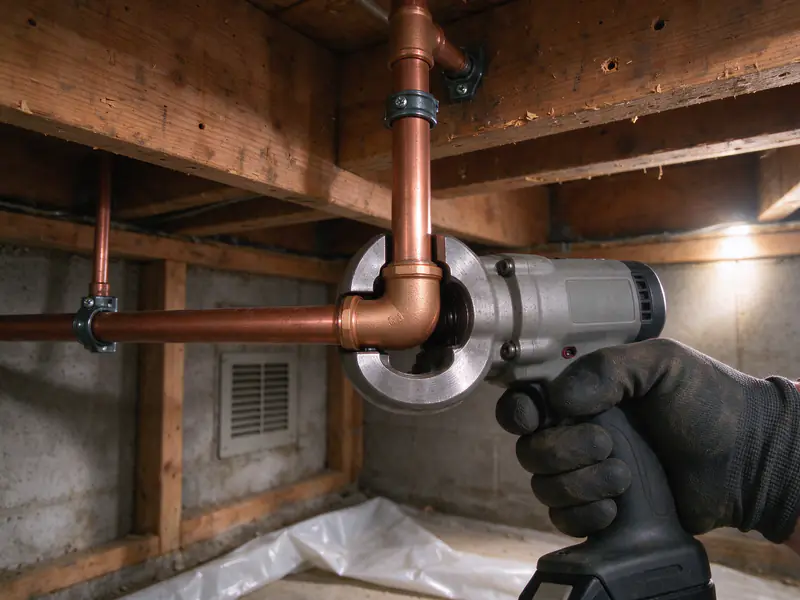
Battery press tool with its jaw closed around a copper elbow on a three-quarter inch line
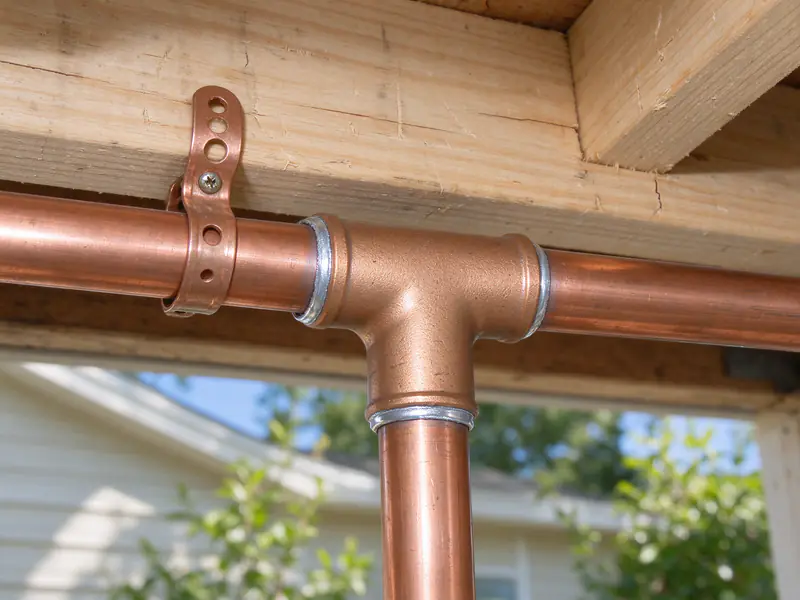
Freshly soldered copper tee with a clean, even solder line and no flux residue on the outside
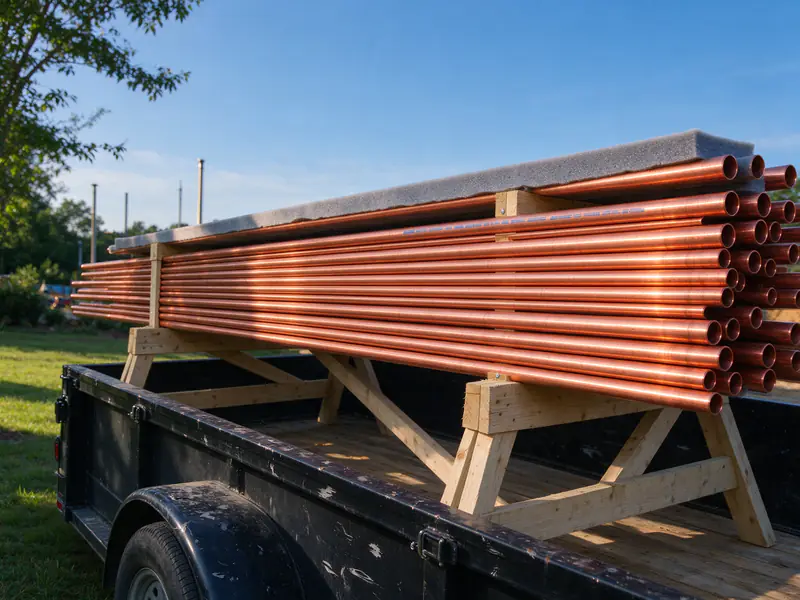
Lengths of copper tube, stacked on a padded rack
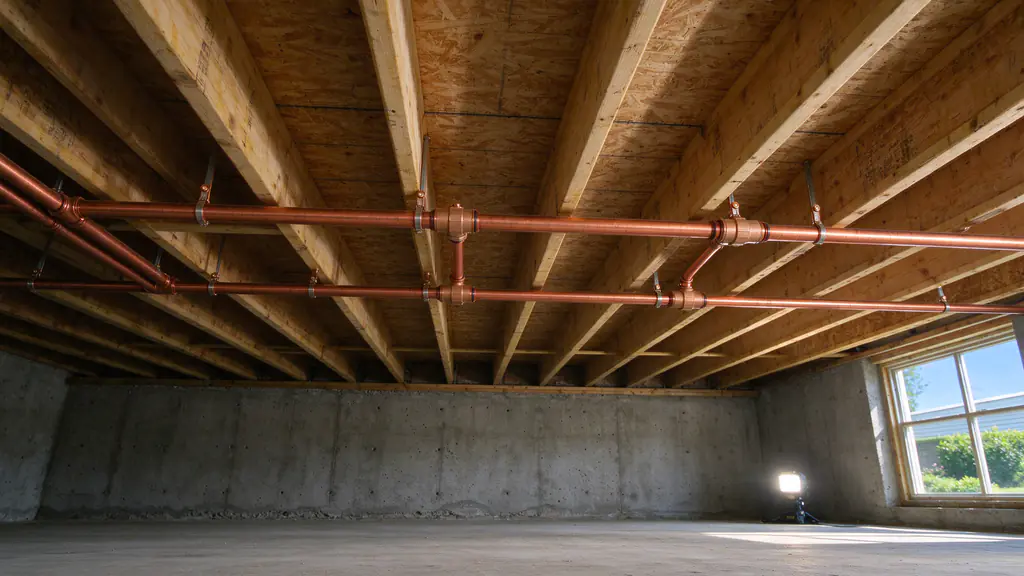
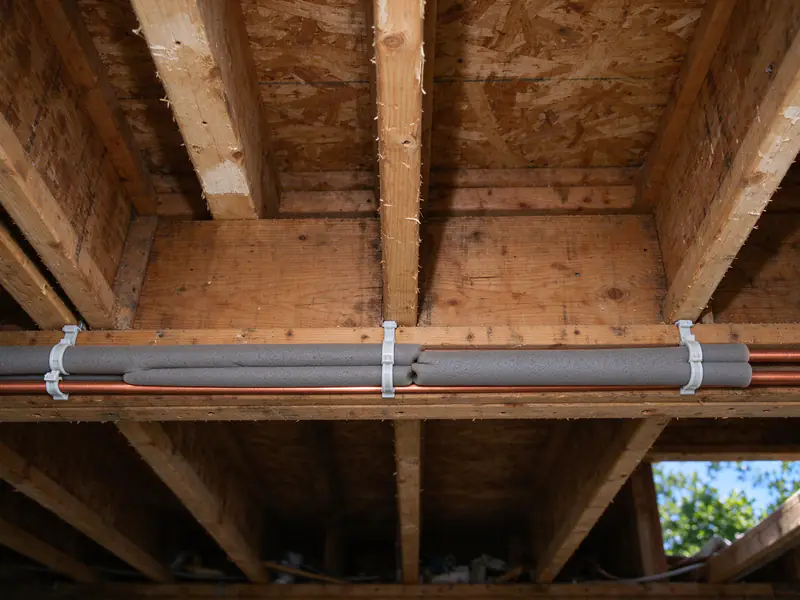
Copper hot and cold lines with foam insulation sleeves, clipped to joists in a crawl space
Want a copper repipe quote for your house?
Tell us the number of bathrooms, the foundation type, and whether you want Type L throughout or a mix of copper and PEX.
Is Type L or Type M copper used for a repipe in Charlotte?
Either can be, since both are listed for water distribution under the North Carolina code. Type L has a thicker wall and costs more; Type M is thinner and cheaper. When an owner is choosing copper for its long life, Type L is the usual choice. The written scope should name the type so two quotes can be compared fairly.
Are press fittings as reliable as soldered copper joints?
When they are listed for drinking water and installed correctly, yes. A press joint seals with an O-ring inside the fitting, crimped by a powered tool. It depends on clean, square, fully inserted tube and the right jaws. A soldered joint depends on clean metal, proper flux and even heat. Each fails when the workmanship slips, not because of the method itself.
Does Charlotte water cause pinhole leaks in copper pipe?
There is no public evidence that it does. Charlotte Water is soft and low in alkalinity, and the utility adds lime to raise its pH for corrosion control. Its tap sampling has reported copper results at or near the detection limit. Pinholes in a given house usually trace to several factors together, such as water velocity, leftover flux, installation or electrical faults.
Can a copper repipe use PEX inside walls and copper where pipe is exposed?
Yes. Some owners want copper where pipe can be seen, in a basement or at the water heater, and PEX where it runs through walls. Both materials are approved, and listed transition fittings join them. The scope should say where each material starts and stops, so the house is described accurately when it is sold.
Does new copper pipe have to be bonded to the electrical system?
Metal water piping is bonded to the electrical system under the electrical code, so a copper repipe keeps or restores that bond. In older houses the water pipe may also have served as part of the grounding path. Where the bond or grounding needs work, an electrician handles that part, and the scope says so.