160 psi Minimum working pressure rating for water service pipe at 73.4°F, with NSF 61 listing (NC Plumbing Code amendment)
12 Mecklenburg repipe permits from April 2025 to October 2026 that include water service work (Mecklenburg County)
About 40 Mecklenburg plumbing permits since 2024 that abandon a private well and connect a new city water service (Mecklenburg County)
66 Customer-side galvanized service lines marked for replacement out of 333,871 connections (Charlotte Water)
Last Updated:
Water line replacement in Charlotte usually means the water service line: the buried pipe that carries water from the meter at the street to the main shutoff in the house. Charlotte Water owns the main and the meter; the homeowner owns the line after the meter and everything inside. Level Repiping Charlotte arranges water service line replacements across Charlotte and the surrounding counties, performed by licensed and insured contractors, either on their own or alongside an interior repipe. This page covers how to tell the service line is the problem, how the work runs, and what changes the decision.
What the water service line is, and who owns it
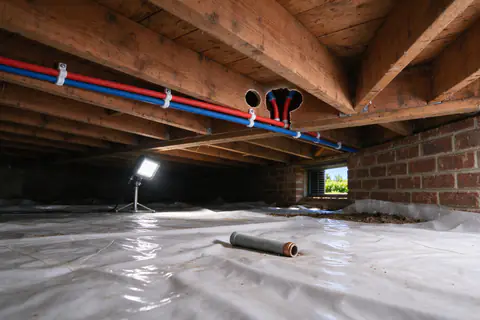
The water service line runs underground from the meter box, usually near the curb or the property line, to the point where the pipe enters the house through the crawl space wall, the slab or a basement wall. Inside, the main shutoff valve marks the start of the interior supply system.
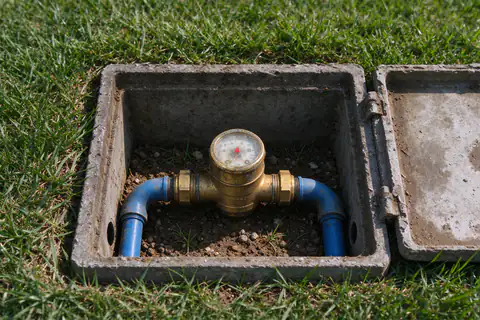
Charlotte Water draws the line of responsibility at the meter. It owns the main under the street, the line from the main to the meter, the meter and the meter box. The homeowner owns the tail piece on the house side of the meter, the shutoff valve, the line from the meter to the house and all interior plumbing. Charlotte Water says leaks inside a building or between the meter and the building are the customer’s to repair with a plumber. Our guide to who owns the water line in Charlotte covers that split in detail. Outside Charlotte Water’s area, the split is confirmed with the local utility, such as Two Rivers Utilities in Gastonia or the city system in Concord.
What happens on the first visit
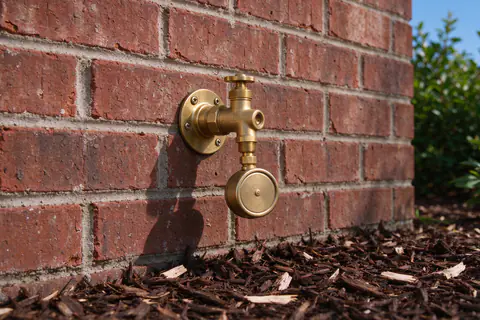
The first visit works out whether the problem really is the service line. With every fixture off, the meter should stand still. Closing the main shutoff at the house splits the system in two: if the meter keeps moving with the main closed, the loss is on the buried line or the valve; if it stops, the leak is inside, and the water leak detection process takes over.
For low pressure, the person assessing the house measures static pressure at a hose bib and looks at what the line is made of where it enters. A narrowed galvanized service line starves the whole house at once, unlike a failing interior pipe that hurts the farthest fixtures first. The low water pressure page covers the other causes that are checked before blaming the line.
The visit also traces the likely route from the meter to the house, notes driveways, walks, trees and landscaping in the way, and records where the line comes inside. Before any digging, a utility locate is requested so that gas, electric, cable and sewer lines are marked.
Why service lines fail
Galvanized steel service lines rust from the inside, which narrows the bore and eventually rusts through. Charlotte Water’s service line inventory lists 66 customer-side galvanized lines marked for replacement out of 333,871 connections, mostly in central and inner-ring neighborhoods. That is a small count, and it covers only Charlotte Water’s own records; other utilities keep their own inventories. The lead and galvanized service lines guide explains the inventory.
Polybutylene was used for service lines in the same era it was used inside houses, and it fails at fittings and from within. Copper and plastic lines can fail where they were damaged during later digging, where a fitting was poorly made, where a root has wrapped them, or where the ground has settled. Freezing is less of a risk for buried pipe than for pipe in a crawl space, but the short exposed section at the meter and where the line enters the house can still be hit in a hard freeze.
How the line is replaced
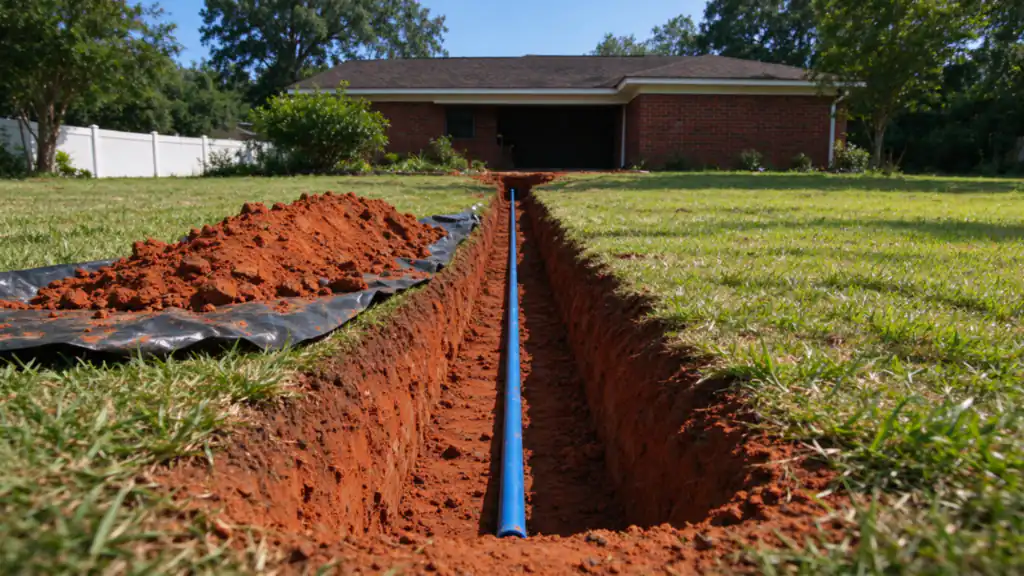
The new line follows the most practical route from the meter connection to the house. In the usual case a narrow trench is dug along that route, the new pipe is bedded and laid, and the trench is backfilled. Where the old line runs straight and the ground allows, the new line can sometimes be pulled along the old path from a pit at each end, which leaves far less lawn disturbed. Bends, rock, tree roots and other utilities decide whether that works.
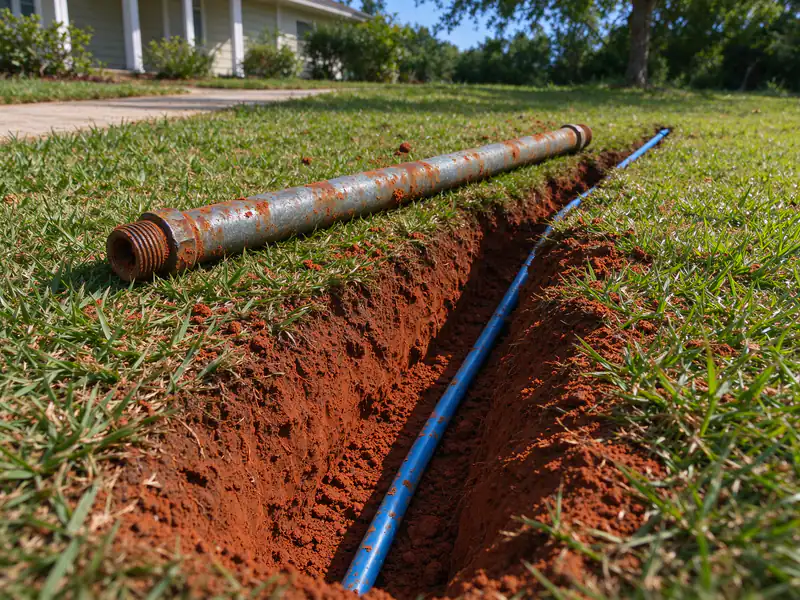
The ground matters. Much of the Charlotte area sits on Piedmont red clay, which is dense to dig, holds water after rain and turns sticky when wet. That affects how long a trench takes and how the backfill settles, which is why the scope says how the trench will be finished. It is not a reason a line fails on its own.
At the meter, the new line connects to the tail piece on the owner’s side. At the house, it rises through the foundation to a new main shutoff. Under the North Carolina amendments, water service pipe must be listed to NSF 61 and rated for at least 160 psi at 73.4°F, and a service material that is not certified for indoor distribution has to end 5 feet outside the foundation, at or before the full-open valve where the line enters. PEX, polyethylene and Type K copper are common choices; the scope names the one used and why.
Pressure, valves and the house connection
A new service line is the natural moment to deal with pressure. Charlotte Water reports pressure from about 40 psi on high ground to more than 100 psi in low areas near creeks, and it says county codes require a pressure-reducing valve on new or remodeled residential plumbing where pressure is above 80 psi. That valve sits either just behind the meter box or inside the house before the water heater, and Charlotte Water says it typically needs replacing in 7 to 12 years. Where a valve is added, an expansion tank usually comes with it. The high water pressure guide explains why.
Water line replacement with an interior repipe
The service line and the interior supply system are separate scopes. A whole house repipe starts at the main shutoff and does not include the buried line unless the estimate says so. They are often done together when the service line is galvanized or polybutylene, because new interior pipe fed by a narrowed or failing line still depends on that line. Of 81 Mecklenburg plumbing permits from April 2025 to October 2026 that describe a repipe, 12 include water service work.
Moving from a private well to city water
About 40 Mecklenburg plumbing permits since 2024 describe abandoning a private well and connecting to a city tap with a new water service line, most of them in Charlotte, Huntersville and Mint Hill. That work adds a new service line from the tap to the house, a tie-in where the well piping used to enter, and often a pressure-reducing valve and expansion tank, because city pressure can run well above what a well pump delivered. Closing the well itself falls under state well rules and is a separate scope; the well line replacement page covers the piping between a well and the house for owners staying on well water.
Permits and inspection
North Carolina requires a permit for installing or repairing plumbing under G.S. 160D-1110, with some single-family exemptions for work that does not change the plumbing design, so the permit question is confirmed per project. In Mecklenburg County, Code Enforcement issues plumbing permits for Charlotte and the six towns; the permit guide covers the process. In Fort Mill, the town’s residential inspection guide calls for water service piping with joints to be tested at 200 psi; that guide is written for new construction, so the test is confirmed per project. The new line is pressure tested before the trench is closed.
What moves the price
Water line replacement is quoted per job. The main drivers are the length of the run, the method (open trench or pulled line), what the trench crosses, the depth and the soil, the new material, the connection at the house, and whether a pressure-reducing valve or new main shutoff is added. Lawn, landscaping, driveway and walkway restoration are scoped separately, because they vary more from house to house than the pipe does. If the meter keeps moving with the main shut, or the yard stays wet along the line, call (704) 452-4386 or describe it through the estimate form.
What's included
What a water line replacement includes
A water line estimate should state the route and the restoration standard. Lawn, driveway and walkway repair are the parts most often left vague.
Confirmation that the leak or restriction is on the owner's side of the meter, using the meter and the main shutoff
A utility locate requested before any digging, so gas, power, cable and sewer lines are marked
A written scope naming the route, the new pipe material, the connection at the meter and the connection at the house
Trenching, or pulling the new line through the old route where the ground and the old pipe allow it
New water service pipe rated for service use, bedded and backfilled
A new main shutoff valve where the line enters the house
A pressure-reducing valve and expansion tank where street pressure calls for one
A pressure test before the trench is closed, then the inspection where a permit is pulled
Backfill and rough grading of the trench, with sod, landscaping and hard surfaces listed as included or excluded
The real choice
Repairing a section of the water service line or replacing all of it
A buried line can sometimes be repaired at one spot. The material and the age of the rest of the line usually decide whether that is worth doing.
Repairing a section of the water service line or replacing all of it
Repair one section
Replace the whole line
What happens
One hole is dug at the leak and the damaged length is cut out and spliced
A new line runs from the meter connection to the house, and the old one is abandoned
Digging
One excavation at the leak
A trench along the route, or pits at each end where the line can be pulled
Good fit
A single break on otherwise sound pipe, such as a line hit during other digging
Galvanized or polybutylene service pipe, repeat leaks, or flow loss along the whole run
Pressure and flow
Unchanged unless the leak itself was robbing pressure
Can restore flow where the old line was narrowed by corrosion
What it leaves
The rest of the old line, at its current age
Nothing of the old line in service
Both are quoted per job after the line is located and the cause confirmed.
Guides
Related resources
Guides that go deeper on water line replacement decisions.
Charlotte Water draws a clear line at the meter. Here is what the utility owns, what the property owner owns, how to tell which side a leak is on, and when the service line is worth replacing with a repipe.
Charlotte Water has classified every one of its service connections. Here is what the inventory says about lead and galvanized lines, what Lead Free CLT does, how to look up your address, and where lead can still hide inside a house.
Street pressure in Charlotte depends on how high your house sits. Here is what the 80 psi line means, how to read a gauge, why pressure creeps up overnight, and how a pressure-reducing valve and an expansion tank work together.
North Carolina law requires plumbing permits but exempts some single-family work. Here is how that exemption applies to a repipe, who is allowed to pull the permit, what Mecklenburg County charges, and how the inspection runs.
The typical Charlotte range for a whole house PEX repipe, why copper is quoted separately, how the Mecklenburg permit fee is set, and which parts of the job only a walk-through can price.
How it runs
How a water line replacement runs
The call or the form
The age of the house, the pipe you have seen, crawl space or slab, and what has been leaking.
The assessment
Pipe material, fixture count, access routes and street pressure, written up as a scope with a price.
The repipe
New lines are run, then connected to fixtures and the water heater, then pressure tested before walls are closed.
Inspection and patching
The permit office inspects the new piping; access openings in walls and ceilings are then patched to the agreed scope.
What this work looks like
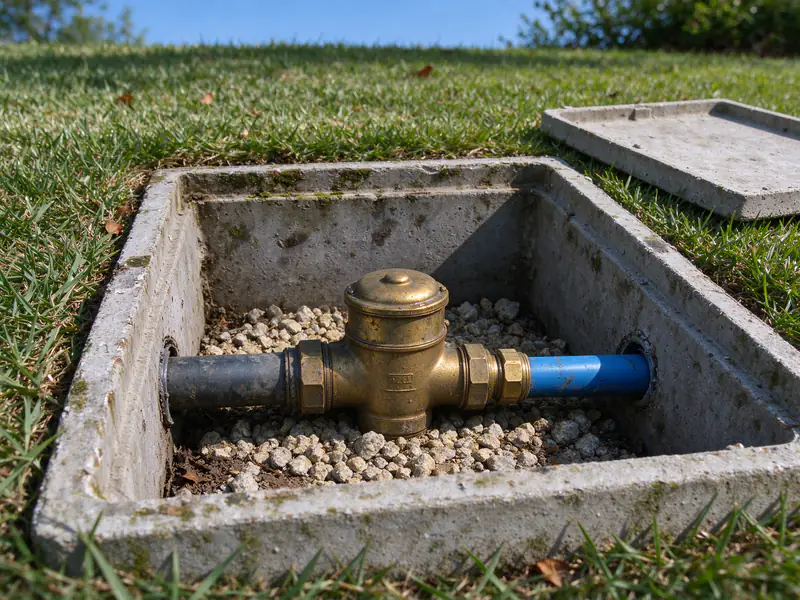
Open meter box at the edge of a lawn with a brass meter and a new blue service line connected on the house side
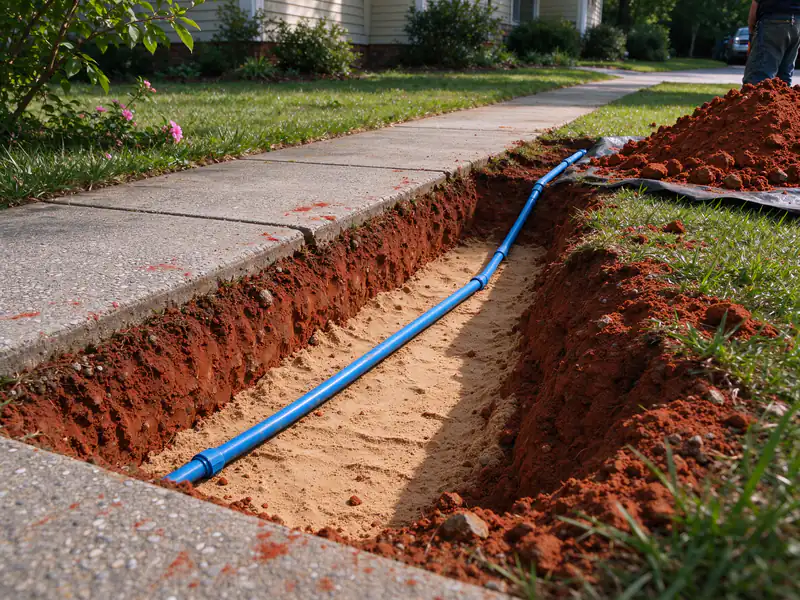
Trench in red clay soil beside a concrete walkway with a new blue PEX service line laid in sand bedding
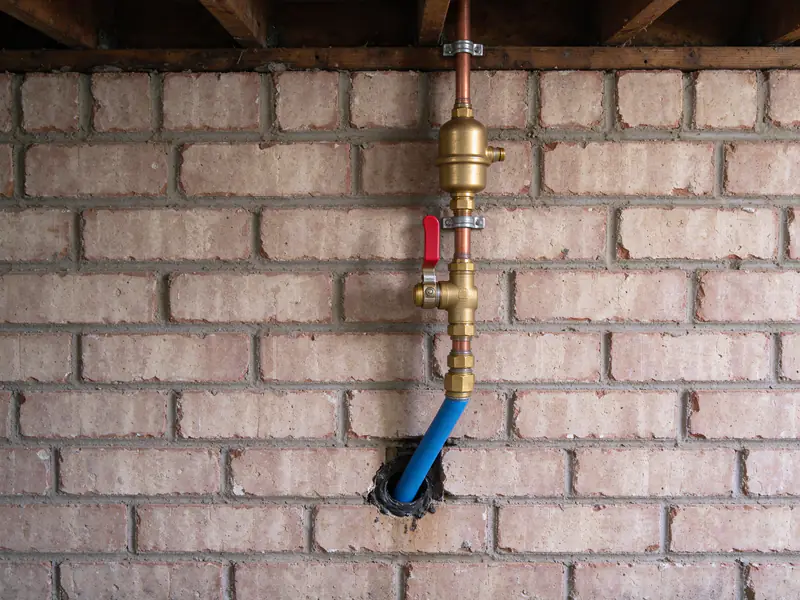
New water service line rising through a crawl space wall to a brass ball valve and pressure-reducing valve
Old rusted galvanized service pipe lying beside the trench after being cut out
Soggy yard or a meter that keeps turning?
Tell us where the meter sits, the rough distance to the house, and what the line is made of where it comes inside.
How can I tell if the leak is in the line between the meter and the house?
Close the main shutoff where the water enters the house and watch the meter. If it still moves, water is leaving between the meter and that valve, which is the buried service line or the valve itself. A soggy strip of lawn along the route, or a spot that stays green in dry weather, often marks it. If the meter stops, the leak is inside.
Does Charlotte Water pay to replace the service line on my side of the meter?
Generally not. Charlotte Water owns the main and the line up to the meter; the homeowner owns the shutoff, the line from the meter to the house and everything inside. Its Lead Free CLT program removes lead lines and galvanized lines that were downstream of lead, but its inventory found no lead service lines, so that program does not reach most houses.
What pipe is used for a new water service line in North Carolina?
Any material the North Carolina Plumbing Code lists for water service, provided it is rated for at least 160 psi at 73.4°F and listed to NSF 61. PEX, polyethylene and Type K copper are common choices. Some service materials are not approved for indoor distribution, and those must end 5 feet outside the foundation at or before the main valve.
Can the water service line be replaced without trenching the whole yard?
Sometimes. Where the old line runs straight and the ground allows, a new line can be pulled along the old route from pits at each end. Tree roots, rock, bends, buried utilities and the dense clay common around Charlotte can rule that out. The method is confirmed after the line and the other utilities are located.
Should the water service line be replaced at the same time as a repipe?
It often makes sense when the service line is galvanized or polybutylene, because new interior pipe fed by a narrowed or failing line still has a weak link. It is a separate scope with its own line on the estimate. If the service line is sound copper or plastic, it can stay.