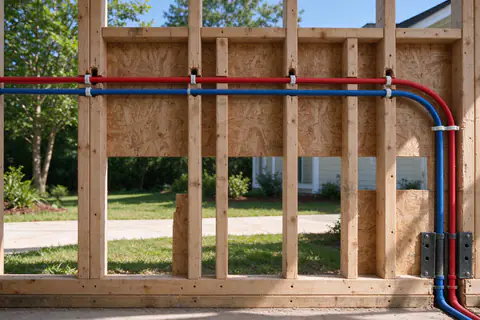
PEX manifold vs trunk and branch: which layout fits your house?
A repipe can feed fixtures from shared main lines with branches, or give each fixture its own line from a central manifold. The house's shape, where the water heater sits and what the owner wants to control decide which.
Last Updated:
Short answerIn a PEX manifold (home-run) layout, every fixture gets its own line from a central manifold with a shutoff for each. In trunk and branch, larger main lines run through the house and smaller branches tee off to fixtures. Manifolds use more tubing and fewer hidden fittings; trunk and branch uses less tubing and more joints.
PEX manifold vs trunk and branch is a layout decision, and it shapes how a repiped house works for decades: where the shutoffs are, how many hidden joints sit in the walls and how long the hot water takes to arrive. Level Repiping Charlotte arranges PEX repipes across Charlotte and the surrounding counties through licensed and insured contractors, in either layout or a mix of the two. This guide explains how each one works and what tips the choice.
Trunk and branch
Trunk and branch is how most houses have always been plumbed, including most copper and galvanized systems. A larger main line, the trunk, runs from the main shutoff and the water heater through the crawl space, attic or walls. Smaller branch lines tee off the trunk to each fixture or group of fixtures, and short stubs connect to each sink, toilet and tub.
Its strengths are economy and familiarity. It uses less tubing, because fixtures share the trunk. It works with PEX or copper. A bathroom group can be fed by one branch with short runs to each fixture.
Its drawbacks are the joints and the shared flow. Every branch is a tee, and tees sit hidden along the run, under floors and inside walls. When several fixtures draw water at once on the same branch, they share it, which is where the familiar shower that changes temperature when a toilet flushes comes from. Pressure-balancing shower valves deal with most of that, and correct sizing deals with the rest.
Home-run manifold
In a home-run layout, a manifold sits in one place: a bar with an inlet and a row of outlets, one for hot and one for cold. Each fixture gets its own line from the manifold, run in one continuous length of PEX with no joints in between. Most manifolds have a shutoff valve for each outlet, labeled by fixture.
Its strengths are control and fewer hidden joints. One fixture can be shut off without touching the rest of the house. The joints sit at the manifold and at the fixture, where they can be reached. Fixtures don’t share a branch, so simultaneous use affects each one less.
Its drawbacks are tubing and space. A home-run layout uses a lot more tubing, and the bundle of lines leaving the manifold needs a route through the framing. The manifold needs an accessible spot. And because each line is filled separately from the water heater, a fixture far from the manifold can wait longer for hot water than it would on a well-sized trunk.
Trunk and branch
Home-run manifold
Tubing used
Less
More
Hidden joints
A tee at every branch
Few or none between manifold and fixture
Shutoffs
Main shutoff plus a stop at each fixture
One per fixture at the manifold, plus fixture stops
Simultaneous use
Fixtures on a branch share flow
Each fixture has its own line
Hot water wait
Depends on trunk size and distance
Depends on each line’s length; far fixtures can wait longer
Materials
PEX or copper
PEX
Hot water wait: what actually changes it
Hot water wait depends on the volume of cold water sitting in the pipe between the water heater and the tap, which has to run out before hot water arrives. A long run of large pipe holds more water than a long run of small pipe. That is why a home run of 3/8-inch PEX to a nearby sink can deliver hot water quickly, while a long home run to a far bathroom may not. The same logic applies to an oversized trunk.
So layout influences wait time, but distance and pipe size decide it. Where a fixture is far from the water heater, a recirculation line or a pump keeps hot water close to the fixture, and that is a separate design choice. A repipe is a good time to add one, because the lines are open.
The hybrid most repipes use
Many repipes combine the two. A trunk runs from the water heater to a remote manifold near a bathroom group or a kitchen, and short home runs feed the fixtures from there. This keeps tubing reasonable, puts shutoffs near the fixtures they control and shortens the distance hot water travels.
The house’s shape usually decides where the line falls. A single-story crawl space ranch with fixtures spread from end to end often suits a trunk under the floor with branches up; the crawl space freezing guide covers protecting those runs. A two-story slab house rerouted through the attic often suits remote manifolds above each bathroom group. Mecklenburg assessor records show most local single-family homes built since 2000 sit on slabs, so attic routing is common in newer houses; see slab leak repair for how slab houses are rerouted.
Pressure, valves and the manifold
A manifold does not regulate pressure. If street pressure runs high, every line in either layout sees it. Charlotte Water says pressure across its system ranges from about 40 psi on high ground to more than 100 psi near creeks, and county codes require a pressure-reducing valve on new or remodeled residential plumbing where pressure is above 80 psi. The valve goes on the incoming line before the manifold or trunk; the high water pressure guide covers it.
Choosing for your house
Neither layout is right for every house. The assessment maps the fixtures, the water heater and the access routes, and the written scope names the layout and the location of any manifold. A whole house PEX repipe on a single-family home typically runs $4,000 to $12,000 or more in the Charlotte area, and the layout moves the price within that range: home runs use more tubing, trunk and branch uses more fittings. The repipe cost guide covers the other drivers.
Where does a PEX manifold go in a Charlotte house?
Somewhere accessible, near the water heater or the center of the fixtures it serves: a utility room, a closet wall, a garage wall or a crawl space near the access door. It needs to stay reachable for the shutoffs to be useful, and in an unconditioned crawl space or garage it is protected from freezing like any other water pipe.
Can an existing trunk and branch system be converted to a manifold during a repipe?
Yes. A whole house repipe replaces every supply line, so the new system can use any layout. A partial repipe is harder to convert, because the lines not replaced still branch off the old trunks. The layout is decided at the assessment and written into the scope.
Do manifold systems need bigger lines to each fixture?
Not usually bigger. Home-run lines are typically 3/8-inch or 1/2-inch PEX sized to each fixture's demand under the plumbing code, fed from a larger supply to the manifold. Because each line serves one fixture, sizing is per fixture rather than for a group sharing one branch.
Get an Estimate for PEX repipe
Tell us the age of the house, the pipe you have seen and what is going wrong. Or call.
Both are approved under the North Carolina Plumbing Code. The house, the routes the pipe has to take and what the owner values decide between them, not a rule of thumb.
The two common types of PEX differ in how they are crosslinked, how flexible they are and which fittings they take. The fitting system and the installer's tools often matter more than the letter.
The three supply pipes found in older Charlotte-area houses, how each one was meant to work and how it fails, the signs that point to the pipe rather than something else, the rules and insurance questions around replacement, and what each scope leaves behind.
A repipe runs in stages, and most of them happen with the water still on. Here is what each stage involves, what makes one house take longer than another, and when you will actually be without water.
Street pressure in Charlotte depends on how high your house sits. Here is what the 80 psi line means, how to read a gauge, why pressure creeps up overnight, and how a pressure-reducing valve and an expansion tank work together.