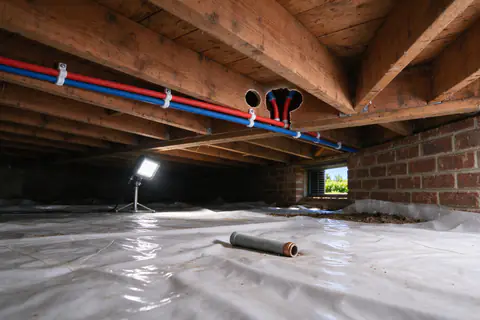
The three supply pipes found in older Charlotte-area houses, how each one was meant to work and how it fails, the signs that point to the pipe rather than something else, the rules and insurance questions around replacement, and what each scope leaves behind.
Last Updated:
Short answerRepipe a house when the supply pipe itself is the problem: polybutylene in any condition you are not willing to live with, galvanized steel that has narrowed or started leaking, or copper with repeat pinhole leaks across different runs. One leak, low pressure from the street or a failed valve calls for repair and measurement first.
Knowing when to repipe a house comes down to one question: is the trouble in a part of the plumbing, or in the pipe itself? Level Repiping Charlotte arranges whole house repipes and partial repipes across Charlotte, the Mecklenburg towns, Gaston and Cabarrus counties and the South Carolina towns south of the line, carried out by licensed and insured contractors. This guide covers the three old supply pipes found in Charlotte-area houses, how each one fails, the signs worth acting on, the rules and insurance questions, and what each scope choice leaves in the walls.
The short answer
A whole house repipe makes sense in four situations:
The house has polybutylene supply pipe and the owner, a buyer or an insurer is not willing to keep it.
The house has galvanized steel that has narrowed inside, runs brown after sitting or has started to leak at the threads.
Copper has had pinhole leaks on more than one run, or repeat leaks on the same run, within a short span.
A remodel, a slab leak or a sale has already opened the house, and the remaining pipe is one of the above.
It does not make sense when one joint failed on otherwise sound pipe, when the pressure problem starts at the street, or when the cause of a leak or discolored water hasn’t been found. The repipe or repair guide covers that boundary in detail.
Three pipes, three eras
Most supply pipe in Charlotte-area houses falls into one of three materials, and the era of the house is the first clue to which one is behind the walls. Charlotte is a young housing market: the city’s median home was built in 1995, and only 10.4% of homes were built before 1960, according to the U.S. Census Bureau’s American Community Survey. That shapes which pipe problems are common.
Material
Typical era in local houses
What it looks like
How it usually fails
Galvanized steel
Houses built before copper took over, mostly before the 1960s
Dull gray metal, threaded joints, a magnet sticks
Rusts inside, narrows, leaks at threads
Copper
From the 1950s on, and the common choice for decades
Reddish-brown metal, soldered joints, a magnet does not stick
Pinhole leaks, worn elbows, joint failures
Polybutylene
Late 1970s to the mid-1990s
Gray (sometimes white or black) flexible plastic, often printed “PB2110”
Fitting and crimp failures, cracking from within
CPVC, a cream or tan rigid plastic, also appears in houses from the 1980s on; the CPVC guide covers it. If you are not sure what you have, the pipe identification guide walks through what to look for at the water heater, the main shutoff and under the sinks.
Polybutylene: why it was used and why it fails
Polybutylene was a flexible gray plastic sold from the late 1970s into the mid-1990s as a cheaper, faster alternative to copper. It coiled, bent around framing and joined with crimped fittings instead of solder, which made it attractive for the subdivisions and condominiums going up around Charlotte in those years. Mecklenburg County building permits show how much of it went into multi-unit buildings: between 2010 and 2013, 1,114 permits described replacing water lines in condominiums and apartments, 531 of them naming polybutylene, concentrated in ZIP codes 28212, 28210 and 28215.
The early systems used plastic (acetal) fittings; later systems used copper or brass fittings with aluminum or copper crimp rings. Failures came from both directions. Oxidants used to disinfect public water can attack the plastic over time, from the inside, so the pipe can look fine on the outside while the inner wall turns brittle. The fittings and crimp rings were a second weak point: a ring crimped too tight or too loose, or a plastic fitting that cracked, could fail without warning. That is why a polybutylene system with no leak history is still treated as a risk by inspectors and insurers: nothing visible tells you how much life is left.
Do all polybutylene systems fail? Nobody can answer that for a particular house. Homeowners report that plumbers, inspectors and agents disagree, with some saying brass-fitted systems that have lasted this long will keep lasting and others saying the question is when, not whether. What can be checked is the fitting type, the leak history, how the line from the meter is made, and how the water heater is connected. What cannot be checked is the condition of the pipe wall from the inside.
A national class-action settlement paid for many polybutylene replacements in the 1990s and 2000s. Homeowners report its claim windows closed years ago, so a repipe today is paid for by the owner. The polybutylene pipe replacement page covers the replacement work itself.
Galvanized steel: rust from the inside
Galvanized pipe is steel with a zinc coating. It was the standard supply pipe in many houses built before copper became common, and it was strong, cheap and joined with threads that any plumber could cut. The zinc layer protects the steel only while it lasts. Once it is used up, the steel itself corrodes, and the rust builds up as lumps (tuberculation) on the inner wall. The bore narrows, flow drops first at the fixtures farthest from the meter, and water that sits overnight can come out brown.
The threads are the thinnest part of the pipe, so leaks often start at joints. A galvanized pipe can look sound on the outside while the inside is badly restricted, so the outside of the pipe proves little either way.
Galvanized pipe in Charlotte is concentrated in the oldest neighborhoods. Mecklenburg County assessor records show average build years of 1932 for Dilworth II, 1938 for Midwood II and 1943 for Elizabeth, with nine in ten or more of those homes on crawl spaces. Charlotte Water’s service line inventory lists 66 galvanized service lines that need replacing, mostly in central and inner-ring Charlotte; the lead and galvanized service line guide explains that program. Interior galvanized pipe is the owner’s. See galvanized pipe replacement for the work.
A partial galvanized repair has a catch. Where new copper meets old steel, the two metals need a proper dielectric transition, or the joint corrodes faster. And when old galvanized pipe is cut or jarred, rust scale breaks loose and can travel into aerators, valve cartridges and the water heater, which is why a galvanized repipe includes flushing the new lines before fixtures are reconnected.
Copper: long-lived, but not immune
Copper became the common supply pipe from the middle of the last century, and plenty of Charlotte houses still run on their original copper without trouble. It resists corrosion in most water, joins with solder or press fittings and handles heat well. It is still approved and still installed.
Copper does fail. The usual signs are pinhole leaks, green spots along a run, and worn elbows on hot water lines. The causes include pitting corrosion, erosion from fast-moving water (especially in hot water lines and recirculating systems), water chemistry, stray electrical current, leftover flux and the thinner wall of Type M tube. No single cause explains every case. Charlotte Water adds lime to raise the pH of its water to control corrosion, and its tap sampling shows low copper levels, so local water is context rather than a diagnosis. The copper pinhole leaks guide goes into the mechanisms.
One pinhole is a repair. A second and third on different runs within a year or two suggests the pipe wall is thinning across the system, and that is when a copper repipe or a PEX repipe enters the conversation.
Signs worth acting on, and signs that point elsewhere
Several symptoms look like old pipe but have other causes. The order of checking matters, because a repipe that doesn’t address the real cause leaves the symptom in place.
What you notice
What it can mean
What gets checked first
Weak flow at several fixtures
Narrowed galvanized pipe, or street pressure, a failing pressure-reducing valve or a half-closed shutoff
Static pressure at a hose bib, the main shutoff and the valve
Brown water after sitting
Galvanized corrosion, or the water heater, or utility work on the main
Whether it is hot only, cold only or both, and whether it clears
A second pinhole leak in copper
Thinning pipe wall on that run or across the system
Where the leaks are, hot or cold, and the condition of nearby pipe
A leak at a polybutylene fitting
The fitting, the crimp ring or the pipe beside it
The fitting type and every other fitting that can be reached
A high water bill with no visible leak
A private leak inside the house or on the line from the meter
The water meter with every fixture off; see leak detection
Banging pipes
Fast-closing valves, high pressure or loose supports
Pressure, supports and the valves that slam
Charlotte Water says pressure ranges from about 40 psi on high ground to more than 100 psi in low areas near creeks, and its leading explanation for a high bill is a private leak. Pressure above 80 psi strains every joint in the house, old or new; the high water pressure guide explains the valve that controls it. On the other end, low water pressure has several causes, and replacing pipe fixes only one of them.
Act soon when water is reaching framing, ceilings or electrical fixtures, when a polybutylene fitting has already failed, or when a slab floor has a warm spot (see signs of a slab leak). Plan rather than rush when the issue is flow, discoloration or a single repaired pinhole: those leave time for an assessment and a written scope.
Why age alone is not the answer
There is no universal lifespan for supply pipe. Copper in one house lasts for decades, and copper of the same age a mile away develops pinholes because of how it was installed, how fast the water moves or how the hot water system is set up. Galvanized pipe ages at a rate set by the water and by how much of the zinc was there to begin with. Polybutylene’s risk is less about age than about the material and its fittings.
So the age of the house points to a likely material, and the material, the leak history and the condition of what can be seen decide the question. Building age is context, not a diagnosis of a particular house.
The rules: permits, licenses and what no law requires
No North Carolina or South Carolina law requires an owner to replace polybutylene or galvanized pipe in an existing house. What the law covers is how replacement is done.
Licensing. Under G.S. 87-21, anyone paid to install, alter or restore plumbing in North Carolina needs a license from the State Board of Examiners of Plumbing, Heating and Fire Sprinkler Contractors. Class I covers all buildings; Class II covers single-family detached dwellings. In South Carolina, residential plumbing work over $500 needs a Residential Plumber license from the state’s Residential Builders Commission.
Permits. G.S. 160D-1110 requires a permit to install, extend or generally repair a plumbing system, and exempts work of $40,000 or less in a single-family home unless it adds to or changes the design of the plumbing. Whether a particular repipe needs a permit is confirmed for each project. Mecklenburg County Code Enforcement issues plumbing permits for Charlotte and the six towns; the permit guide covers fees and inspections.
Homeowner permits. In Mecklenburg, a homeowner permit is for an owner who lives in the house and does the work personally. An owner hiring a contractor should not pull one; the licensed contractor does.
Code details. The North Carolina code requires at least R-6.5 insulation or heat on water pipe in unconditioned attics and crawl spaces (amendment 305.4), and Charlotte Water notes that county codes require a pressure-reducing valve on new or remodeled residential plumbing where pressure is above 80 psi.
Fort Mill lists re-piping among the projects that need a permit and air tests interior water lines at 200 psi. Rock Hill and Lancaster County run their own permit offices, so their requirements are confirmed per project.
Insurance and selling a house
Insurers set their own rules on old pipe. Some will not write a new policy on a house with polybutylene, some ask questions, and some do not care. Homeowners report all three. Many homeowners policies treat sudden water damage differently from the gradual wear of an old pipe, and the replacement of the pipe itself is usually the owner’s cost. The repiping insurance guide covers what to ask your insurer, and the polybutylene insurance guide covers the gray pipe specifically.
For buyers, the North Carolina Real Estate Commission says the mere presence of polybutylene is not a material fact unless an agent knows or should know of a probable defect, and it suggests buyers discuss the pipe with their insurer before making an offer. The guide to buying a house with polybutylene covers due diligence, credits and timing.
What an assessment looks at
An honest repipe recommendation is built from evidence gathered in the house. The process runs in four steps:
The call or the form. The age of the house, the pipe you have seen, crawl space or slab, and what has been leaking.
The assessment. The person assessing the house maps the pipe material at the main shutoff, the water heater and every exposed run; counts the fixtures; works out access routes through the crawl space, attic and walls; and measures street pressure at a hose bib. The result is a written scope with a price.
The repipe. New lines are run while the old system still works, fixtures are moved over to the new pipe, and the new system is pressure tested before walls are closed.
Inspection and patching. Where a permit is pulled, the permit office inspects the new piping; access openings are then patched to the written scope.
The assessment also settles the details that change the scope: whether the line from the meter is the same failing material, whether the water heater connections and the main shutoff should be replaced, and whether a pressure-reducing valve and an expansion tank are needed.
The service line is polybutylene, galvanized or leaking
A whole house repipe covers supply pipe only. Drains are a separate system with separate failure modes, covered on the drain line replacement page. The water service line from the meter is the owner’s under Charlotte Water’s rules but is a separate underground run, and it appears as its own line on an estimate; see who owns the water line.
How the replacement runs in Charlotte houses
The foundation shapes the job. Mecklenburg assessor records show that 94% of single-family homes built in the 1950s and 95% of those built in the 1960s sit on crawl spaces, while 71% of those built in the 2000s and 82% of those built since 2020 sit on slabs.
In a crawl space house, new lines run along the floor joists and come up through the floor behind each fixture, so first-floor fixtures often need small openings or none. In a slab house, new lines run through the attic and drop down inside interior walls, and the old lines under the slab are abandoned in place. A two-story house needs lines brought up through walls, closets or chases to the upper fixtures, which usually means more openings. Interior walls in most Mecklenburg houses are drywall, but some older houses have plaster or plywood paneling, which changes how openings are patched; the drywall guide covers that.
Pipe in a vented crawl space or an unconditioned attic is exposed to cold. Charlotte averages about 58 nights a year at or below freezing (NOAA 1991-2020 normals), and hard freezes such as 9°F on December 24, 2022 and 10°F on February 2, 2026 are why the insulation rule exists. New pipe in the same cold spot can freeze like the old one did; the crawl space freezing guide explains the protection.
Most families stay in the house during a repipe. The water is off while fixtures are moved from the old pipe to the new, and the written scope says when that is. The repiping process guide covers timing.
Choosing the new pipe and layout
Both PEX and copper are approved under the North Carolina Plumbing Code, and neither is the right answer for every house. PEX bends around framing in long runs with few joints, which suits crawl spaces and attics; copper suits owners who want metal pipe and takes more fittings and labor. The PEX vs copper guide sets out the trade-offs, the PEX-A vs PEX-B guide covers the two common types of PEX, and the manifold vs trunk and branch guide covers the two ways to lay out the lines. The PEX repipe page describes the installation.
Living with old pipe until you repipe
If the decision is to wait, a few steps reduce the damage a failure can do:
Find the main shutoff and make sure it closes fully. A worn gate valve that won’t close turns a small leak into a large one.
Measure the street pressure. If it runs above 80 psi, a pressure-reducing valve lowers the strain on every joint, old or new.
Insulate exposed pipe in the crawl space and attic before the first hard freeze.
Check the water meter with every fixture off now and then. A moving dial points to a hidden leak.
On polybutylene, check every reachable fitting under sinks, at the water heater and in the crawl space for white residue, staining or drips.
Replacing visible polybutylene fittings is a question homeowners ask often. It addresses one failure point and leaves the pipe itself, so it is a stopgap rather than a fix.
What it costs
A whole house PEX repipe on a single-family home typically runs $4,000 to $12,000 or more in the Charlotte area. Larger homes, two-story homes and slab homes run higher, and copper is quoted per house. The repipe cost guide explains the drivers, and the repipe assessment quiz gives a quick read on whether your symptoms point to the pipe.
Next step
If you know the material and the leak history, you have most of what an estimate needs. Send the year the house was built, crawl space or slab, and what has failed, or call (704) 452-4386 to talk it through before anyone visits.
Questions
More questions on this
Does a Charlotte house built in the 1990s need repiping just because of its age?
No. Age is a clue to the material, not a verdict. A house from the early 1990s may have polybutylene, CPVC or copper, and each behaves differently. Identify the pipe first, then look at the leak history and the fittings. A 1990s house with copper and no leaks has no reason to be repiped on age alone.
Can a repipe be done in stages, starting with the worst runs?
Yes, as a partial repipe, but each stage leaves old pipe in service and adds a joint between old and new material. Staging suits copper with a leak pattern confined to one area. It suits polybutylene and galvanized less well, because the material is the same throughout and the remaining runs carry the same risk.
Is it worth repiping a house you plan to sell in a few years?
It depends on the pipe and the buyers you expect. Homeowners ask whether a repipe pays for itself at sale, and there is no reliable local figure for that. What a repipe does is take an inspection finding and an insurance question off the table. If you would rather leave the decision to the buyer, a written scope with a price gives them a number instead of a worry.
Get an Estimate for whole house repipe
Tell us the age of the house, the pipe you have seen and what is going wrong. Or call.
One leak on sound pipe is a repair. A pattern of leaks, or a pipe with a known failure history, is a question about the whole system. The evidence that separates the two is usually in the house.
Five supply pipes turn up in Charlotte-area houses. Color, joints, markings and a magnet tell most of them apart in a few minutes, as long as you look in more than one place.
Polybutylene usually turns up in the inspection report, partway through due diligence, with an offer already on the table. Here is what to confirm, who to call, and how buyers handle it, in the order the clock allows.
Copper fails from the inside, usually at one spot first. The cause can be the water, the speed it moves, how the pipe was installed or the tube itself, and often more than one of those at once.
The typical Charlotte range for a whole house PEX repipe, why copper is quoted separately, how the Mecklenburg permit fee is set, and which parts of the job only a walk-through can price.