What should you know before buying a house with polybutylene pipes?
Polybutylene usually turns up in the inspection report, partway through due diligence, with an offer already on the table. Here is what to confirm, who to call, and how buyers handle it, in the order the clock allows.
Last Updated:
Short answerBuying a house with polybutylene pipes is common in Charlotte's 1980s and early 1990s neighborhoods and condos. Confirm the pipe and its extent, call your insurer before you commit, and get a written repipe scope during due diligence. Then decide between a price reduction or credit, a seller-arranged repipe, or walking away.
Buying a house with polybutylene pipes is a familiar situation around Charlotte, where many subdivisions and condominiums went up while the gray pipe was in use. Level Repiping Charlotte arranges polybutylene pipe replacement across Charlotte and the surrounding counties through licensed and insured contractors, and buyers often call with an inspection report in hand and a due-diligence deadline days away. This guide covers what to check, in the order the clock allows.
Why it shows up so often around Charlotte
Polybutylene was installed in many houses from the late 1970s to the mid-1990s. About 30% of Charlotte’s homes were built between 1980 and 1999, according to the U.S. Census Bureau’s American Community Survey, and Mint Hill and Matthews have median build years of 1992 and 1994. Not every house from those years has polybutylene, but enough do that buyers in those neighborhoods should expect the question.
Condos and townhomes are a large part of the story. Mecklenburg County permits from 2010 to 2013 record more than a thousand water line replacements in condominium and apartment buildings, concentrated in ZIP codes 28212, 28210 and 28215, many naming polybutylene. A condo buyer should ask whether the building has already been repiped, and whether the pipe inside the unit is the owner’s or the association’s; see condo repiping.
Step 1: confirm what is actually there
Inspection reports sometimes call gray pipe polybutylene without much detail. Before negotiating, confirm:
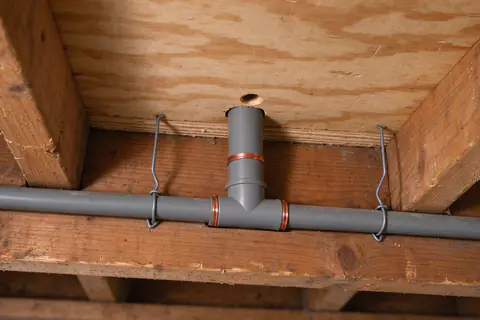
The material. Polybutylene is flexible gray plastic, often printed “PB2110.” Gray PEX can look similar, and the printing settles it. The pipe identification guide shows what to look for.
The extent. Is it the whole supply system, or a remnant left after an earlier partial repipe? Look at the water heater, the main shutoff, under sinks and in the crawl space or attic.
The fittings. Plastic fittings, or copper and brass with crimp rings. Homeowners report that some inspectors treat the fitting type as the main risk; it is one factor, and the pipe itself is another.
The water service. Whether the line from the meter to the house is polybutylene too. That line is the owner’s in Charlotte and is quoted separately; see water line replacement.
The history. Whether the seller knows of leaks or repairs. Fresh patches in ceilings below bathrooms are worth asking about.
Step 2: call the insurer before you commit
The North Carolina Real Estate Commission addresses this directly. In its bulletin on polybutylene, the Commission says the mere presence of polybutylene is not a material fact that agents must disclose, unless the agent knows or should know of a probable defect, and that buyer’s agents may advise clients to discuss the matter with their insurer before making an offer.
That call matters because insurers differ. Homeowners report that some carriers would not write a policy on a house with polybutylene, some needed to be asked specifically, and some didn’t care. Ask your carrier in writing whether it will insure the house as it is, whether it will cover water damage from the pipe, and whether that changes after a repipe. The polybutylene insurance guide lists the questions.
Step 3: get a written scope during due diligence
North Carolina’s standard offer to purchase gives the buyer a due-diligence period, and that is the window for getting real numbers. A written scope with a price shows what a repipe would include: every supply line, the fixtures, the water heater connections, the main shutoff, the access openings, the patching and, if needed, the line from the meter.
For budgeting, a whole house PEX repipe on a single-family home typically runs $4,000 to $12,000 or more in the Charlotte area; larger, two-story and slab homes run higher. Homeowners report wide spreads between quotes for the same house. Ask each contractor what is included, particularly patching, so you compare the same work. The repipe cost guide explains the drivers.
Step 4: decide how to handle it
Buyers handle polybutylene in one of four ways.
Option
How it works
Worth knowing
Price reduction or credit
The seller lowers the price or credits the buyer, and the buyer repipes after closing
Lenders can limit how much a seller can credit; ask your loan officer
Seller repipes before closing
The seller arranges the work, under a permit, before closing
Ask for the written scope, the permit and the final inspection; you don’t choose the contractor
Buy as is
The buyer accepts the pipe, with the insurer’s answer in hand
Plan the repipe for later, and know where the main shutoff is
Walk away
The buyer terminates during due diligence
Timing and any fees are set by the contract; your agent explains them
Homeowners report that plumbers disagree about whether a polybutylene house without leaks needs repiping, and that some buyers’ requests for credits have been questioned by sellers. A written scope from a walk-through is the strongest basis for any request, because it describes the work for that house rather than a general fear.
In South Carolina
Buyers in Fort Mill, Tega Cay, Rock Hill and Indian Land work under South Carolina contracts and practice, which handle inspections and repairs differently. The pipe questions are the same: confirm the material, call the insurer and get a written scope. Residential plumbing work over $500 in South Carolina is done under a state Residential Plumber license; see the Fort Mill service area page.
After you close
If you repipe after closing, the work runs like any other: an assessment, new lines run while the old system still works, a pressure test before walls close, inspection by the permit office, and patching to the written scope. Most families stay in the house during a repipe, though an empty house is easier. The guide on when to repipe a house covers the wider decision.
If your due-diligence date is close, call (704) 452-4386 with the address and the inspection findings.
Questions
More questions on this
Should a polybutylene repipe be done before moving in?
If you plan to repipe, an empty house is the easiest time. Furniture doesn't have to be moved away from walls, the water can be off without disrupting a household, and patching and paint can happen before you unpack. It also means the new pipe is in place before your first winter in the house.
How can a buyer check a seller's polybutylene repipe before closing?
Ask for the written scope, the invoice naming the new material, and the permit with its final inspection where one was pulled; Mecklenburg County posts inspection results online. Then look at the pipe at the water heater, the main shutoff and under the sinks, and check that the access openings were patched as the scope said.
Can a buyer's lender or loan program refuse a house because of polybutylene?
Buyers ask this about FHA and VA loans in particular. Lending and appraisal requirements are set by each program and lender and can change, so ask your loan officer directly, early in due diligence. Some buyers' questions about lending come back to the insurance answer, which is why the insurer call comes first.
Get an Estimate for polybutylene pipe replacement
Tell us the age of the house, the pipe you have seen and what is going wrong. Or call.
Each insurer sets its own rules on polybutylene. Some write the policy, some ask questions, some decline. The answer that counts is your carrier's, in writing, and the paperwork from a repipe is what changes it.
Five supply pipes turn up in Charlotte-area houses. Color, joints, markings and a magnet tell most of them apart in a few minutes, as long as you look in more than one place.
The three supply pipes found in older Charlotte-area houses, how each one was meant to work and how it fails, the signs that point to the pipe rather than something else, the rules and insurance questions around replacement, and what each scope leaves behind.
A policy usually pays for the damage a sudden leak causes, not for replacing the old pipe. Where a repipe helps is with the insurer's view of the house, and that depends on the carrier.
The typical Charlotte range for a whole house PEX repipe, why copper is quoted separately, how the Mecklenburg permit fee is set, and which parts of the job only a walk-through can price.