How much does it cost to repipe a house in Charlotte?
The typical Charlotte range for a whole house PEX repipe, why copper is quoted separately, how the Mecklenburg permit fee is set, and which parts of the job only a walk-through can price.
Last Updated:
Short answerA whole house PEX repipe on a single-family home typically costs $4,000 to $12,000 or more in the Charlotte area. Larger homes, two-story homes and slab homes run higher. Copper costs more and is quoted per house. The Mecklenburg County plumbing permit is a separate county fee, and wall patching depends on access.
How much does it cost to repipe a house in Charlotte? For a whole house PEX repipe on a single-family home, the typical range is $4,000 to $12,000 or more. Level Repiping Charlotte publishes that range because a number on the page is more useful than a promise to call. This guide explains where a house falls in it, why copper is quoted separately, how the county permit fee is calculated, and which parts of the price only a walk-through can settle.
The typical Charlotte range
Scope
Typical Charlotte-area range
Whole house PEX repipe, single-family home
$4,000 to $12,000+
Larger, two-story or slab home
Toward the top of the range or above it
Whole house copper repipe
Quoted per house
Mecklenburg County plumbing permit
County fee schedule (below)
The range is open at the top on purpose. A large two-story house on a slab, with several bathrooms and finished ceilings between floors, can run past $12,000. A small crawl space ranch with one bathroom sits near the bottom. The figure is a typical market range for the Charlotte area, not a quote and not a fixed price.
What moves the price
What changes
Why it matters
Bathrooms and fixtures
Each sink, toilet, tub, shower, hose bib and appliance is a run of pipe and a connection
Crawl space or slab
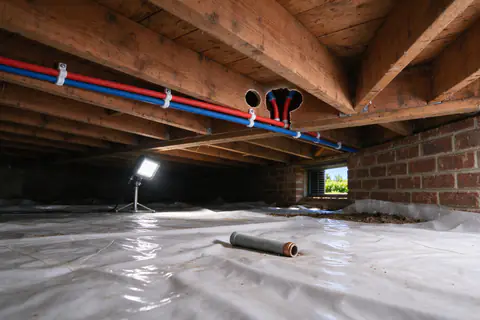
Crawl space lines run under the floor; slab houses are rerouted through the attic and walls
Stories
Upper floors need lines brought up through walls, closets or chases
Finished ceilings between floors
More openings to reach second-floor fixtures, and more patching
PEX or copper
Copper costs more to buy and to install; see copper repipe
Layout
Home runs from a manifold use more tubing; trunk and branch uses more fittings
A pressure-reducing valve, a new main shutoff or new fixture stops add parts and time
Patching standard
Closed and ready for paint costs less than fully finished
Two of these deserve a closer look in Charlotte. The foundation is the big one, and the slab leak repair page explains how slab houses are rerouted. About 94% of Mecklenburg single-family homes built in the 1950s and 95% of those built in the 1960s sit on crawl spaces, according to county assessor records, while 71% of those built in the 2000s sit on slabs. A crawl space house is usually the cheaper house to repipe. The second is pressure. Charlotte Water’s pressure runs from about 40 psi on high ground to more than 100 psi in low areas near creeks, and the county requires a pressure-reducing valve on new or remodeled plumbing where it is above 80 psi. If your street runs high, the valve belongs in the estimate; the low water pressure page covers the other end of the problem.
What’s inside a Charlotte repipe price
A repipe price is made of labor, material, the permit and the parts of the job that depend on the house. Some of those have public figures. Some don’t.
Part of the price
What sets it
Local figure
Labor
Hours on site, set by fixtures, foundation and stories
Insulation on pipe in unconditioned attics and crawl spaces
At least R-6.5 (NC Plumbing Code amendment 305.4)
Pressure control
A pressure-reducing valve where street pressure is above 80 psi
Required on remodeled plumbing (Charlotte Water)
Wall and ceiling patching
Number of openings and the finish standard
No public figure; scope to check
Water service line
Length and depth of the run from the meter
No public figure; quoted separately
Charlotte’s median plumber wage sits about 8% below the national median. A wage is not a billing rate: the hourly rate a contractor bills also carries licensing, insurance, vehicles, tools and overhead, so it is always higher than the wage. The comparison explains why Charlotte prices are not higher than national figures; it does not turn hours into a price.
The Mecklenburg permit fee
Mecklenburg County Code Enforcement issues plumbing permits for Charlotte and the six towns. Its fee ordinance, revised July 1, 2026, sets fees by permit value:
Permit value
Fee
$1 to $3,000
$59.70 minimum
$3,001 to $50,000
$59.70 plus $12.19 per $1,000 over $3,000
All permits
Plus a $3 technology charge
The same ordinance charges renovation and alteration projects per trade and by the square footage of the space altered, so the county decides which basis applies to a particular repipe. A permit pulled by a homeowner doing their own work in a home they live in costs $60 per trade plus $45 per inspection trip, but homeowners hiring a contractor should not use a homeowner permit; the licensed contractor pulls it. North Carolina also exempts some like-for-like replacements under $40,000 in a single-family home from permits, so whether a repipe needs one is confirmed for each project. The permit guide covers the rules.
Outside Mecklenburg, Gaston County, Cabarrus County and the South Carolina towns set their own fees. See the Gastonia and other service area pages.
Incentives and insurance
No federal, state or utility program pays homeowners to repipe a house. Charlotte Water’s Lead Free CLT program replaces lead or galvanized service lines at homes the utility selects, and its inventory lists no lead service lines and 66 galvanized lines needing replacement. Interior piping is the owner’s.
Homeowners insurance usually covers sudden water damage, not the replacement of old pipe, and polybutylene houses get the most questions. Whether an insurer requires polybutylene to be replaced is set by each insurer, so ask yours. Our repiping and insurance guide goes further.
Getting a number for your house
The repipe cost estimator places your house in the typical range from the details above, without a phone call. A written estimate from a walk-through settles the rest: the access routes, the patching standard and the valves. For more on the job itself, see the whole house repipe page, or call (704) 452-4386.
Questions
More questions on this
Is polybutylene replacement priced differently from a whole house repipe?
No. Replacing polybutylene means replacing the whole supply system, so it is the same scope as a whole house repipe and falls in the same typical range for PEX. The difference sits in the details: polybutylene houses are usually from the late 1970s to the mid-1990s, so many are slab or crawl space houses of ordinary size.
Why is copper quoted per house instead of as a range?
Copper costs more than PEX for material, and copper prices have moved sharply: the government's producer price index for copper mill shapes rose about 30% between September 2025 and September 2026. Copper also takes more labor, because every change of direction needs a fitting. With both moving, a quote for the actual house is more honest than a published range.
Does the price include patching the walls?
Only to the extent the written scope says. Some estimates include closing openings ready for paint, some include finished patching, and some leave it out. Ask for the patching standard in writing, because it is one of the parts of the job with no public figure to compare against.
Get an Estimate for whole house repipe
Tell us the age of the house, the pipe you have seen and what is going wrong. Or call.
The three supply pipes found in older Charlotte-area houses, how each one was meant to work and how it fails, the signs that point to the pipe rather than something else, the rules and insurance questions around replacement, and what each scope leaves behind.
Both are approved under the North Carolina Plumbing Code. The house, the routes the pipe has to take and what the owner values decide between them, not a rule of thumb.
North Carolina law requires plumbing permits but exempts some single-family work. Here is how that exemption applies to a repipe, who is allowed to pull the permit, what Mecklenburg County charges, and how the inspection runs.
Every repipe needs some access. How many openings a house needs depends on its foundation, its stories and where the fixtures sit, and how they are closed depends on a patching standard that belongs in writing.
One leak on sound pipe is a repair. A pattern of leaks, or a pipe with a known failure history, is a question about the whole system. The evidence that separates the two is usually in the house.