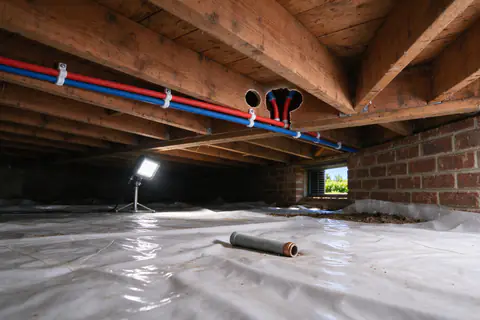
A policy usually pays for the damage a sudden leak causes, not for replacing the old pipe. Where a repipe helps is with the insurer's view of the house, and that depends on the carrier.
Last Updated:
Short answerUsually not. Homeowners policies are generally written to cover sudden water damage, such as a burst fitting soaking a ceiling, while replacing aging pipe is treated as the owner's maintenance. Some policies pay to open and close a wall to reach a covered leak. A repipe may improve insurability or terms, at the carrier's discretion.
Is repiping covered by homeowners insurance? In most cases, no: the policy is built to pay for sudden water damage, and replacing pipe that has worn out is treated as the owner’s maintenance. Level Repiping Charlotte arranges whole house repipes across Charlotte and the surrounding counties through licensed and insured contractors, and this guide explains where insurance usually stops, where it may help, and how a repipe can change the conversation with a carrier.
What a policy is usually built to cover
Homeowners policies generally distinguish between sudden, accidental events and gradual deterioration. A fitting that lets go and floods a bathroom ceiling is sudden. A pinhole that seeped into a wall cavity for months is gradual. Policies are usually written to pay for the first and to leave the second, along with wear and tear, to the owner.
Cost after a leak
How policies commonly treat it
Water damage to ceilings, walls, floors and contents from a sudden leak
Usually covered, subject to the deductible and the policy terms
Opening and closing a wall or slab to reach a covered leak
Covered by some policies, limited by others
Repairing or replacing the pipe that failed
Usually the owner’s cost
Damage from a slow or repeated leak
Often excluded as gradual
Mold from long-running moisture
Often limited or excluded
A whole house repipe
The owner’s cost
Every policy reads differently, so the table is a guide to the questions, not to your coverage. The wording in your policy decides.
Why the repipe itself is the owner’s
Insurers treat plumbing like a roof: it ages, and replacing it at the end of its life is maintenance. Polybutylene, galvanized steel and copper with repeat pinholes are all known aging patterns, so a carrier won’t usually pay to replace them before they fail, and after a failure it usually pays for the damage rather than the pipe. No federal, state or utility program pays homeowners to repipe either; Charlotte Water’s Lead Free CLT program replaces certain service lines, not interior pipe.
How water damage happens in Charlotte houses
The way a leak happens affects how a claim is handled.
A fitting fails. Polybutylene fittings and crimp rings can let go without warning, and a supply line under pressure can release a lot of water quickly. That is typically sudden damage.
A pinhole seeps. Copper pinholes often spray a fine stream inside a wall or under a floor, where it can run unnoticed. If the damage looks long-running, the carrier may call it gradual. The copper pinhole leaks guide explains why they repeat.
A pipe freezes. Charlotte averages about 58 nights a year at or below freezing (NOAA 1991-2020 normals), and nights such as 9°F on December 24, 2022 split pipes in crawl spaces and exterior walls. The crawl space freezing guide covers protection.
Pressure strains every joint. Charlotte Water says pressure across its system reaches more than 100 psi near creeks, and county codes require a pressure-reducing valve on new or remodeled plumbing above 80 psi. See the high water pressure guide.
When water is coming out, shut the main valve first, then photograph the damage before cleanup, and call the carrier. Leaks between the meter and the house, or inside it, are the owner’s under Charlotte Water’s rules; see who owns the water line.
Does repiping lower insurance?
It can, depending on the carrier. Some insurers ask about the age and type of plumbing when they write or renew a policy, and some decline houses with polybutylene or old galvanized pipe, or attach conditions. Replacing the supply pipe can make a house eligible with a carrier that would otherwise decline it, or improve the terms. Whether it lowers the premium is each carrier’s decision. Ask yours before the work, so you know which documents it wants afterward.
The invoice or scope naming the new material, the address and the date, and saying which pipe was replaced. A partial repipe should say what stayed.
The permit and final inspection record, where a permit was pulled. Mecklenburg County Code Enforcement posts inspection results online; the permit guide explains when one applies.
Photos of the new pipe at the water heater and main shutoff.
The same documents help when you sell.
Planning the cost yourself
Because the repipe is usually the owner’s cost, the budget matters. A whole house PEX repipe on a single-family home typically runs $4,000 to $12,000 or more in the Charlotte area; larger, two-story and slab homes run higher, and copper is quoted per house. The repipe cost guide explains the drivers, and the repipe or repair guide helps decide whether a repipe is needed yet.
If a leak has already been through a claim and you want the pipe dealt with, call (704) 452-4386.
Questions
More questions on this
Will an insurer pay to patch the drywall opened to reach a leak?
Some policies pay to open and restore a wall or ceiling to reach a covered leak, and some limit it. That is different from the access openings made during a planned repipe, which are part of the owner's project and are patched to the written scope. Check the access wording in your policy.
Do repeated pinhole leaks affect a homeowners insurance claim?
They can. A carrier may treat damage from a slow or repeated leak as gradual rather than sudden, and policies commonly exclude gradual damage. Repeated water claims can also follow a house on the claims history reports insurers use. Fixing the cause, rather than patching one leak at a time, is part of the answer.
Will an insurer pay for frozen pipe damage in a crawl space?
Many policies cover sudden damage from a pipe that freezes and bursts, often on the condition that the owner kept the house heated or took reasonable steps to protect the plumbing. A vacant house can be treated differently. North Carolina's code requires R-6.5 insulation or heat on pipe in unconditioned crawl spaces, which also helps the claim conversation.
Get an Estimate for whole house repipe
Tell us the age of the house, the pipe you have seen and what is going wrong. Or call.
Each insurer sets its own rules on polybutylene. Some write the policy, some ask questions, some decline. The answer that counts is your carrier's, in writing, and the paperwork from a repipe is what changes it.
One leak on sound pipe is a repair. A pattern of leaks, or a pipe with a known failure history, is a question about the whole system. The evidence that separates the two is usually in the house.
Copper fails from the inside, usually at one spot first. The cause can be the water, the speed it moves, how the pipe was installed or the tube itself, and often more than one of those at once.
The three supply pipes found in older Charlotte-area houses, how each one was meant to work and how it fails, the signs that point to the pipe rather than something else, the rules and insurance questions around replacement, and what each scope leaves behind.
The typical Charlotte range for a whole house PEX repipe, why copper is quoted separately, how the Mecklenburg permit fee is set, and which parts of the job only a walk-through can price.