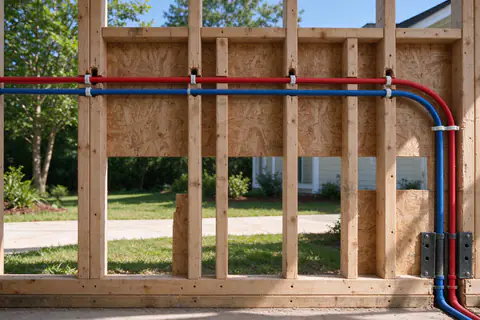
Charlotte freezes most winters and sees a hard freeze every few years. Here is why crawl space and attic pipes are the ones that split, what the state code requires, and what helps before and after a cold night.
Last Updated:
Short answerKeep cold air off the pipe. Pipes in a crawl space freeze when outside air reaches them through foundation vents, gaps and the rim joist. North Carolina's code requires at least R-6.5 insulation or heat on water pipe in unconditioned crawl spaces and attics. Sealing air leaks and dripping exposed lines on hard-freeze nights help too.
Frozen pipes in a crawl space are a Charlotte winter problem, not just a mountain one. The city freezes on most winter nights in an average year, and every few years a hard freeze reaches single digits. Level Repiping Charlotte arranges repipes and pipe repairs across Charlotte and the surrounding counties through licensed and insured contractors, and new lines through crawl spaces and attics are insulated to North Carolina’s code. This guide explains why crawl space and attic pipes freeze, what the code requires, and what to do before and after a cold night.
How cold Charlotte gets
Charlotte’s winters are mild by national standards, but they are not frost-free. NOAA’s 1991-2020 climate normals for Charlotte Douglas International Airport show:
Measure
Average per year
Nights at or below 32°F
58.3
Nights at or below 20°F
7.2
Nights at or below 10°F
0.5
Days when the high stays at or below 32°F
1.1
An ordinary freeze rarely hurts pipe that is insulated and out of the wind. The damage comes on the outliers. NOAA’s daily records for the airport show 6°F on January 7, 2014, 7°F on February 20, 2015, a run of 8°F to 12°F nights in early January 2018, 9°F on December 24, 2022 with a high of only 29°F, and 10°F on February 2, 2026. A night like December 24, 2022, when the temperature never rose above freezing during the day, gives a crawl space no chance to warm up.
Why crawl space pipes freeze
Most older Charlotte houses sit on vented crawl spaces. About 94% of Mecklenburg single-family homes built in the 1950s and 95% of those built in the 1960s are on crawl spaces, according to county assessor records. A vented crawl space is open to outside air on purpose, so it can dry out in summer. In winter that same air moves across the pipes.
Pipes rarely freeze in the middle of a crawl space, where the ground gives off some warmth and the floor above leaks heat downward. They freeze where cold air moves fastest: next to foundation vents, along the rim joist at the edge of the house, near the access door, and on the short runs out to hose bibs. Lines that carry little water, like a hose bib supply or a little-used guest bath, freeze before lines that are used every day. Old galvanized and polybutylene lines in these spots carry extra risk because their joints are already weak.
Moving cold air matters more than the thermometer. A pipe in still air at 25°F can last a night; the same pipe in a draft from an open vent at 25°F can freeze in hours.
Attic pipes in slab houses
Slab houses have the opposite routing. When a slab house is repiped, or when its original lines run overhead, the supply pipe often runs through the attic and drops down inside walls. An attic is unconditioned too, and on a clear winter night it can be colder than outside air.
The fix is placement as much as insulation. Pipe laid on the ceiling drywall and covered by the attic’s blown-in insulation stays on the warm side, close to the heated rooms below. Pipe hung high in the rafters, above the insulation, sits in the coldest part of the attic. The same applies to pipes in exterior walls, which North Carolina’s code says must sit on the heated side of the wall insulation. The slab leak repair page explains why slab houses are rerouted through the attic in the first place.
What North Carolina’s code requires
North Carolina’s Plumbing Code amendment 305.4, in effect since January 1, 2021, sets three rules that matter here:
Water pipe may not be installed outside, in unconditioned attics, unconditioned utility rooms or other places subject to freezing unless it is protected by at least R-6.5 insulation, heat, or both.
Water pipe in exterior walls must sit on the heated side of the insulation.
Exterior water supply pipe must be at least 6 inches below the frost line and at least 12 inches below grade.
A vented crawl space counts as unconditioned, so pipe there needs the insulation. A sealed and conditioned crawl space can be treated differently, but whether a particular crawl space counts as conditioned is confirmed for each house, not assumed. On a whole house repipe, insulation is part of the scope and part of what the inspector checks.
How ice splits a pipe
When water freezes it expands by about a tenth of its volume. Ice forming in a pipe pushes water ahead of it toward a closed faucet, and pressure builds in that trapped section until something gives. That is why a pipe often splits a short distance away from the coldest spot, and why a split often shows up only after the thaw, when water flows again.
Pipe also expands and contracts with ordinary temperature changes. Plastic pipe lengthens noticeably when hot water runs through it and shortens again as it cools, so PEX and CPVC need room to move at supports and turns. Old CPVC becomes brittle with age and cracks more easily in the cold. Copper can split outright. PEX stretches somewhat and often survives a freeze that would split copper, but its fittings can still fail, and it is not freeze-proof. New material alone does not remove freeze exposure. Insulation, air sealing and routing do. The PEX vs copper guide compares the materials in more detail.
Before a hard freeze
Close or cover foundation vents in a vented crawl space for the cold spell, and open them again afterward.
Close the crawl space access door and seal gaps around pipes where they pass through the rim joist.
Disconnect garden hoses and use the hose bib’s shutoff inside, if it has one.
Open sink cabinet doors on exterior walls so room heat reaches the pipes.
Let a thin stream run from the faucet farthest from the main on the coldest nights. Moving water is slower to freeze, and an open faucet relieves pressure if ice forms.
Know where the main shutoff is and make sure it turns.
If a pipe freezes
If a faucet gives a trickle or nothing on a cold morning, assume a frozen section rather than a pressure problem. Leave the faucet open. Warm the likely spot gently with a hair dryer, a space heater kept well clear of anything that can burn, or warm towels. Never use an open flame. If you find a split, or water appears as the pipe thaws, shut off the main right away.
After a hard freeze, check for hidden leaks once temperatures rise. With every fixture off, a moving water meter means water is escaping somewhere. In a crawl space house, look for wet insulation, puddles and drips near vents and the rim joist. For leaks you can’t find, see the water leak detection page.
When freeze damage points to a bigger job
One split hose bib line is a pipe repair. Repeated freezes in the same runs, splits in old polybutylene or brittle CPVC, or a crawl space where the pipe was never insulated suggest the routing itself is the problem. A PEX repipe can move lines away from vents and the rim joist, put them on the heated side of the insulation and insulate them to R-6.5, which deals with the cause rather than one split. The when to repipe guide covers how to tell the difference. To talk about pipes in your crawl space or attic, call (704) 452-4386.
Questions
More questions on this
Should crawl space vents be closed during a Charlotte winter?
In a vented crawl space, closing or covering the foundation vents during a hard freeze cuts the cold air that reaches the pipes, and many vents are made to close for that reason. Open them again when the weather warms so the crawl space can dry. A sealed, conditioned crawl space is designed differently and has no vents to close.
Does PEX survive a freeze better than copper?
PEX stretches a little as ice forms, so it often survives a freeze that would split rigid copper. It is not freeze-proof: fittings can fail, and repeated freezing still stresses the system. North Carolina's code requires the same insulation on PEX as on copper in unconditioned spaces.
How do I find a crawl space leak after a hard freeze?
Once temperatures rise, turn off every fixture and watch the water meter. If it keeps moving, water is leaving somewhere. Then look and listen at the crawl space hatch, check the ground under hose bibs and look for wet insulation or puddles. A split pipe often leaks only after it thaws.
Get an Estimate for PEX repipe
Tell us the age of the house, the pipe you have seen and what is going wrong. Or call.
Both are approved under the North Carolina Plumbing Code. The house, the routes the pipe has to take and what the owner values decide between them, not a rule of thumb.
The three supply pipes found in older Charlotte-area houses, how each one was meant to work and how it fails, the signs that point to the pipe rather than something else, the rules and insurance questions around replacement, and what each scope leaves behind.
Five supply pipes turn up in Charlotte-area houses. Color, joints, markings and a magnet tell most of them apart in a few minutes, as long as you look in more than one place.
A leak under a concrete floor rarely announces itself. Here are the signs that point to one, the ordinary things that cause the same signs, and the simple test that tells you whether water is leaving the house at all.
Street pressure in Charlotte depends on how high your house sits. Here is what the 80 psi line means, how to read a gauge, why pressure creeps up overnight, and how a pressure-reducing valve and an expansion tank work together.