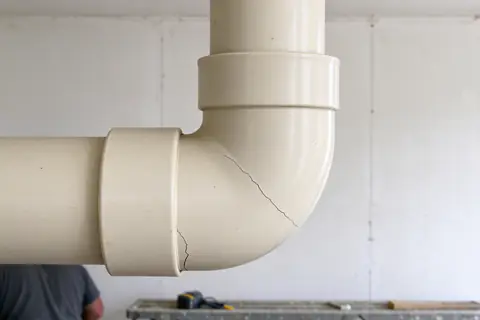
CPVC is an approved water pipe, not a defective one. But it ages, it becomes brittle, and brittle CPVC cracks in ways that make repairs harder each time. Here is how to tell which situation you are in.
Last Updated:
Short answerNo. CPVC is an approved hot and cold water pipe under the North Carolina Plumbing Code. Older CPVC can turn brittle, though, and brittle CPVC cracks when it is bent, struck, frozen or exposed to incompatible chemicals. One failed joint is usually a repair; pipe that keeps cracking is a reason to replace it.
Is CPVC pipe bad? Not as a material. CPVC is approved for hot and cold water supply under North Carolina’s plumbing code, and many houses run on it without trouble. The problem is age: older CPVC can turn brittle, and brittle pipe cracks. Level Repiping Charlotte arranges CPVC pipe replacement, repairs and whole house repipes across Charlotte and the surrounding counties through licensed and insured contractors. This guide explains why CPVC becomes brittle, what speeds it up, and how to decide between a repair and replacement.
What CPVC is
CPVC, short for chlorinated polyvinyl chloride, is a rigid plastic pipe made for drinking water. It is usually cream, tan or off-white, marked along its length with its size and standard, and joined with solvent cement that chemically welds each pipe into its fitting. The added chlorine lets it handle hot water that ordinary PVC can’t. It became a common alternative to copper because it is light, doesn’t corrode and goes together without a torch.
In the Charlotte area it shows up in houses from several eras, sometimes as the original supply pipe and sometimes as repairs or additions spliced into polybutylene or copper. Homeowners in the region report CPVC as common in local repipes. If you’re not sure what you have, the identify your pipe material guide shows how to tell CPVC from polybutylene and PEX.
Why CPVC becomes brittle
New CPVC flexes a little. Over many years, especially with hot water running through it, it loses that give and becomes more glass-like. Brittle pipe still holds water at normal pressure. It just stops tolerating stress, and the house supplies plenty of it.
The things that turn brittleness into cracks:
Heat and age. Hot lines age faster than cold ones, and the hottest stretch is near the water heater.
Thermal movement. CPVC lengthens as hot water runs and shortens as it cools. Where a run has no room to move, at a tight support or a short offset, the stress concentrates at fittings.
Incompatible chemicals. Some spray foams, fire-stop caulks, thread sealants, insecticides and the plasticizers in certain cable jackets can cause environmental stress cracking when they touch CPVC under load. Pipe manufacturers publish compatibility lists for this reason.
Installation stress. Pipe forced into a bend, fittings that were not fully seated, or the wrong cement leave built-in stress that shows up years later.
Impact and freezing. A bump while working in a crawl space, or a freeze, can crack brittle pipe that would have flexed when new. The frozen crawl space pipes guide covers cold-weather exposure.
High pressure. Street pressure above 80 psi adds load to every joint; the high water pressure guide explains how to check it.
Signs your CPVC has turned brittle
What you notice
What it can mean
A hairline crack at a fitting, often near the water heater
Heat-aged pipe under stress at a joint
A repair leads to a new leak nearby
The pipe is cracking from the handling during the repair
Pipe snaps or shatters when cut
Advanced brittleness
Several leaks in different places over a short period
A system-wide condition, not one bad joint
One leak at one fitting after years of none
Possibly a single failed joint
Color is not a reliable guide. CPVC can darken or yellow with age and heat without being badly brittle, and pale pipe can be brittle. The behavior of the pipe when it is worked on tells more than its appearance. One leak doesn’t prove the whole system is failing; repeat cracks in different places point that way.
A partial repipe can make sense when the brittleness is concentrated, such as the hot side. It is worth being clear about what it leaves behind: the old CPVC still in service ages on its own schedule, and the scope should say exactly which runs are replaced and which remain. Our repipe or repair guide walks through the wider decision.
Brittleness also changes how repairs are done. Cutting brittle CPVC with a saw or ratchet cutter can crack it; a wheel-type tubing cutter is gentler. Each new fitting is a point where a crack can start, which is why a run with several old repairs often makes more sense to replace than to keep patching.
What replaces CPVC
Most CPVC replacement in the Charlotte area uses PEX or copper. PEX flexes, runs long distances with few joints and tolerates movement, which suits crawl spaces and attics. Copper is rigid metal with the longest track record. Neither is the right choice for every house; the PEX vs copper guide sets out the differences. Mecklenburg permit records from April 2025 to October 2026 include one repipe described as CPVC to PEX, along with 17 that name PEX as the new material.
Before deciding
Start by finding out what you have and where it has failed. Note where each leak was, whether it was hot or cold, and whether any came after a repair. Check the street pressure at a hose bib. Then compare the cost of continuing to repair with the cost of replacing; the repipe cost guide gives the typical Charlotte range for a whole house PEX repipe. To talk through the CPVC in your house, call (704) 452-4386.
Questions
More questions on this
Can new PEX be connected to old CPVC?
Yes. Transition fittings join PEX to CPVC, and that is how a partial repipe or a repair ties into the old system. The risk is the CPVC itself: if it is brittle, cutting it or putting a new fitting on it can start a crack nearby. Where the old pipe is brittle, the tie-in point is chosen carefully or the run is replaced back to sound pipe.
Why does CPVC crack near the water heater first?
Hot water is the main factor in CPVC losing flexibility over the years, and the lines near the water heater carry the hottest water most often. Those lines also move the most as they heat and cool, and they are close to the heater's own heat. So the first brittle pipe and the first cracks often show up there.
Is yellowed CPVC pipe a sign it is failing?
Not reliably. CPVC is often cream or tan to begin with, and it can darken or yellow with age and heat, but color alone doesn't measure brittleness. The more telling signs are hairline cracks at fittings, cracks that appear after a repair, and pipe that snaps or shatters when cut instead of cutting cleanly.
Get an Estimate for CPVC pipe replacement
Tell us the age of the house, the pipe you have seen and what is going wrong. Or call.
Five supply pipes turn up in Charlotte-area houses. Color, joints, markings and a magnet tell most of them apart in a few minutes, as long as you look in more than one place.
One leak on sound pipe is a repair. A pattern of leaks, or a pipe with a known failure history, is a question about the whole system. The evidence that separates the two is usually in the house.
Both are approved under the North Carolina Plumbing Code. The house, the routes the pipe has to take and what the owner values decide between them, not a rule of thumb.
Charlotte freezes most winters and sees a hard freeze every few years. Here is why crawl space and attic pipes are the ones that split, what the state code requires, and what helps before and after a cold night.
The typical Charlotte range for a whole house PEX repipe, why copper is quoted separately, how the Mecklenburg permit fee is set, and which parts of the job only a walk-through can price.