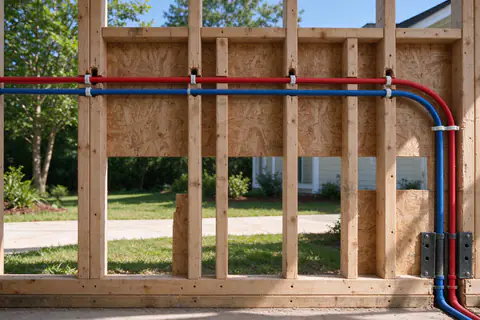
Both are approved under the North Carolina Plumbing Code. The house, the routes the pipe has to take and what the owner values decide between them, not a rule of thumb.
Last Updated:
Short answerPEX suits most Charlotte repipes because it bends through crawl spaces, attics and walls in long runs with few joints, which means fewer openings and a lower price. Copper suits owners who want rigid metal pipe and accept more fittings, more labor and a higher, per-house quote. Neither is best for every house.
PEX vs copper is the first material decision in almost every repipe, and the honest answer is that it depends on the house. Level Repiping Charlotte arranges PEX repipes and copper repipes across the Charlotte area through licensed and insured contractors, and both materials are approved under the North Carolina Plumbing Code. This guide sets out how each one works, where each fails, and which conditions push the choice one way.
How the two materials differ
PEX is crosslinked polyethylene: a plastic tube whose molecules are chemically bonded into a network, which lets it handle hot water and pressure without softening. It comes in coils, bends around obstacles and runs from the main to a fixture in one length. Joints sit only where the tube branches or connects.
Copper is rigid tube in straight lengths. Every change of direction needs an elbow or tee, joined by soldering or by press fittings crimped with a powered tool. Residential repipes usually use Type L, which has a thicker wall than Type M.
PEX
Copper (Type L)
Joints
Few: branches and connections only
One at every turn, branch and connection
Routing
Pulled through joists and walls in long lengths
Planned in straight runs with fittings
Openings
Often fewer
Often more
Layout
Trunk and branch, or home runs from a manifold
Trunk and branch
Freeze behavior
Flexes somewhat; can still split, and fittings can fail
Rigid; splits when water inside freezes
Main risks
Sunlight, heat sources, chewing, poor fittings
Pinholes, erosion, water chemistry, poor joints
Price
Typical Charlotte range published
Higher; quoted per house
Neither material is freeze-proof. North Carolina’s code requires at least R-6.5 insulation or heat on water pipe in unconditioned attics and crawl spaces (amendment 305.4), whichever pipe is used.
Where plastic pipe fits in
PEX is one of several plastic supply pipes, and owners sometimes lump them together. Polybutylene, the gray pipe installed from the late 1970s to the mid-1990s, is a different plastic with a known failure history and is no longer made; see the pipe identification guide to tell the two apart. CPVC is a rigid plastic joined with solvent cement, which can turn brittle with age; the CPVC guide covers it. PEX is flexible and joined with mechanical fittings. Of the 81 Mecklenburg County plumbing permits issued between April 2025 and October 2026 that describe a repipe, 17 name PEX as the new pipe.
Where PEX needs care
PEX’s weaknesses are about where it goes and how it is joined. Ultraviolet light degrades it, so it is kept out of sunlight during storage and installation. It must be kept clear of flue pipes and other heat sources. It needs supports at the right spacing and bends no tighter than the maker allows. The fittings, whether expansion or crimp, are only as good as the tool and the person using it. The PEX-A vs PEX-B guide explains the two fitting systems.
Homeowners also ask how long PEX lasts. There is no honest single number. Listed PEX systems are made and tested to published standards, and the installation matters at least as much as the tube.
Where copper needs care
Copper’s weaknesses are about the water and the workmanship. Pinhole leaks can come from pitting corrosion, from water moving too fast through hot lines and elbows, from flux left inside joints or from the thinner wall of Type M tube. Charlotte Water adds lime to raise its water’s pH for corrosion control, and its tap sampling shows low copper levels, so the city’s water is context, not a reason to avoid copper. The copper pinhole leaks guide covers the mechanisms.
Soldering inside finished walls brings heat and fire risk, which press fittings avoid. Copper also costs more to buy: the U.S. Bureau of Labor Statistics producer price index for copper mill shapes rose about 30% from September 2025 to September 2026.
What tips the choice
A few conditions move the decision more than any general preference:
The routes. A crawl space house with long runs under the floor suits PEX, which pulls through the joists in one length. A slab house rerouted through the attic suits PEX for the same reason. Copper works in both but takes more fittings and time.
The layout. Home runs from a manifold, with a shutoff for each fixture in one place, are a PEX layout. Owners who want that convenience choose PEX; see manifold vs trunk and branch.
The budget. Copper costs more in material and labor. A whole house PEX repipe on a single-family home typically runs $4,000 to $12,000 or more in the Charlotte area; copper is quoted per house. The repipe cost guide breaks down the drivers.
Preference. Some owners want metal pipe and accept the cost. That is a legitimate reason.
A detail that comes with any switch to PEX
In many older houses the metal water pipe was part of the electrical bonding or grounding path. When copper or galvanized pipe is replaced with PEX, that path can be broken. It is checked during the assessment and, where needed, corrected by a licensed electrician. It belongs in the scope before work starts, not after.
Picking for your house
The assessment maps the routes, counts the fixtures and measures street pressure, and the written scope says which material was picked and why. If you already know you want one or the other, say so at the start. To talk through PEX vs copper for your house, call (704) 452-4386 or read the whole house repipe page for how the job runs.
Questions
More questions on this
Does PEX make tap water taste different from copper?
PEX sold for drinking water is certified to NSF/ANSI 61, the health standard for materials in contact with drinking water. Some owners notice a plastic taste or smell in new lines that fades as the system is used and flushed. If a taste persists, the water heater, the incoming water and the fixtures are worth checking too.
Do mice and rats chew PEX in Charlotte crawl spaces?
Rodents can chew plastic, including PEX, where they have access to it. Homeowners ask about it often, and it is a reason to keep a crawl space sealed and to route and support tubing tight to the framing. It is not a common reason to choose copper, but owners with a known rodent problem sometimes do.
Can a house have both PEX and copper after a repipe?
Yes. A PEX repipe often keeps short copper stubs at fixtures or the water heater, and a partial repipe leaves the old copper in service on the runs not replaced. The two are joined with listed transition fittings, and the written scope should say exactly where old copper stays.
Get an Estimate for PEX repipe
Tell us the age of the house, the pipe you have seen and what is going wrong. Or call.
The two common types of PEX differ in how they are crosslinked, how flexible they are and which fittings they take. The fitting system and the installer's tools often matter more than the letter.
A repipe can feed fixtures from shared main lines with branches, or give each fixture its own line from a central manifold. The house's shape, where the water heater sits and what the owner wants to control decide which.
Copper fails from the inside, usually at one spot first. The cause can be the water, the speed it moves, how the pipe was installed or the tube itself, and often more than one of those at once.
The three supply pipes found in older Charlotte-area houses, how each one was meant to work and how it fails, the signs that point to the pipe rather than something else, the rules and insurance questions around replacement, and what each scope leaves behind.
The typical Charlotte range for a whole house PEX repipe, why copper is quoted separately, how the Mecklenburg permit fee is set, and which parts of the job only a walk-through can price.