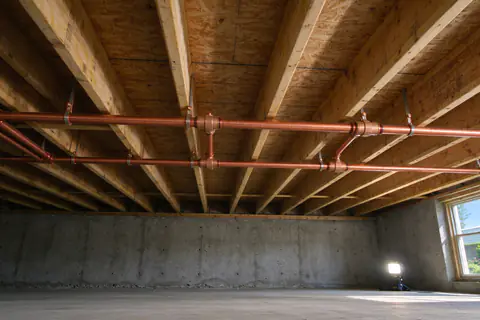
Copper fails from the inside, usually at one spot first. The cause can be the water, the speed it moves, how the pipe was installed or the tube itself, and often more than one of those at once.
Last Updated:
Short answerPinhole leaks in copper pipe come from corrosion that eats through the wall at one small spot. Common causes are pitting, erosion from fast water in hot lines and elbows, water chemistry, flux left inside joints, stray electrical current and thin Type M tube. One leak can be a local defect; several suggest a wider problem.
Pinhole leaks in copper pipe start with corrosion at one small spot on the inside of the tube, which works through the wall until water finds its way out. Level Repiping Charlotte arranges copper repipes, PEX repipes and pipe repairs across Charlotte and the surrounding counties through licensed and insured contractors. This guide explains the mechanisms behind copper pinholes, why no single cause explains every case, and how the pattern of leaks points to the right scope.
How copper thins from the inside
Copper resists corrosion because it forms a thin protective film on its inner surface. Most copper pipe lasts for decades because that film stays intact. A pinhole forms where the film breaks down at one spot and corrosion concentrates there instead of spreading evenly. The wall thins in a small pit while the pipe a few inches away is still at full thickness. From outside, nothing shows until the pit breaks through.
That is why a copper pipe can look sound and still leak, and why one pinhole doesn’t tell you how much of the rest of the system is thinning. It is also why pipe wall thinning is the link between corrosion and leaks: the pit is the corrosion, and the pinhole is where it finally reaches the outside.
The mechanisms
Corrosion researchers and the trade describe several mechanisms. More than one can be at work in the same house.
Pitting corrosion. Localized corrosion that forms deep, narrow pits. It is linked to combinations of water chemistry (pH, alkalinity, dissolved oxygen, the disinfectant used), temperature and the condition of the pipe surface. Pitting can appear on hot or cold lines.
Erosion corrosion. Fast or turbulent water wears away the protective film, especially just downstream of elbows and tees, at burrs left when tube was cut and not reamed, and in hot water recirculating loops where a pump runs continuously. Hot water makes it worse. The pattern is often a cluster of leaks on one hot line.
Water chemistry. Water that is low in alkalinity, or whose pH is unstable, can make copper’s protective film harder to keep. Utilities manage this with corrosion control treatment.
Workmanship. Excess flux left inside joints keeps corroding after the job is done. Solder drips, debris and unreamed cuts create turbulence. Pipe that was overheated during soldering can be weakened at the joint.
Thin tube. Type M copper has a thinner wall than Type L, so it has less metal to lose before a pit breaks through.
Electrical current. Stray current from faulty grounding or bonding can drive corrosion at specific spots. It is less common, but it is checked when leaks cluster near where the electrical system is bonded to the plumbing.
Outside contact. Copper buried in concrete, touching soil or rubbing against framing or metal straps can corrode or wear from the outside.
Charlotte Water: context, not a diagnosis
Charlotte Water draws from Mountain Island Lake and Lake Norman and adds lime to adjust pH, which the utility says helps prevent pipe corrosion and the leaching of metals. Its annual water quality report gives an entry-point pH of about 8.5, total hardness of 32 ppm and alkalinity of 21 ppm, which makes it soft, low-alkalinity water managed for corrosion control. The state set a pH range of 7.0 to 9.2 for Charlotte Water to keep that control in place. Copper in Charlotte Water’s tap sampling came back at non-detectable levels at the 90th percentile.
None of that proves why a particular pipe in a particular house leaked. Two houses on the same street, on the same water, can behave differently because of the tube type, the installation, the hot water setup and the pressure. Homeowners elsewhere in the country, on very different water, report the same pinhole patterns. The water is one input among several. The Charlotte Water quality report guide explains how to read the report.
Reading the pattern
Where the leaks are says more than how many there have been.
First, stop the water and get the leak repaired. A pinhole often sprays a fine stream that soaks framing and insulation quietly, so check the area around it for damage. Then gather the facts: where it was, hot or cold, the age of the copper and whether others have occurred. Measure street pressure, because pressure above 80 psi adds strain to every joint; Charlotte Water notes that county codes require a pressure-reducing valve on new or remodeled plumbing where pressure is above that. See the high water pressure guide.
If leaks repeat across the system, the choice is between a partial repipe of the affected runs and a whole house repipe. The new pipe can be copper again or PEX; the PEX vs copper guide compares them. A whole house PEX repipe on a single-family home typically runs $4,000 to $12,000 or more in the Charlotte area; copper is quoted per house.
Water damage from a sudden leak and the cost of replacing the pipe are often treated differently by homeowners insurance; the repiping insurance guide covers what to ask.
Talking it through
If you have had more than one pinhole, the history is the most useful thing to bring to the conversation. Call (704) 452-4386 to talk about what the pattern suggests for your house.
Questions
More questions on this
Are green spots on copper pipe a sign of pinhole leaks?
Sometimes. A small blue-green crust or bump at one spot often marks a slow seep that has partly sealed itself with corrosion product, and it is worth having looked at. An even dull green or brown film across the outside of the pipe is ordinary surface oxidation and does not by itself mean the wall is thin.
Do copper pinhole leaks happen more on hot water lines?
They often do, because hot water speeds up corrosion and hot lines carry faster flow when a recirculating pump runs. Erosion corrosion in particular is tied to velocity and temperature. Cold lines leak too, especially where pitting is the mechanism, so the location is a clue rather than a rule.
Can an epoxy coating stop copper pinhole leaks?
Lining systems coat the inside of existing pipe and are marketed as an alternative to repiping. They depend on how well the pipe is cleaned and coated, and they leave the old pipe and fittings in place. Our relining guide compares the method with replacement.
Get an Estimate for copper repipe
Tell us the age of the house, the pipe you have seen and what is going wrong. Or call.
One leak on sound pipe is a repair. A pattern of leaks, or a pipe with a known failure history, is a question about the whole system. The evidence that separates the two is usually in the house.
Both are approved under the North Carolina Plumbing Code. The house, the routes the pipe has to take and what the owner values decide between them, not a rule of thumb.
The three supply pipes found in older Charlotte-area houses, how each one was meant to work and how it fails, the signs that point to the pipe rather than something else, the rules and insurance questions around replacement, and what each scope leaves behind.
Epoxy lining coats the inside of the pipe you already have; a repipe replaces it. Both are real options for some houses. Here is how lining works, where it reaches its limits, and the questions that decide between them.
A policy usually pays for the damage a sudden leak causes, not for replacing the old pipe. Where a repipe helps is with the insurer's view of the house, and that depends on the carrier.