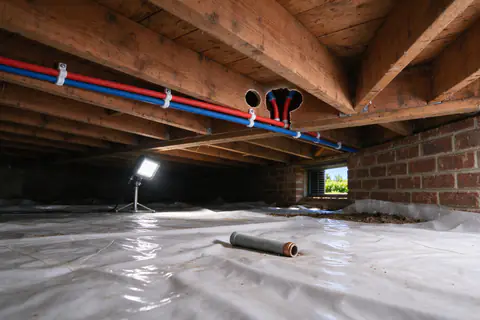
Epoxy lining coats the inside of the pipe you already have; a repipe replaces it. Both are real options for some houses. Here is how lining works, where it reaches its limits, and the questions that decide between them.
Last Updated:
Short answerRepiping replaces the old supply pipe with new PEX or copper. Pipe relining, usually epoxy lining, cleans the inside of the existing pipe and coats it. Lining can suit sound metal pipe where access is hard, but it can't fix plastic pipe, failed fittings or walls too thin to clean, and its record is shorter than copper's.
Repiping vs pipe relining is a choice between replacing the pipe and coating the inside of the pipe you have. Both are real methods, and each suits some houses better than others. Level Repiping Charlotte arranges whole house repipes, partial repipes and pipe repairs across Charlotte and the surrounding counties through licensed and insured contractors. Level Repiping Charlotte does not offer pipe lining, which is worth knowing as you read. This guide explains how epoxy lining works, what it can and can’t treat, and the questions that decide between the two.
How epoxy lining works
Epoxy lining, often called pipe relining, treats the inside of existing supply pipe without removing it. The process generally runs like this:
The water is shut off and the pipes are drained.
Heated, filtered air is blown through the lines to dry them.
An abrasive, carried by high-speed air, is blown through the pipe to scour off corrosion, scale and debris down to clean metal.
Epoxy is blown or drawn through the pipe to coat the inside wall.
The coating cures, the lines are reconnected and flushed, and the water goes back on.
The equipment connects at points such as the main, the water heater and fixture connections, and it works through sections of the system at a time. A coating approved for drinking water should be certified to NSF/ANSI 61, the standard for materials in contact with potable water.
What lining can do
Lining makes sense on paper in a specific case: metal pipe that is still structurally sound but corroding inside, in a building where reaching the pipe is hard. Cleaning removes the scale that narrows old galvanized pipe, so flow can improve, and the coating separates the water from the metal. It can seal very small pinholes. Because it works through the existing pipe, it can mean fewer openings than running new pipe to every fixture, which is why it is offered for apartment and condo buildings with pipe inside shared walls.
Where lining reaches its limits
Question
Lining
Repiping
Pipe material it suits
Metal pipe: copper and galvanized steel
Any existing material, replaced with PEX or copper
Polybutylene, CPVC or PEX
Not a candidate
Replaced
Pipe wall already thin or split
Cleaning can open weak spots; the pipe has to be sound enough to blast
Old pipe is retired
Failed fittings and joints
The coating may not reach or seal a failed joint
Every joint is new
Fixture shutoffs and valves
Not renewed unless replaced separately
Normally replaced as part of the job
Layout and routing
Unchanged, including lines under a slab or in cold spots
Can be rerouted, for example out of a slab or away from foundation vents
Inspection
Coating can’t be seen after it cures; quality depends on process
New pipe is pressure tested and inspected before walls close
Track record
In use for decades, a shorter record than copper’s
Copper has the longest record; PEX has been widely used for decades
Two of these deserve more explanation. First, material. Lining systems are made for metal pipe. Polybutylene fails in the plastic itself and at its crimp fittings, and CPVC that has turned brittle cracks under stress; coating the inside of either does not touch those causes. Second, layout. Lining keeps every existing route. If the real problem is pipe under a slab, pipe in a cold crawl space, or a system that was undersized from the start, lining preserves that problem with a new coating inside it.
The Charlotte picture
Most Charlotte houses that need new pipe fall into three groups, and lining fits them unevenly.
Polybutylene houses, mostly built from the late 1970s to the mid-1990s, are not candidates for lining at all. Of the 81 Mecklenburg plumbing permits from April 2025 to October 2026 that describe a repipe, 14 name polybutylene. See polybutylene pipe replacement.
Galvanized houses in older central neighborhoods are lining’s natural target, since cleaning removes scale. The question is whether the steel is still sound after decades of rusting from the inside, and whether its threaded joints, where galvanized pipe is thinnest, will hold. See galvanized pipe replacement.
Copper houses with pinholes depend on why the pinholes formed. Charlotte Water’s supply is soft and low in alkalinity, and the utility adds lime to raise the pH for corrosion control, but pinholes have several causes, including workmanship and water velocity. Lining can seal small pinholes in otherwise sound copper; it doesn’t help where the wall has thinned along whole runs. The copper pinhole leaks guide covers the causes.
A crawl space changes the balance too. In a crawl space house, new pipe can often be run under the floor with few openings, which removes much of lining’s advantage on access.
Permits and inspection
North Carolina requires a permit for the installation, extension or general repair of plumbing, with an exemption for some single-family work of $40,000 or less. How a lining job fits those rules, and what an inspector would look at, is confirmed with the permit office for each project. A repipe has a clear inspection point: the new pipe is pressure tested and inspected before walls close. The permit guide explains the rules.
Questions to ask a lining provider
If you are considering lining, these questions help you compare it fairly with a repipe:
What is the exact epoxy product, and where is its NSF/ANSI 61 listing? What pipe sizes and water temperatures does the listing cover?
How is the pipe assessed before lining to confirm the walls are sound enough to clean?
Which fittings, valves and fixture connections are replaced, and which stay?
How is the coating checked after it cures?
What happens if a section fails later, and who pays to repair it?
Does the job need a permit, and who pulls it?
Ask the same set about a repipe: which material, which layout, which openings, which valves, the pressure test, the inspection and the patching standard.
How to decide
Lining is worth considering when the pipe is metal, structurally sound, hard to reach, and the routes are ones you would keep anyway. A repipe fits better when the pipe is polybutylene or CPVC, when leaks keep coming from fittings and joints, when the walls are thin along whole runs, or when the routes themselves are part of the problem. The repipe or repair guide helps with the wider decision, and the repipe cost guide shows what a repipe typically costs in the Charlotte area. To talk through your pipe, call (704) 452-4386.
Questions
More questions on this
Can polybutylene pipe be relined instead of replaced?
No. Epoxy lining systems are made for metal pipe, and polybutylene's weaknesses are in the plastic itself and at its fittings, which a coating can't fix. The established answer for polybutylene is replacement, either a whole house repipe or a partial one where only some of the pipe remains.
Does epoxy lining need fewer wall openings than a repipe?
Often fewer, because lining works through the existing pipe from connection points instead of running new pipe to every fixture. It still needs access where the equipment connects and where fixtures are disconnected, so it is not a no-openings job. A crawl space house may need few openings for either method.
How do I check that an epoxy lining is approved for drinking water?
Ask for the exact product name and its certification to NSF/ANSI 61, the standard for materials in contact with drinking water, then look it up on the certifier's public listing. The listing also states limits such as pipe sizes and water temperatures, which matter for hot water lines.
Get an Estimate for whole house repipe
Tell us the age of the house, the pipe you have seen and what is going wrong. Or call.
One leak on sound pipe is a repair. A pattern of leaks, or a pipe with a known failure history, is a question about the whole system. The evidence that separates the two is usually in the house.
Copper fails from the inside, usually at one spot first. The cause can be the water, the speed it moves, how the pipe was installed or the tube itself, and often more than one of those at once.
Both are approved under the North Carolina Plumbing Code. The house, the routes the pipe has to take and what the owner values decide between them, not a rule of thumb.
The typical Charlotte range for a whole house PEX repipe, why copper is quoted separately, how the Mecklenburg permit fee is set, and which parts of the job only a walk-through can price.
The three supply pipes found in older Charlotte-area houses, how each one was meant to work and how it fails, the signs that point to the pipe rather than something else, the rules and insurance questions around replacement, and what each scope leaves behind.