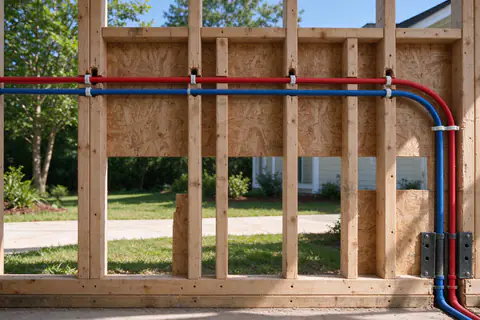
PEX-A vs PEX-B: does the type of PEX matter for a repipe?
The two common types of PEX differ in how they are crosslinked, how flexible they are and which fittings they take. The fitting system and the installer's tools often matter more than the letter.
Last Updated:
Short answerBoth PEX-A and PEX-B are approved for drinking water and suited to a whole house repipe. PEX-A is more flexible and usually joined with expansion fittings that keep a wider bore. PEX-B is stiffer and usually joined with crimp or clamp rings over an insert. Correct fittings and installation matter more than the type.
PEX-A vs PEX-B is the second question many owners ask once they have chosen plastic pipe over copper. Level Repiping Charlotte arranges PEX repipes across Charlotte and the surrounding counties through licensed and insured contractors, and both types are approved for drinking water when they carry the right listings. This guide explains how the two are made, how they are joined, and which differences actually change a repipe.
The letter names the manufacturing method
PEX is polyethylene whose molecules have been crosslinked, bonded into a network so the tube can handle hot water under pressure. The letter after “PEX” tells you how the crosslinking was done, not how good the tube is.
PEX-A
PEX-B
PEX-C
How it is crosslinked
During extrusion, with peroxide (the Engel method)
After extrusion, with moisture and a silane chemical
After extrusion, with electron-beam radiation
Feel
Most flexible; tightest bends
Stiffer; holds its coil shape
Similar to PEX-B
Kinks
Often restored with heat
Cut out and joined
Cut out and joined
Usual fittings
Cold expansion (ASTM F1960) or crimp
Crimp or clamp rings over an insert (ASTM F1807, F2159)
Crimp or clamp
Where it shows up
Repipes, manifold systems
Repipes, trunk and branch
Less common in whole house work
PEX-C exists but is less common in whole house repipes. All three, when sold for potable water, carry a pressure and temperature rating printed on the tube and a listing to NSF/ANSI 61 for drinking water.
Expansion fittings
An expansion joint works by stretching the end of the tube with a powered or hand expansion tool, sliding a ring over it, and pushing it onto a fitting while it is stretched. The tube shrinks back over the fitting and seals. The fitting sits inside the tube, but because the tube was stretched first, the fitting’s bore can be close to the tube’s.
That is the practical advantage: less restriction at each joint. In a house with long runs and many branches, the difference adds up, especially at fixtures far from the main. Expansion fittings are used mainly with PEX-A, though some makers list expansion systems for their own PEX-B.
The trade-off is time and temperature. The tube shrinks back more slowly in cold air, so in a winter crawl space the installer waits longer before testing. The tools and fittings also tend to cost more.
Crimp and clamp fittings
A crimp joint slides a copper ring over the tube, pushes an insert fitting inside, and squeezes the ring with a crimp tool. A clamp (cinch) joint does the same with a stainless steel band. Both work with PEX-B and PEX-A.
The insert sits inside the tube without stretching it, so the bore narrows at every joint. For most fixtures that does not matter. It matters more where many fittings sit in series on a long run, or where flow is already marginal because street pressure is low. The low water pressure page explains why pressure problems often start before the house.
The weak point of crimp work is the crimp itself. A ring squeezed too little or too much, or set too close to the end of the tube, can leak. Installers check each crimp with a go/no-go gauge. The tool and the habit of checking matter more than the ring.
What matters more than the letter
Owners comparing quotes sometimes see one contractor proposing PEX-A and another PEX-B and wonder which is better. The type is one factor among several, and usually not the deciding one.
Listed fittings. Every fitting must be listed for the tube it is used on. Mixing brands or ring types outside the maker’s listing is a common source of trouble.
The tool. Expansion and crimp tools need calibration and the right heads for each size.
Support and protection. Tubing supported at the right spacing, protected where it passes through framing, kept away from heat sources and out of sunlight.
The layout. Trunk and branch uses more fittings than home runs from a manifold, so fitting choice matters more there; see manifold vs trunk and branch.
The pressure test. The new system is pressure tested before walls close, and the county or town inspects it where a permit is pulled; see the permit guide.
North Carolina’s insulation rule applies to both types: water pipe in unconditioned attics and crawl spaces needs at least R-6.5 insulation or heat (amendment 305.4). PEX of either type can still freeze and split, or push a fitting apart, in an exposed run.
How it affects the price
The tube type moves a repipe price less than the house does. Fixture count, stories, crawl space or slab, and finished ceilings matter more. A whole house PEX repipe on a single-family home typically runs $4,000 to $12,000 or more in the Charlotte area. The repipe cost guide covers the drivers, and PEX vs copper covers the bigger material choice.
Asking about your repipe
If you prefer one type, say so when you call. The written scope should name the tube, the fitting system and the layout, so you can compare quotes on the same terms. Call (704) 452-4386 or read the whole house repipe page to see how the work runs.
Questions
More questions on this
Can a kinked PEX-A line be repaired without cutting it?
Often, yes. PEX-A has shape memory, so a kink in the tube can usually be restored with controlled heat from a heat gun, following the manufacturer's instructions. PEX-B does not recover the same way, and a kinked section is normally cut out and joined with fittings. Either way, a kink found during installation should be dealt with before the walls close.
Can PEX-A and PEX-B be mixed in one repipe?
They can be joined where the fittings are listed for both, and crimp-style fittings can be listed for either. What matters is that every joint uses a fitting and ring system the maker lists for that tube. A written scope normally names the tube and the fitting system so the inspector and a future plumber know what is in the walls.
Does cold weather affect PEX expansion fittings during installation?
It slows them. An expansion joint seals as the stretched tube shrinks back over the fitting, and that happens more slowly in a cold crawl space or attic. Installers allow more time before pressure testing. It does not change how the joint performs once it has recovered.
Get an Estimate for PEX repipe
Tell us the age of the house, the pipe you have seen and what is going wrong. Or call.
Both are approved under the North Carolina Plumbing Code. The house, the routes the pipe has to take and what the owner values decide between them, not a rule of thumb.
A repipe can feed fixtures from shared main lines with branches, or give each fixture its own line from a central manifold. The house's shape, where the water heater sits and what the owner wants to control decide which.
The three supply pipes found in older Charlotte-area houses, how each one was meant to work and how it fails, the signs that point to the pipe rather than something else, the rules and insurance questions around replacement, and what each scope leaves behind.
A repipe runs in stages, and most of them happen with the water still on. Here is what each stage involves, what makes one house take longer than another, and when you will actually be without water.
The typical Charlotte range for a whole house PEX repipe, why copper is quoted separately, how the Mecklenburg permit fee is set, and which parts of the job only a walk-through can price.