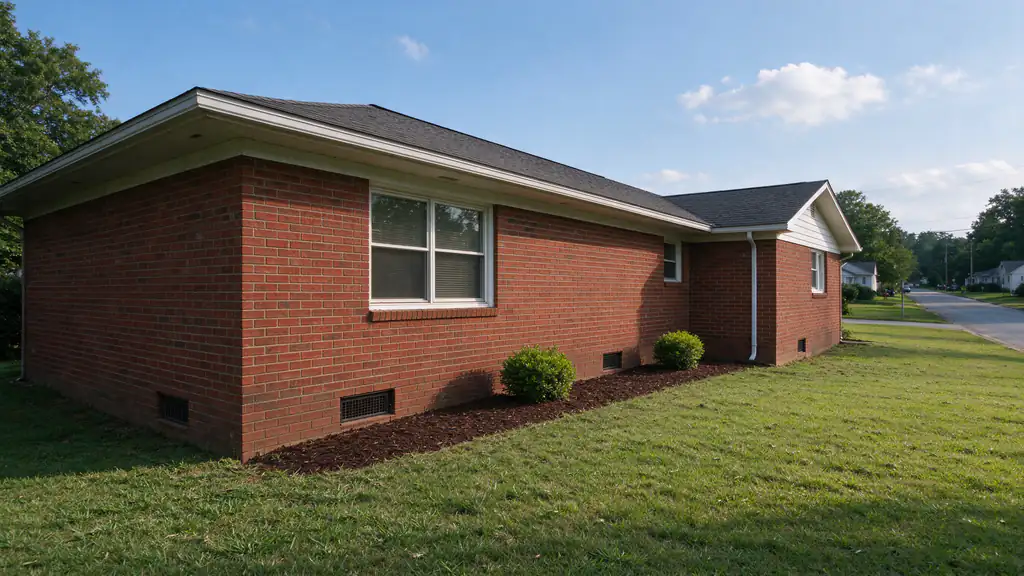
A 1980s or 90s Concord house
About a quarter of Concord's housing went up from 1980 to 1999, the decades of polybutylene and early CPVC supply pipe.
Service area · Cabarrus County
In Concord
About a quarter of Concord's housing went up from 1980 to 1999, the decades of polybutylene and early CPVC supply pipe.
Nearly 30% of Kannapolis housing predates 1960 and about one home in ten predates 1940, the age when galvanized steel supply pipe was standard.
Three quarters of Harrisburg's homes were built after 2000; a leak under a slab there raises the choice between a spot repair and an attic reroute.
Services
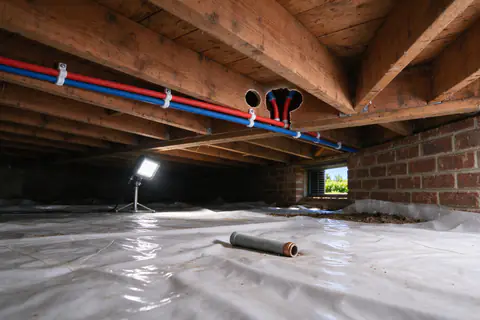
Whole house repipe in Charlotte: every supply line replaced with PEX or copper, pressure tested and inspected. Typical cost published.
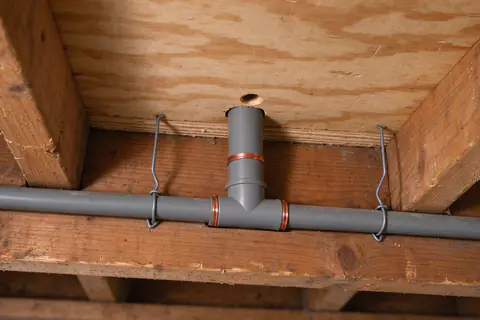
Polybutylene pipe replacement in Charlotte: identifying gray PB and its fittings, what it means for a sale or insurance, and typical cost.
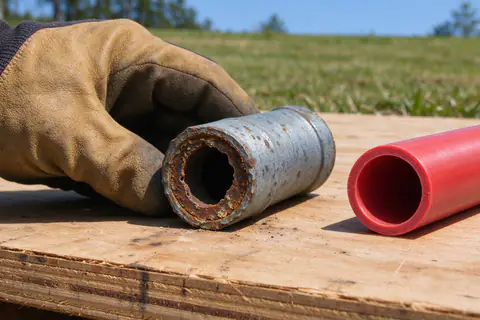
Galvanized pipe replacement in Charlotte: why old steel pipe loses flow and runs brown, how it is tested, and how a repipe runs in older homes.
Last Updated:
A permit to repipe Concord NC homes is filed once and reviewed twice. Inside Concord city limits, construction applications go through a single Accela submission: the City of Concord checks zoning, and Cabarrus County Construction Standards reviews the building and plumbing work and handles the inspections. Level Repiping Charlotte arranges whole house and partial repipes in Concord, Kannapolis and Harrisburg, with the work performed by licensed and insured contractors under that Cabarrus County process rather than Mecklenburg’s.
The two-step review is the practical difference from Charlotte. Zoning review rarely touches a repipe, since the house keeps its footprint, but the application still passes through it before Cabarrus County takes up the plumbing scope. The county’s fee comes from its own schedule, not Mecklenburg’s fee ordinance, and it is confirmed per project and added to the written estimate. The repipe permit guide explains when North Carolina law requires a plumbing permit at all, and that statute applies in Cabarrus County exactly as in Mecklenburg.
What does not change at the county line is the code. The North Carolina Plumbing Code is statewide, so the pressure test, the R-6.5 insulation rule for water pipe in unconditioned crawl spaces and attics, and the 160 psi rating for water service pipe are the same in Concord. So is the license: paid plumbing work needs a North Carolina plumbing license, and a homeowner permit covers only an owner-occupant doing their own work.
Charlotte drinks Catawba River water. Concord does not. The City of Concord treats water from Lake Don T. Howell at its Coddle Creek plant and from Lake Fisher and Lake Howell at its Hillgrove plant, and it buys more from the City of Albemarle, whose sources are Tuckertown Reservoir and Badin Lake. Its annual water quality report gives an average pH of 8.1, a little below Charlotte Water’s 8.5. Lead was not detected at the 90th percentile, with no site among the 51 sampled over the action level, and copper’s 90th percentile was 0.120 ppm. The city publishes its service line inventory on its website.
Those numbers are context for copper, not a verdict on any one house. Copper corrosion depends on chemistry, water velocity, workmanship and the pipe’s age together, which is why the copper pinhole leak guide treats chemistry as one input among several. A soft, mildly alkaline water like Concord’s suits both PEX and copper, and the PEX vs copper guide sets out how the choice usually turns on cost, routing and the owner’s preference.
Two details matter for the service line. Concord’s interconnections with Kannapolis are normally closed, and some customers inside Concord are served directly by Kannapolis, so the utility is confirmed for each address. And as in every North Carolina system, the owner is responsible for the line from the meter to the house; the water line replacement page covers replacing it along with a repipe.
Concord’s 43,142 housing units have a median build year of 1998, close to Charlotte’s 1995, but the spread is wide (Census American Community Survey). About 15% of the housing predates 1960, a quarter went up from 1980 to 1999, and nearly half has been built since 2000. That spread maps onto three different repipe conversations.
The pre-1960 houses near the city’s center are where original galvanized steel supply pipe turns up, if no one has replaced it. It rusts from the inside, narrows and sends brown water out after it sits; the galvanized pipe replacement page covers that work. Houses from the 1980s and 90s span the polybutylene years and the early CPVC years. Gray pipe stamped PB at the water heater points to polybutylene replacement; cream or tan pipe that cracks when it is moved points to CPVC replacement. If the markings are unclear, the pipe identification guide shows what to look for. Houses built since 2000 are mostly plumbed with CPVC or PEX and come to a repipe through leaks, remodels or a failed fitting rather than age.
Kannapolis grew as a textile mill town, and its housing shows it: the median home was built in 1989, but 29.7% predates 1960 and 10.6% predates 1940. That is a larger share of galvanized-era housing than Concord’s, and where those houses stand on crawl spaces, new lines run under the floor with few wall openings. Building and trade review sits with Cabarrus County as in Concord, while the city’s own intake step and its water system are confirmed for the address before work starts.
Harrisburg is the newest of the three. Its median home was built in 2006, and 74.9% of its housing went up after 2000. In houses of that age a repipe is usually about a specific failure rather than the whole system wearing out: a leak in a supply line under a slab, a run of fittings that has started to weep, or a remodel that changes the bathrooms. Where a slab line leaks, the slab leak repair page explains the choice between repairing the run and rerouting supply through the attic, and the slab leak signs guide lists what points to one.
A whole house PEX repipe on a single-family home typically runs $4,000 to $12,000 or more across the Charlotte area, and Cabarrus County houses sit in the same range. A small crawl space ranch tends toward the bottom of that range and a large two-story slab house toward the top or past it; copper is quoted per house. The repipe cost guide explains the drivers, the whole house repipe page covers the scope, and the cost estimator gives a range in a minute. To talk through a Concord, Kannapolis or Harrisburg house, call (704) 452-4386.
Repipe estimate for a Cabarrus County house
Send the year the house was built, your town, the pipe at the water heater, and whether the house is on a crawl space or a slab.
The area
The shaded disc marks the general service area around the area’s center, not an office or job site. Open Concord, NC in Google Maps
Questions
A whole house PEX repipe on a single-family home typically runs $4,000 to $12,000 or more across the Charlotte area, and Concord falls in the same range. Bathrooms, stories, crawl space or slab, and PEX versus copper move it most. The Cabarrus County permit fee is set by the county's schedule and added to the estimate.
Two offices read the same application. The City of Concord reviews zoning and Cabarrus County Construction Standards reviews the building and trade work, and both happen through one Accela submission. Inspections are the county's.
The City of Concord treats surface water from Lake Don T. Howell at the Coddle Creek plant and from Lake Fisher and Lake Howell at the Hillgrove plant, and it also buys water from the City of Albemarle. Some customers inside Concord are served directly by Kannapolis instead, so the utility is confirmed for each address.
Kannapolis sits in Cabarrus County, so building and trade permits run through Cabarrus County Construction Standards as they do for Concord. The city's own intake step and the water utility are confirmed for the address before work starts.
North Carolina's rules, which are the same in both counties. The state plumbing code, the R-6.5 insulation rule for pipe in unconditioned crawl spaces and attics, and the state plumbing license apply in Concord exactly as in Charlotte. Only the reviewing office, its fee schedule and the water system differ.
Guides
North Carolina law requires plumbing permits but exempts some single-family work. Here is how that exemption applies to a repipe, who is allowed to pull the permit, what Mecklenburg County charges, and how the inspection runs.
Both are approved under the North Carolina Plumbing Code. The house, the routes the pipe has to take and what the owner values decide between them, not a rule of thumb.
Five supply pipes turn up in Charlotte-area houses. Color, joints, markings and a magnet tell most of them apart in a few minutes, as long as you look in more than one place.
The typical Charlotte range for a whole house PEX repipe, why copper is quoted separately, how the Mecklenburg permit fee is set, and which parts of the job only a walk-through can price.
A leak under a concrete floor rarely announces itself. Here are the signs that point to one, the ordinary things that cause the same signs, and the simple test that tells you whether water is leaving the house at all.
Nearby
Tell us the age of the house, the pipe you have seen and what is going wrong. Or call.
Get a repipe estimate